
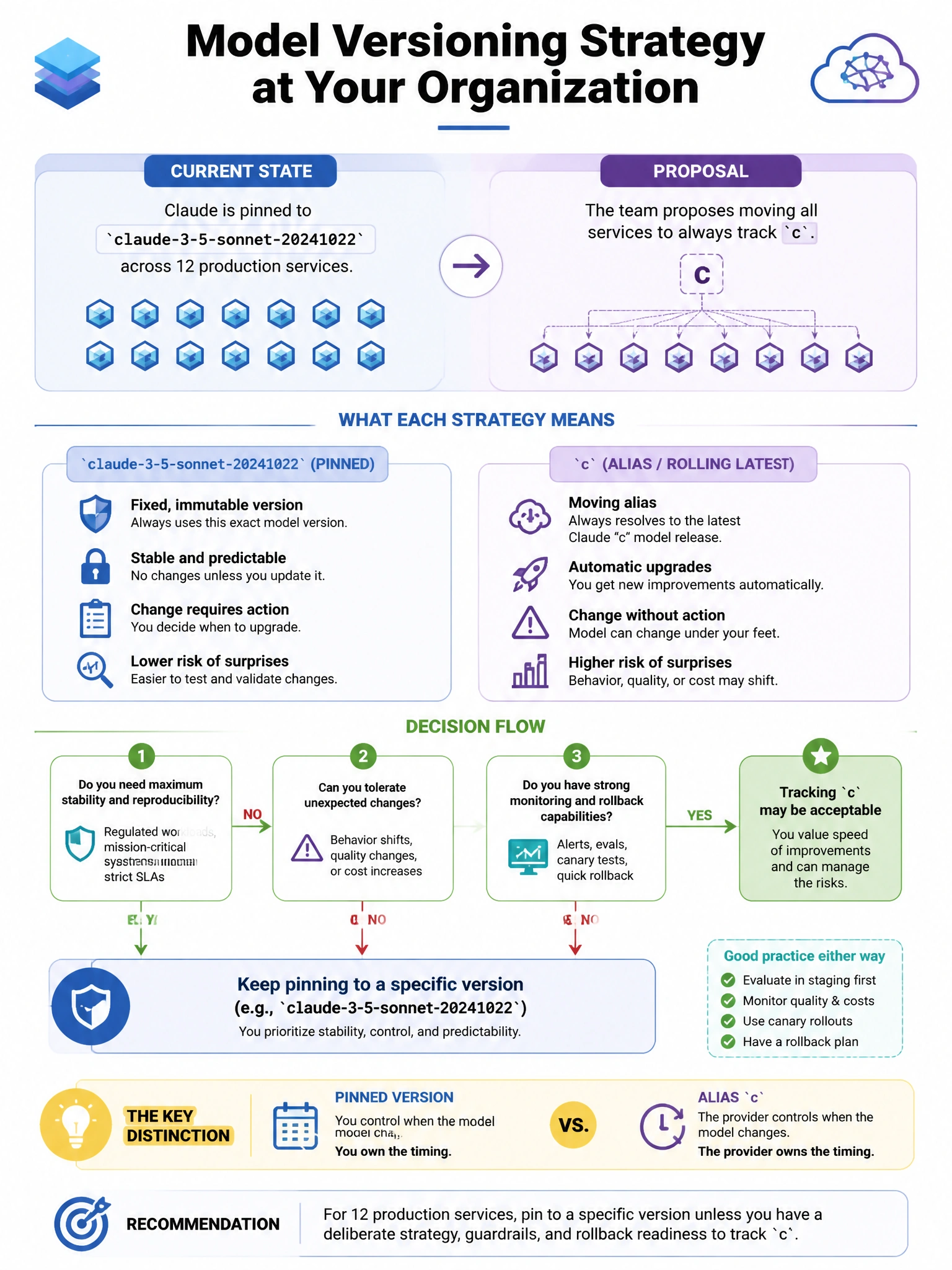
A model versioning strategy at your organization pins Claude to claude-3-5-sonnet-20241022 across 12 production services. The team proposes moving all services to always track claude-3-5-sonnet-latest. An architect raises an objection. What is the most technically valid objection to the latest alias strategy?
Select an answer to reveal the explanation.
Short Explanation and Infographic
Here's the deal — b is correct because tracking latest transfers model upgrade control from the engineering team to Anthropic's release schedule. When Anthropic updates what latest points to, all 12 services update simultaneously without an explicit deployment event, change review, or regression testing cycle.
Full explanation below image
Full Explanation
B is correct because tracking latest transfers model upgrade control from the engineering team to Anthropic's release schedule. When Anthropic updates what latest points to, all 12 services update simultaneously without an explicit deployment event, change review, or regression testing cycle. For production systems, this violates the principle that deployments should be intentional, testable, and reversible. Compliance-sensitive systems (financial, healthcare, legal) require auditability of exactly which model version produced each output. A is wrong because the Anthropic API does support alias-style references (e.g., claude-3-5-sonnet-latest); the objection to using them is operational, not a technical impossibility. C is wrong because latest does not always point to the most expensive model — it tracks the most recently released stable version, which may or may not be the highest-cost option. D is wrong because prompt cache keys include the model version identifier, but this is a secondary effect — the primary objection is uncontrolled behavioral change, not cache invalidation costs.