
A team is evaluating extended thinking for a supply chain optimization problem that requires Claude to evaluate 50+ variables across 12 supplier constraints. They are debating what budget_tokens value to set. What principle should guide the thinking budget calibration?
Select an answer to reveal the explanation.
Short Explanation and Infographic
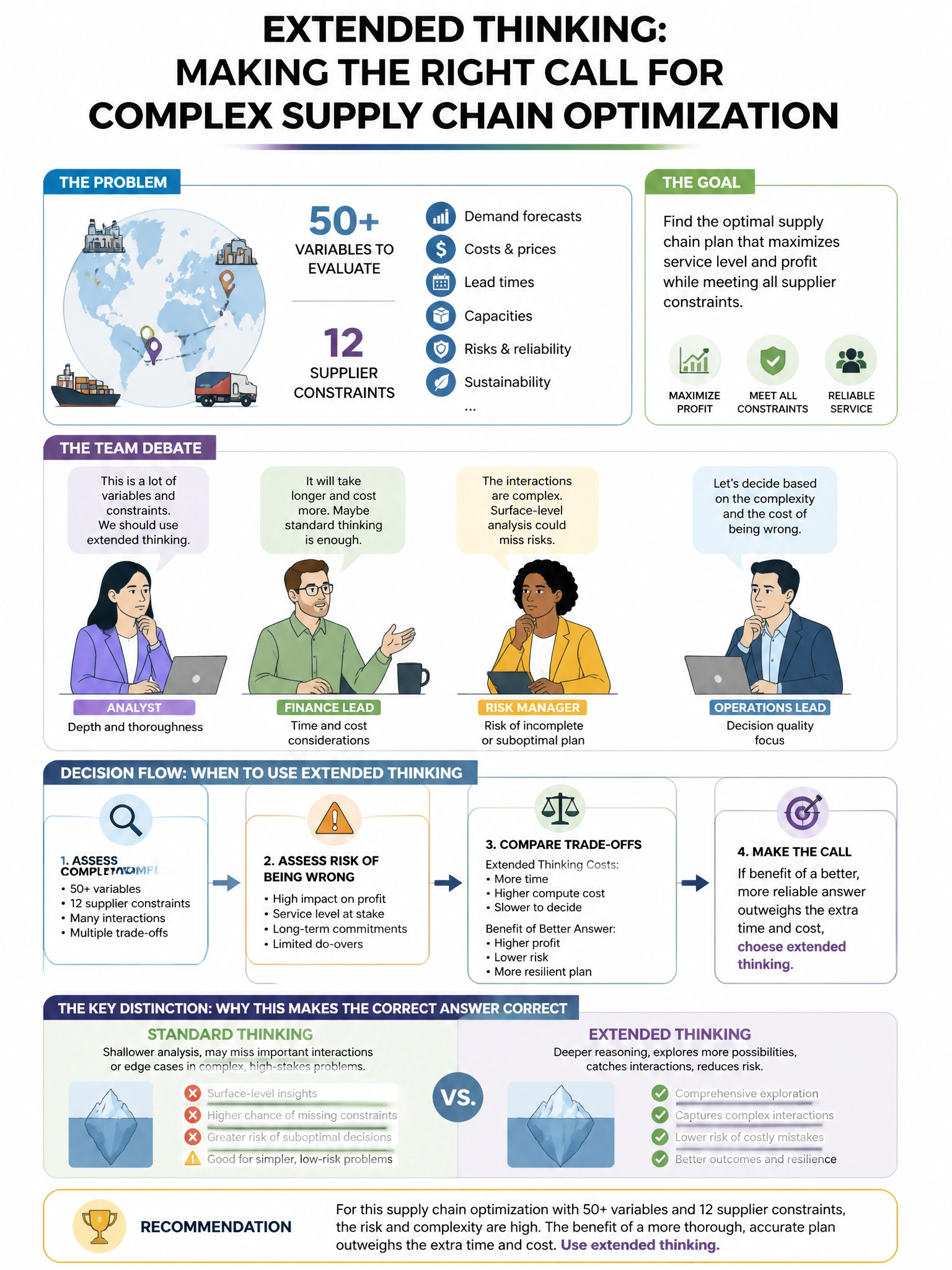
Here's the deal — b is correct because thinking budget should be calibrated empirically rather than set to maximum or derived from arbitrary heuristics. The key insight is that thinking tokens incur real API cost, and the marginal quality improvement from a larger budget exhibits diminishing returns — there is a sweet spot beyond which additional thinking tokens do not improve output quality.
Full explanation below image
Full Explanation
B is correct because thinking budget should be calibrated empirically rather than set to maximum or derived from arbitrary heuristics. The key insight is that thinking tokens incur real API cost, and the marginal quality improvement from a larger budget exhibits diminishing returns — there is a sweet spot beyond which additional thinking tokens do not improve output quality. Starting with a moderate budget, measuring quality on representative instances, and scaling up only when there is measurable improvement is the correct engineering approach. A is wrong because maximum thinking budget does not guarantee maximum output quality — for some problems, the model converges on a good answer quickly and additional thinking tokens are wasted. The cost increase is real and can be substantial. C is wrong because there is no principled relationship between the number of problem variables and the optimal thinking budget — this is an unfounded heuristic that may grossly under or over-allocate. D is wrong because extended thinking is not limited to creative writing; it is effective for complex reasoning across mathematical, analytical, and constraint satisfaction domains.