
An architect is designing a system where Claude assists users in performing financial research. The system will be deployed on a public platform accessible to anonymous users. What trust level should be assigned to user-provided information claims (e.g., 'I am a licensed financial advisor' or 'I am conducting academic research') and how should this affect system design?
Select an answer to reveal the explanation.
Short Explanation and Infographic
Here's the deal — a is correct because the trust framework for anonymous public users correctly treats unverified self-reported claims as context that informs — but does not verify — user intent. A user claiming to be a licensed financial advisor shifts some moral responsibility to them if they are lying, but the system should not treat this claim as equivalent to operator-verified credentials.
Full explanation below image
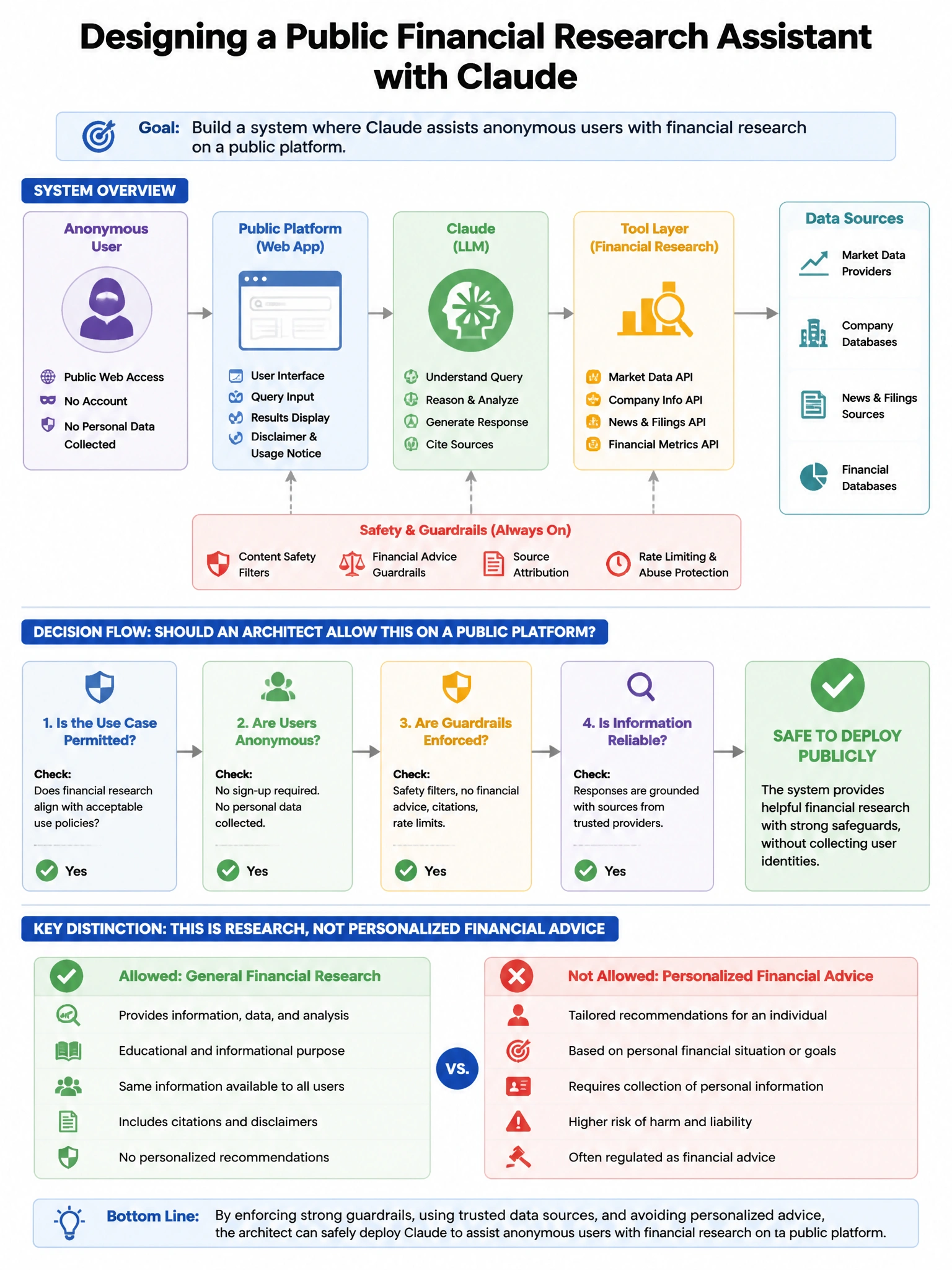
Full Explanation
A is correct because the trust framework for anonymous public users correctly treats unverified self-reported claims as context that informs — but does not verify — user intent. A user claiming to be a licensed financial advisor shifts some moral responsibility to them if they are lying, but the system should not treat this claim as equivalent to operator-verified credentials. The design should establish baseline protections appropriate for the public user population, use stated context to calibrate response detail and tone (not to unlock restricted capabilities), and reserve capability expansion for verifiable signals (operator-level verification, authenticated professional accounts). B is wrong because Claude cannot verify identity claims and the system should not be designed as if it can; 'trusting Claude's judgment about user authenticity' is not a reliable security mechanism. C is wrong because maximum restrictions for all anonymous users would prevent legitimate public users from accessing the system's core value — the constraint should be proportional to the risk profile, not binary. D is wrong because operator-verified and user-self-reported are categorically different trust levels in Anthropic's framework; treating them as equivalent collapses a fundamental security boundary.