
A RAG system for a healthcare organization needs to answer clinical questions from medical literature. The system retrieves passages from 500,000 clinical papers. During evaluation, the team discovers that when the correct answer requires integrating information across three separate papers, the system either answers with the most statistically common finding or refuses due to insufficient context. What architectural addition directly addresses this multi-document synthesis gap?
Select an answer to reveal the explanation.
Short Explanation and Infographic
Here's the deal — d is correct because the failure mode — inability to integrate information across three papers — requires iterative, query-driven retrieval. A recursive retrieval loop uses Claude to identify what information is missing after reading the initial retrieved context, then issues targeted sub-queries to retrieve the complementary papers.
Full explanation below image
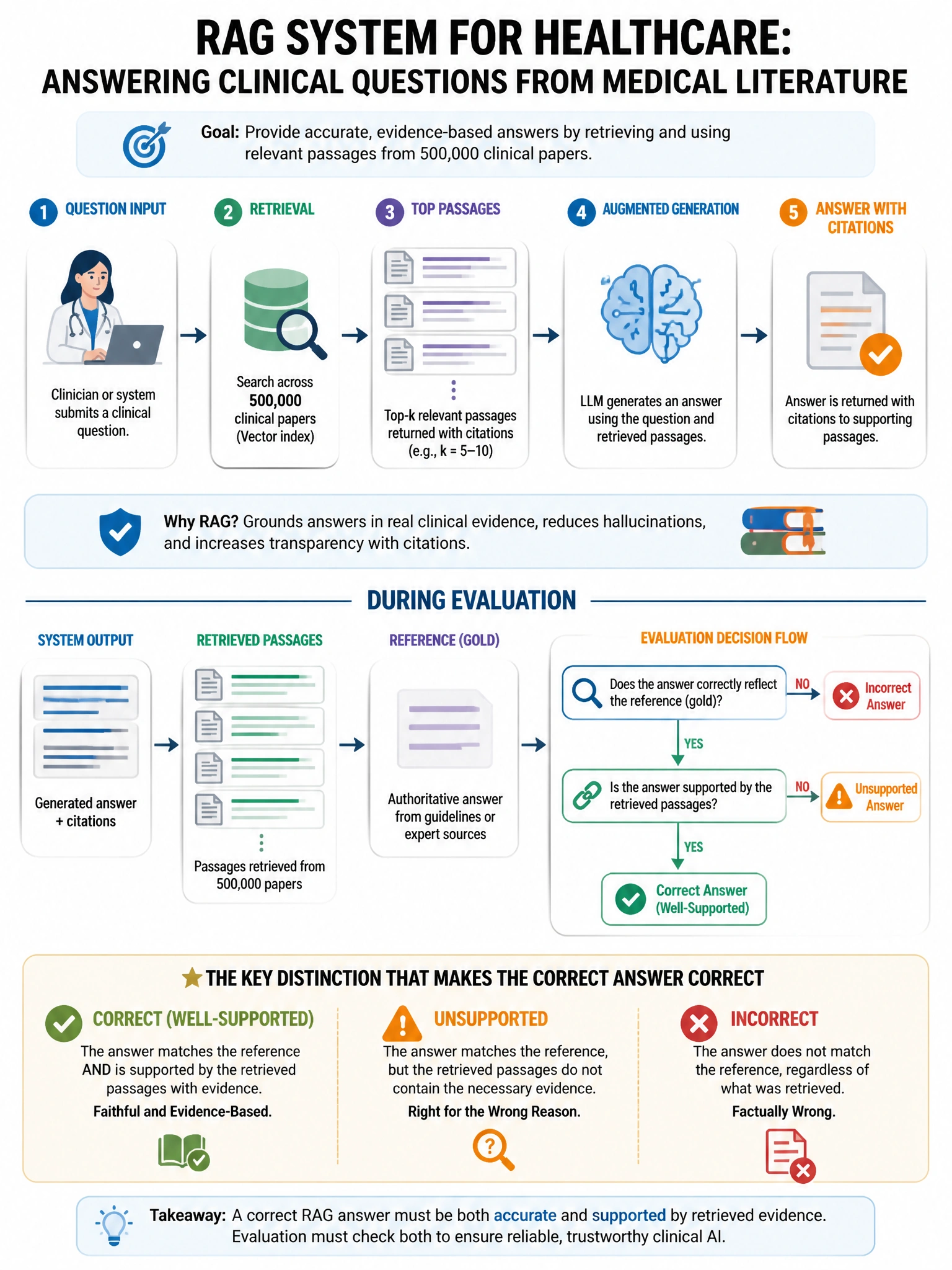
Full Explanation
D is correct because the failure mode — inability to integrate information across three papers — requires iterative, query-driven retrieval. A recursive retrieval loop uses Claude to identify what information is missing after reading the initial retrieved context, then issues targeted sub-queries to retrieve the complementary papers. This mirrors how a human researcher would sequentially build up a complete picture from multiple sources. A is wrong because increasing k to 30 adds more retrieved passages but does not guarantee the specific combination of three papers needed is included — with 500K papers, statistical coverage is low, and a large k degrades answer quality by adding noise. C is wrong because the problem is synthesis across multiple documents, not keyword matching precision — switching to BM25 changes the ranking mechanism but does not add multi-document synthesis capability. B is wrong because pre-computing all possible paper combinations at indexing time is computationally infeasible at 500K papers (combinations would be in the quadrillions for three-paper sets) and does not generalize to future papers.