
An organization indexes technical documentation using sentence-transformer embeddings from 24 months ago. The documentation domain has since expanded to include new product lines with distinct terminology. Users report that searching for new product terms returns results about legacy products. What is the technical diagnosis and remediation?
Select an answer to reveal the explanation.
Short Explanation and Infographic
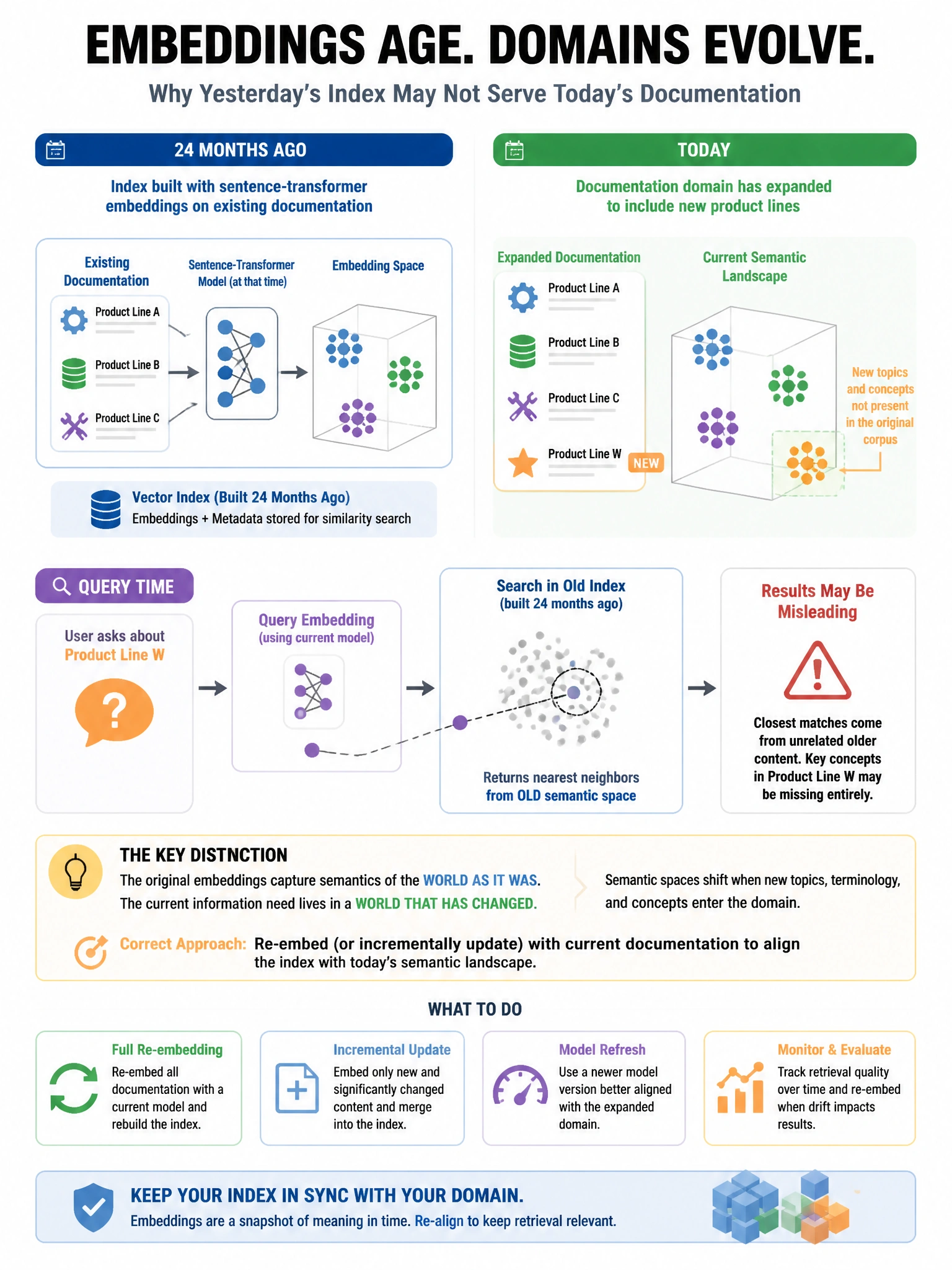
Here's the deal — d is correct because the described symptom — new terminology queries returning legacy product results — is a classic embedding drift problem. The embedding model was trained 24 months ago on data that did not include new product terminology.
Full explanation below image
Full Explanation
D is correct because the described symptom — new terminology queries returning legacy product results — is a classic embedding drift problem. The embedding model was trained 24 months ago on data that did not include new product terminology. New terms therefore have no well-defined representation in the embedding space, and the model approximates them using the nearest known concepts (legacy products with similar surface features). The correct remediation is to evaluate a newer embedding model with broader training coverage, potentially fine-tune on the new terminology corpus, and re-index. A is wrong because vector index defragmentation affects query performance (latency), not semantic accuracy — fragmentation does not cause terminology confusion. C is wrong because increasing the similarity threshold would reduce false positives but at the cost of missing relevant results entirely — it treats the symptom of low confidence matches without addressing why the embedding space maps new terms to old product clusters. B is wrong because chunk size affects context density but not the embedding model's representation of terminology; even sentence-level chunks will be misrepresented in a space where the new terms have no training signal.