
Your organization is evaluating whether to deploy a Claude-based system that can generate highly technical content about both industrial chemical safety and chemical synthesis procedures. Security researchers flag this as a dual-use risk. What is the correct framework for assessing and managing this dual-use capability risk?
Select an answer to reveal the explanation.
Short Explanation and Infographic
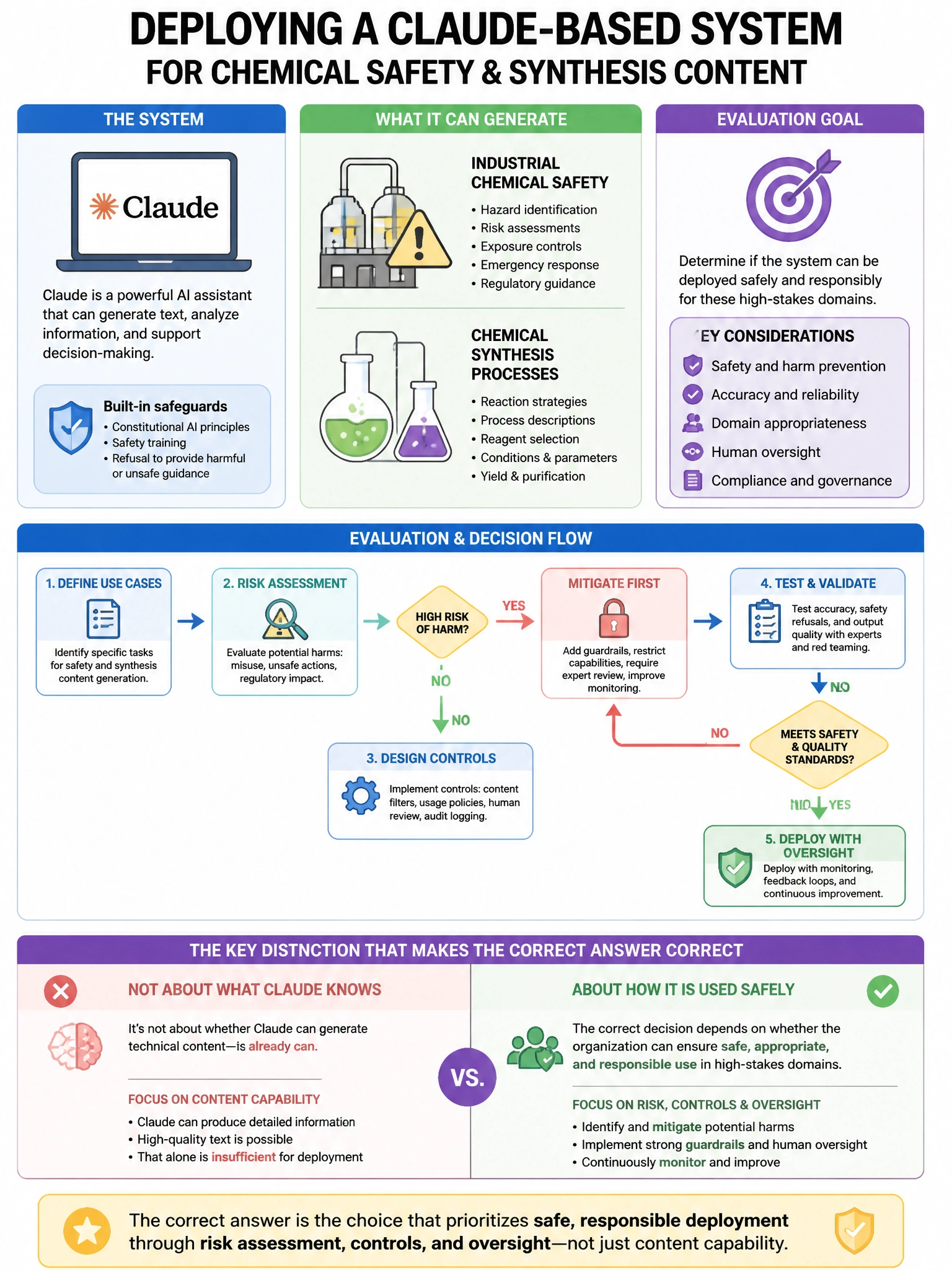
Here's the deal — a is correct because dual-use risk assessment requires structured analysis, not categorical restriction or categorical permission. The correct framework evaluates: whether the deployment context specifically attracts bad actors (e.g., a professional chemical safety platform vs.
Full explanation below image
Full Explanation
A is correct because dual-use risk assessment requires structured analysis, not categorical restriction or categorical permission. The correct framework evaluates: whether the deployment context specifically attracts bad actors (e.g., a professional chemical safety platform vs. a general public chatbot), the marginal uplift Claude provides versus what is freely available in textbooks or academic sources, the specificity of harm-enabling content producible (general chemistry education vs. step-by-step synthesis of controlled substances), and the counterfactual impact of the system's existence. Mitigations — use-case scoping, monitoring, output filtering for specific harmful patterns — are then calibrated to the assessed risk level. B is wrong because categorical disablement of dual-use capabilities eliminates legitimate safety and educational value without a risk-proportional justification. B addresses the genuine risk while preserving beneficial applications. C is wrong because model-level safety training reduces but does not eliminate dual-use risk; deployment context controls are an important additional layer, especially for professionally sensitive domains. D is wrong because credential verification reduces but does not eliminate risk (credentialed users can misuse access), does not address risk from credential fraud, and does not eliminate organizational liability as the deploying operator.