
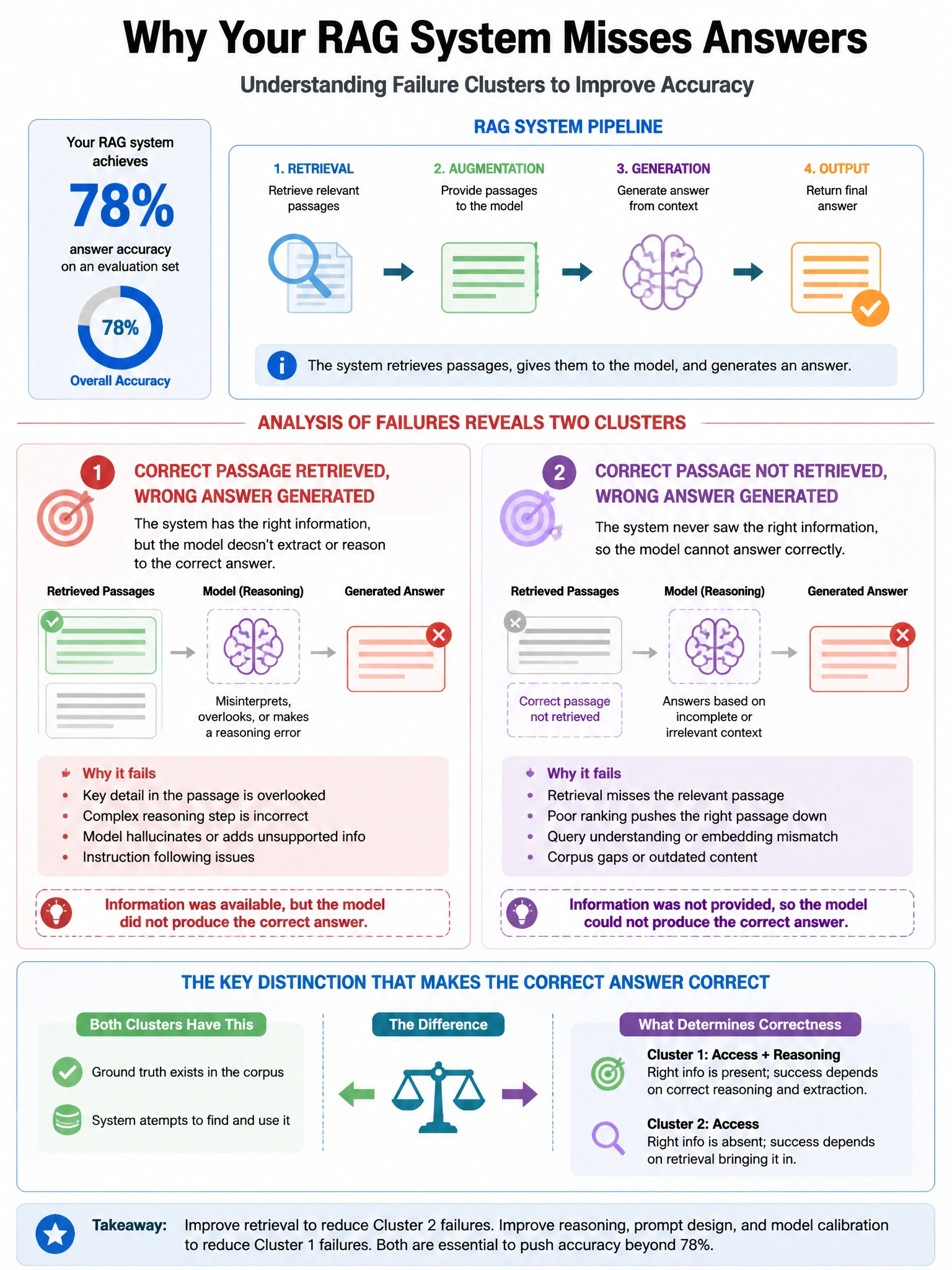
Your RAG system achieves 78% answer accuracy on an evaluation set. Analysis of failures shows two clusters: (1) questions where the correct passage is retrieved but the answer is wrong (generation failure), and (2) questions where the correct passage is not retrieved (retrieval failure). They split roughly 40/60. The team has budget to address only one. Which intervention has higher expected impact?
Select an answer to reveal the explanation.
Short Explanation and Infographic
Here's the deal — c is correct because retrieval is the binding constraint in a RAG system. Retrieval failures (60%) represent cases where the correct passage exists in the corpus but is not found — fixing retrieval converts these into generation-tractable cases.
Full explanation below image
Full Explanation
C is correct because retrieval is the binding constraint in a RAG system. Retrieval failures (60%) represent cases where the correct passage exists in the corpus but is not found — fixing retrieval converts these into generation-tractable cases. Even a perfect LLM cannot produce the right answer when the context window does not contain the right passage. The 60% retrieval failure cluster is the larger failure mode and the higher-ROI fix. A is wrong because generation failures (40%) are the smaller cluster, and addressing the smaller cluster first while leaving the larger one unaddressed maximizes the remaining error rate. The logic inverts the correct priority. B is wrong because retrieval failures are explicitly described as cases where the correct passage is not retrieved — this implies the corpus contains the relevant content but retrieval fails to surface it. This is a retrieval system problem, not a corpus coverage problem. D is wrong because fine-tuning the embedding model on an evaluation set introduces evaluation leakage — the model trains on its own benchmark — and embedding models do not affect generation quality; they are separate pipeline stages.