
A RAG system has been in production for 18 months. Users are reporting that answers to questions about current company policies are frequently incorrect — the system returns outdated answers confidently. The corpus was indexed 18 months ago and has not been updated. The embedding model was not changed. What is the most likely cause, and what is the remediation?
Select an answer to reveal the explanation.
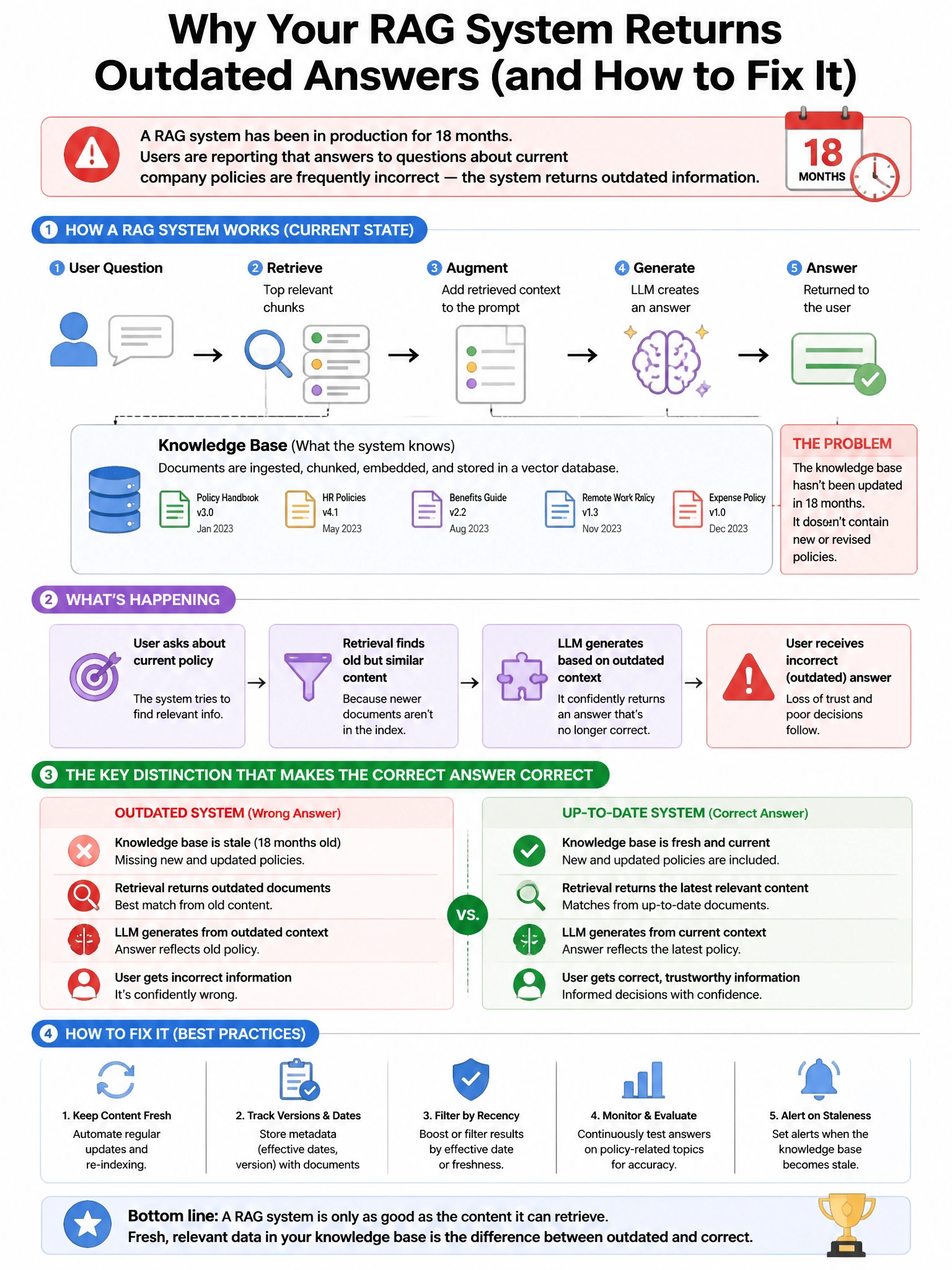
Short Explanation and Infographic
Here's the deal — d is correct because the described problem — stale answers from 18-month-old indexed content — is a corpus freshness problem. Company policies change, and a static index returns outdated information confidently because the retrieved passages were accurate at index time.
Full explanation below image
Full Explanation
D is correct because the described problem — stale answers from 18-month-old indexed content — is a corpus freshness problem. Company policies change, and a static index returns outdated information confidently because the retrieved passages were accurate at index time. The remediation requires: (1) keeping the index current via event-driven re-indexing on document changes, (2) surfacing document timestamps in retrieved context so the LLM can reason about recency, and (3) flagging or caveating answers based on stale source material. A is wrong because embedding model weights do not drift after deployment — they are static artifacts. The 'continued training by the provider' claim is incorrect; a deployed embedding model API serves a fixed model version. C is wrong because vector index fragmentation affects query performance (latency, throughput) but not retrieval accuracy — vector similarity scores are geometric and do not degrade due to index structure. B is wrong because the symptom (confident outdated policy answers) points directly to stale indexed content, not to the generation model — the LLM faithfully generates answers from stale retrieved passages.