
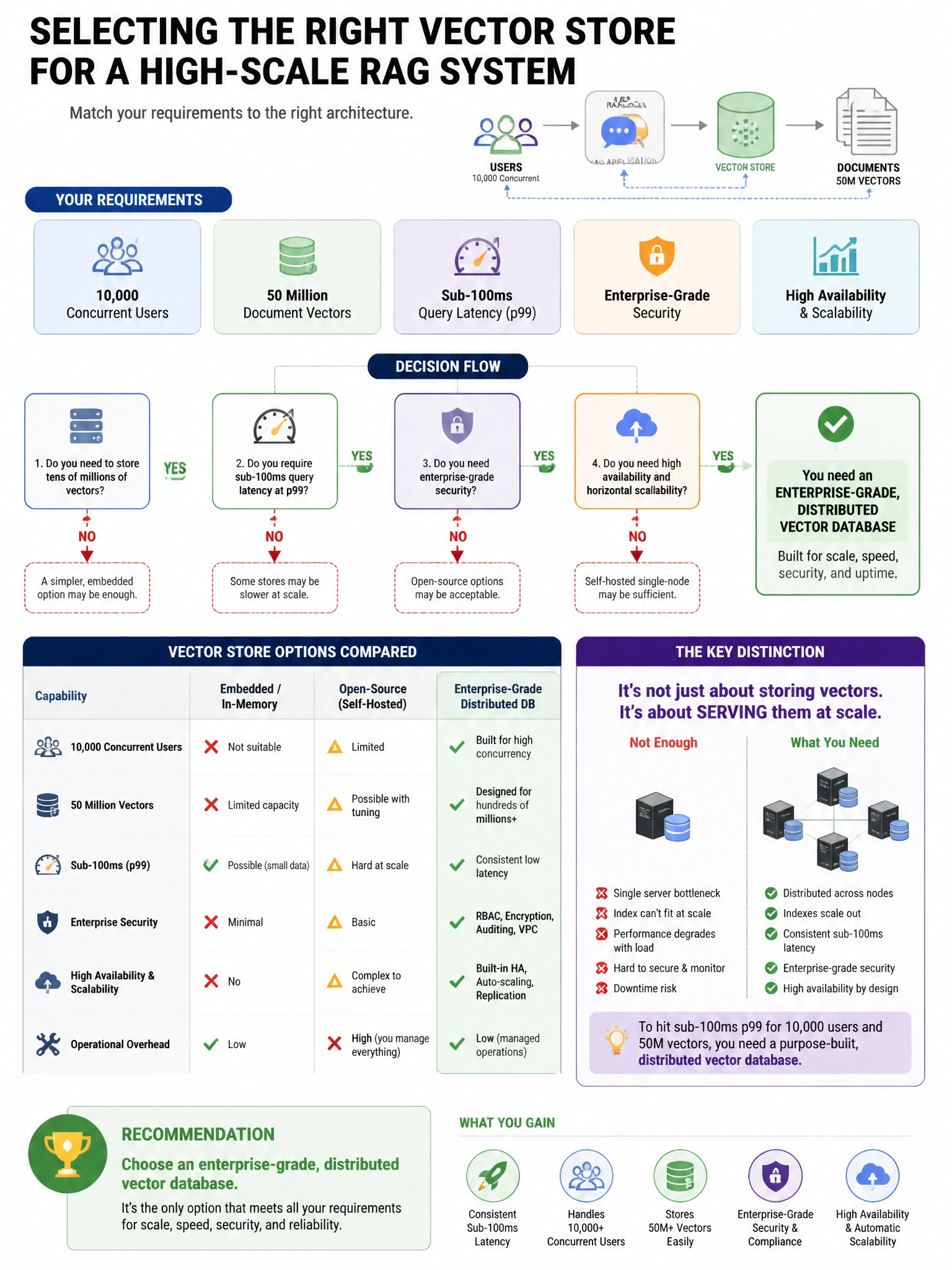
Your team is selecting a vector store for a RAG system that will serve 10,000 concurrent users, store 50 million document vectors, require sub-100ms query latency at p99, and need to support metadata filtering (date range, department, classification level). The system requires no maintenance downtime. Which criteria should most heavily weight the vector store selection decision?
Select an answer to reveal the explanation.
Short Explanation and Infographic
Here's the deal — a is correct because the operational requirements (10K concurrent users, 50M vectors, sub-100ms p99 latency, metadata filtering, zero-downtime maintenance) are the binding constraints for vector store selection at this scale. A managed service with horizontal scaling handles concurrent load.
Full explanation below image
Full Explanation
A is correct because the operational requirements (10K concurrent users, 50M vectors, sub-100ms p99 latency, metadata filtering, zero-downtime maintenance) are the binding constraints for vector store selection at this scale. A managed service with horizontal scaling handles concurrent load. Native metadata filtering (date range, department, classification) is a functional requirement — stores without this capability require client-side post-filtering, which degrades performance at scale. Proven SLAs provide contractual guarantees. BEIR benchmark performance, while important, is a secondary criterion given that the operational constraints will rule out most options first. B is wrong because BEIR benchmark accuracy, while a useful quality signal, does not address the scale, latency, filtering, or operational requirements that are the actual selection constraints at this scale. C is wrong because GitHub stars measure developer interest, not production readiness — many popular open-source projects require significant operational expertise to run at 50M vectors and 10K concurrent users. D is wrong because selecting a vector store based on maximum dimension support for future embedding models prioritizes a hypothetical future requirement over present, concrete operational needs.