
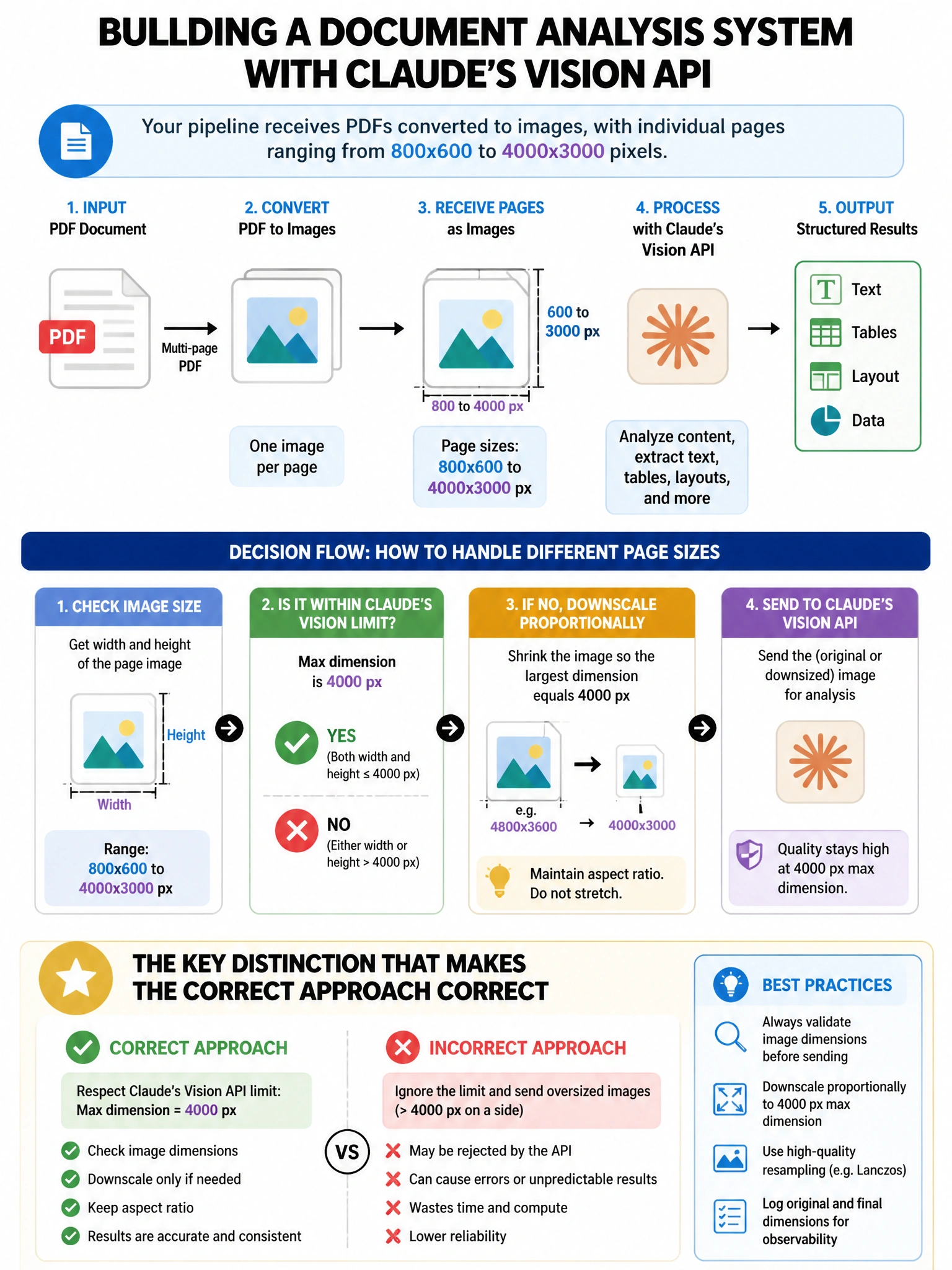
You are building a document analysis system using Claude's vision API. Your pipeline receives PDFs converted to images, with individual pages ranging from 800x600 to 4000x3000 pixels. Some pages contain dense technical tables. What constraint must the architect account for when designing the image preprocessing step?
Select an answer to reveal the explanation.
Short Explanation and Infographic
Here's the deal — b is correct because Claude's vision API enforces both a file size limit (5MB) and a maximum pixel dimension (8000px on the longest edge). Images exceeding these constraints are rejected.
Full explanation below image
Full Explanation
B is correct because Claude's vision API enforces both a file size limit (5MB) and a maximum pixel dimension (8000px on the longest edge). Images exceeding these constraints are rejected. Dense technical tables at 4000x3000 pixels push toward these limits and the architect must implement preprocessing to resize, compress, or tile large pages appropriately. A is wrong because Claude does not silently auto-downscale — oversized images return an error, not a silently degraded result. C is wrong because there are explicit size limits and the cost model is based on tokens computed from image size, not raw megapixels in a user-defined way. D is wrong because while JPEG and PNG are the primary supported formats, the question as stated in option D misrepresents the constraint — the real limiting factor for this scenario is size/dimension, not format rejection of WebP/TIFF per se (though format support matters, B is the most operationally critical constraint for this architecture).