
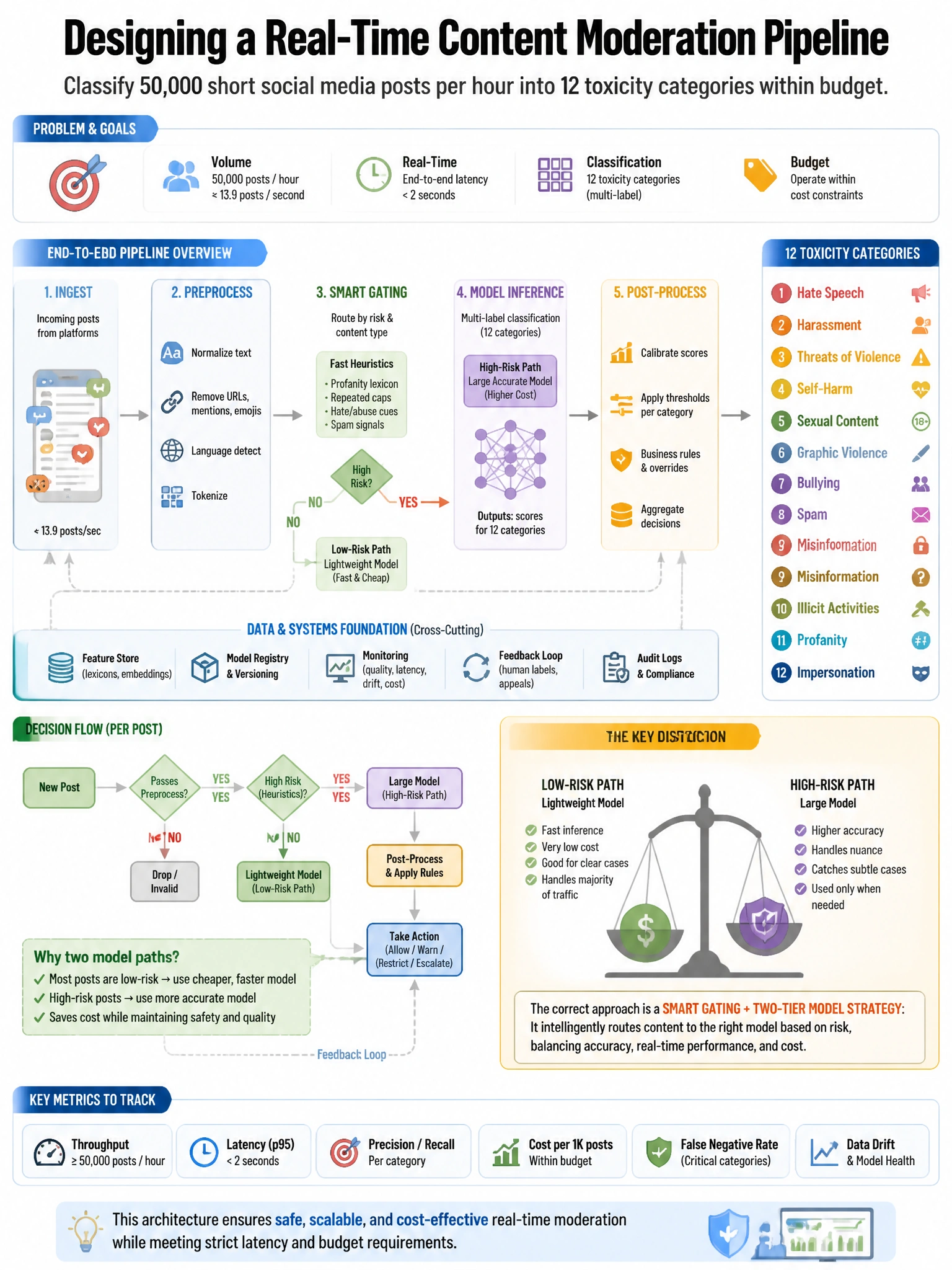
An architect is designing a real-time content moderation pipeline that must classify 50,000 short social media posts per hour into 12 toxicity categories. The system has a budget constraint of $0.50 per 1,000 posts and a latency requirement of under 500ms per classification. Which deployment pattern best fits these constraints?
Select an answer to reveal the explanation.
Short Explanation and Infographic
Here's the deal — a is correct because claude-3-haiku is purpose-built for high-volume, low-latency classification tasks. Its cost profile and sub-second latency make it well-suited for the 50K/hour throughput at $0.50 per 1,000 posts.
Full explanation below image
Full Explanation
A is correct because claude-3-haiku is purpose-built for high-volume, low-latency classification tasks. Its cost profile and sub-second latency make it well-suited for the 50K/hour throughput at $0.50 per 1,000 posts. A structured taxonomy in the system prompt with JSON schema output maximizes consistency. Concurrent worker pools horizontally scale to throughput requirements. B is wrong because batching 100 posts per call in a single prompt makes attribution of classifications back to individual posts ambiguous and does not address latency at 500ms for Sonnet. C is wrong because extended thinking adds significant latency and cost, directly violating the 500ms requirement, and is unnecessary for structured classification. D is wrong because Opus far exceeds the cost budget and the keyword pre-filter introduces precision/recall tradeoffs that undermine the classification system's purpose.