
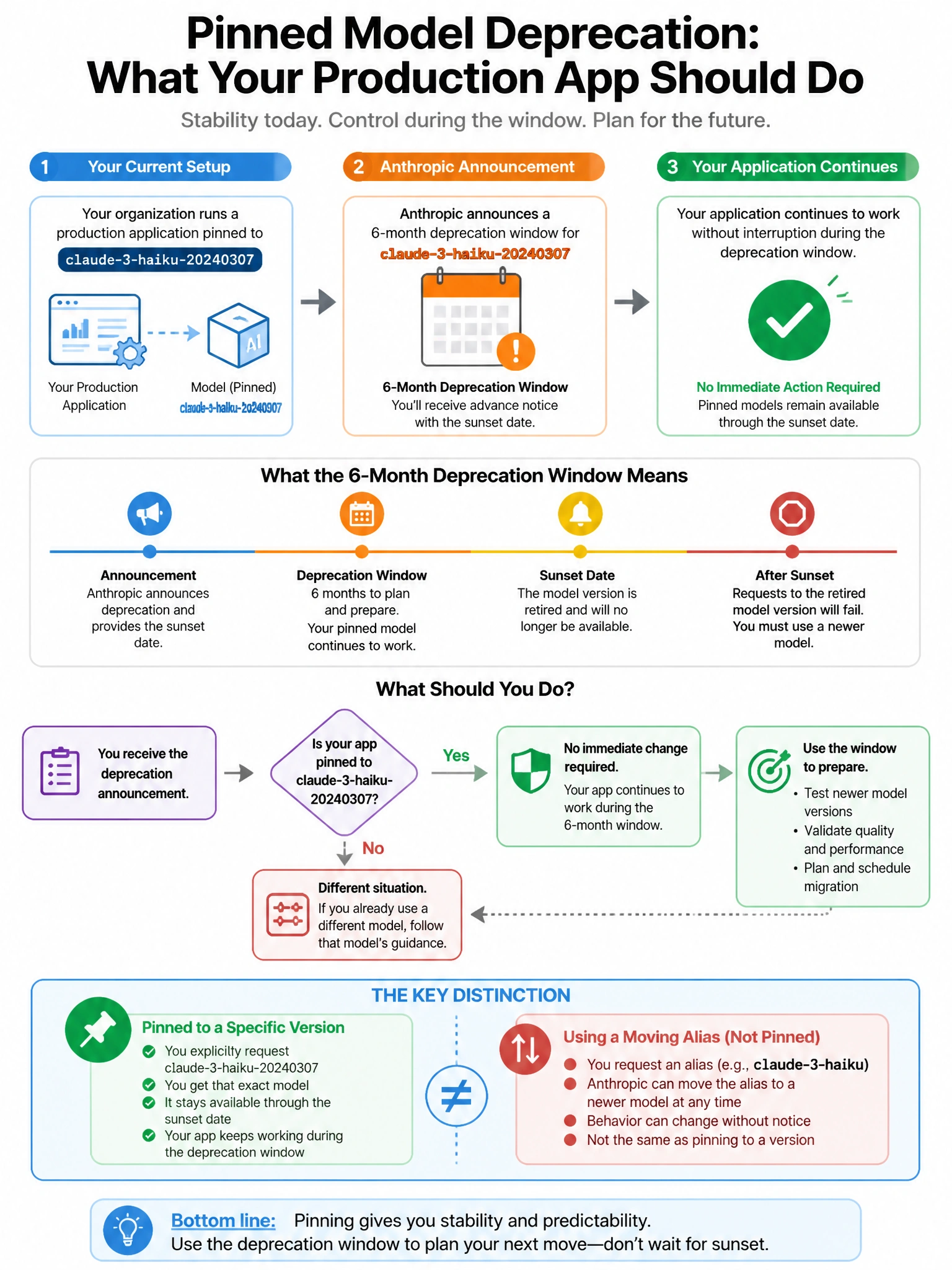
Your organization runs a production application pinned to claude-3-haiku-20240307. Anthropic announces a 6-month deprecation window for this model version. Your application processes 2 million classification requests per day with strict latency SLAs. What is the most operationally sound deprecation migration strategy?
Select an answer to reveal the explanation.
Short Explanation and Infographic
Here's the deal — a is correct because shadow traffic testing with statistical comparison of output distributions identifies behavioral regressions without risking production SLAs. Staged rollout with automated rollback triggers is the industry-standard approach for high-volume, latency-sensitive migration.
Full explanation below image
Full Explanation
A is correct because shadow traffic testing with statistical comparison of output distributions identifies behavioral regressions without risking production SLAs. Staged rollout with automated rollback triggers is the industry-standard approach for high-volume, latency-sensitive migration. B is wrong because running both versions for only 30 days is arbitrary and does not validate output consistency statistically — it adds cost without structured evaluation. C is wrong because automatic forwarding is not guaranteed, and assuming classification backward compatibility at 2M req/day is a dangerous operational gamble that violates the principle of validating before relying on. D is wrong because claude-haiku-latest is not a supported API alias; Anthropic's API requires explicit version strings, so this approach would fail at the API call level.