
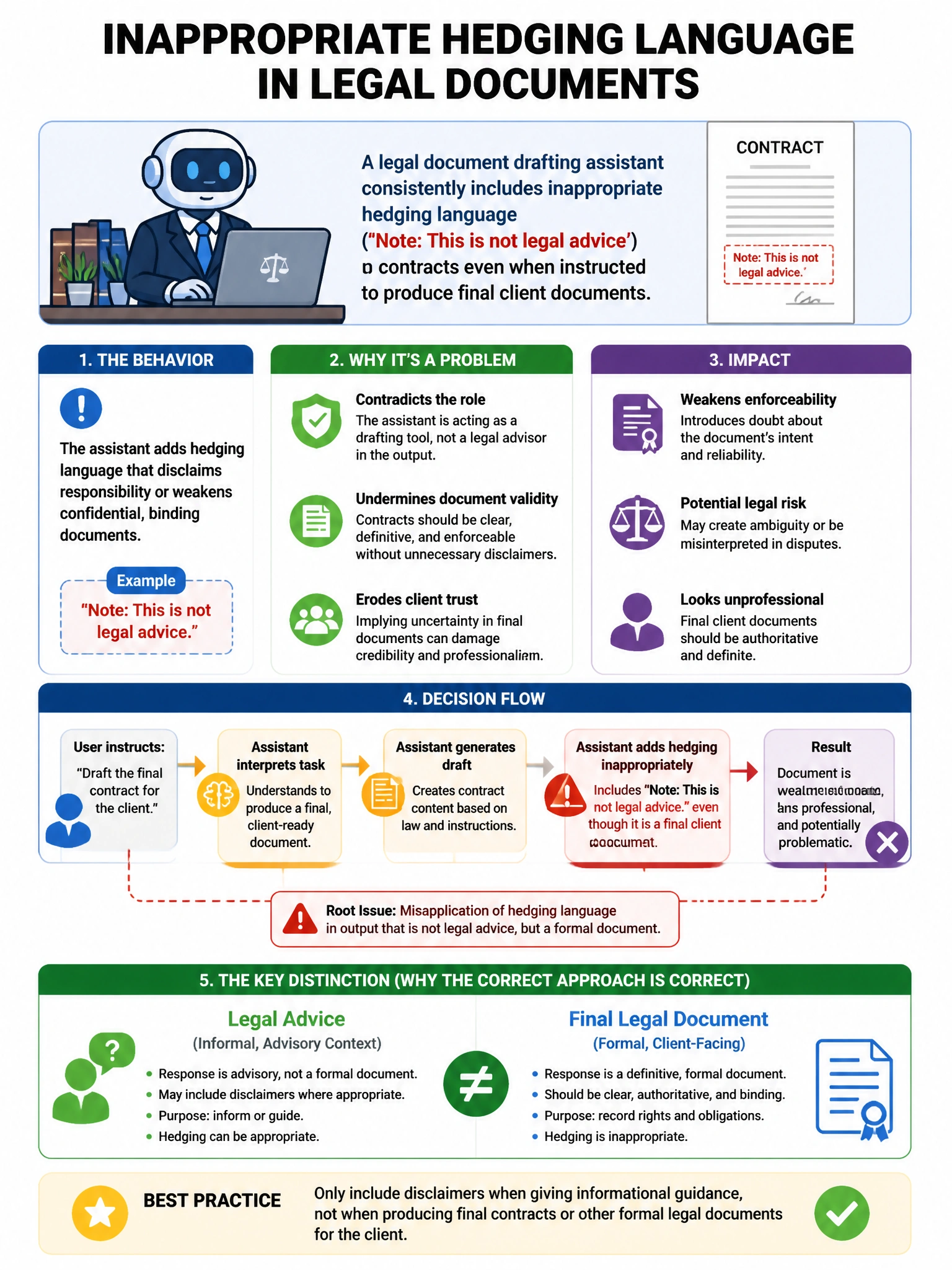
A legal document drafting assistant consistently includes inappropriate hedging language ('Note: This is not legal advice') in contracts even when instructed to produce final client-ready documents. The system prompt includes: 'Draft professional legal documents as requested.' What is the most effective fix?
Select an answer to reveal the explanation.
Short Explanation and Infographic
Here's the deal — b is correct because effective negative prompting combines three elements: naming the specific prohibited behavior (disclaimers, hedging phrases), providing example language to avoid (makes the prohibition concrete), and framing the positive alternative (practicing attorney voice, final deliverables). This multi-layered instruction disambiguates the intended behavior.
Full explanation below image
Full Explanation
B is correct because effective negative prompting combines three elements: naming the specific prohibited behavior (disclaimers, hedging phrases), providing example language to avoid (makes the prohibition concrete), and framing the positive alternative (practicing attorney voice, final deliverables). This multi-layered instruction disambiguates the intended behavior. A is wrong because 'do not include disclaimers' is too abstract — the model may not classify its hedging as 'disclaimers'; naming specific phrases and patterns is more reliable. C is wrong because temperature 0 maximizes output determinism but does not change which behaviors the model considers appropriate — if the model's default is to include disclaimers, determinism will consistently produce disclaimers. D is wrong because post-processing regex is a fragile workaround that misses paraphrased hedging and creates maintenance burden; fixing the prompt is more robust and prevents the problem at generation time.