
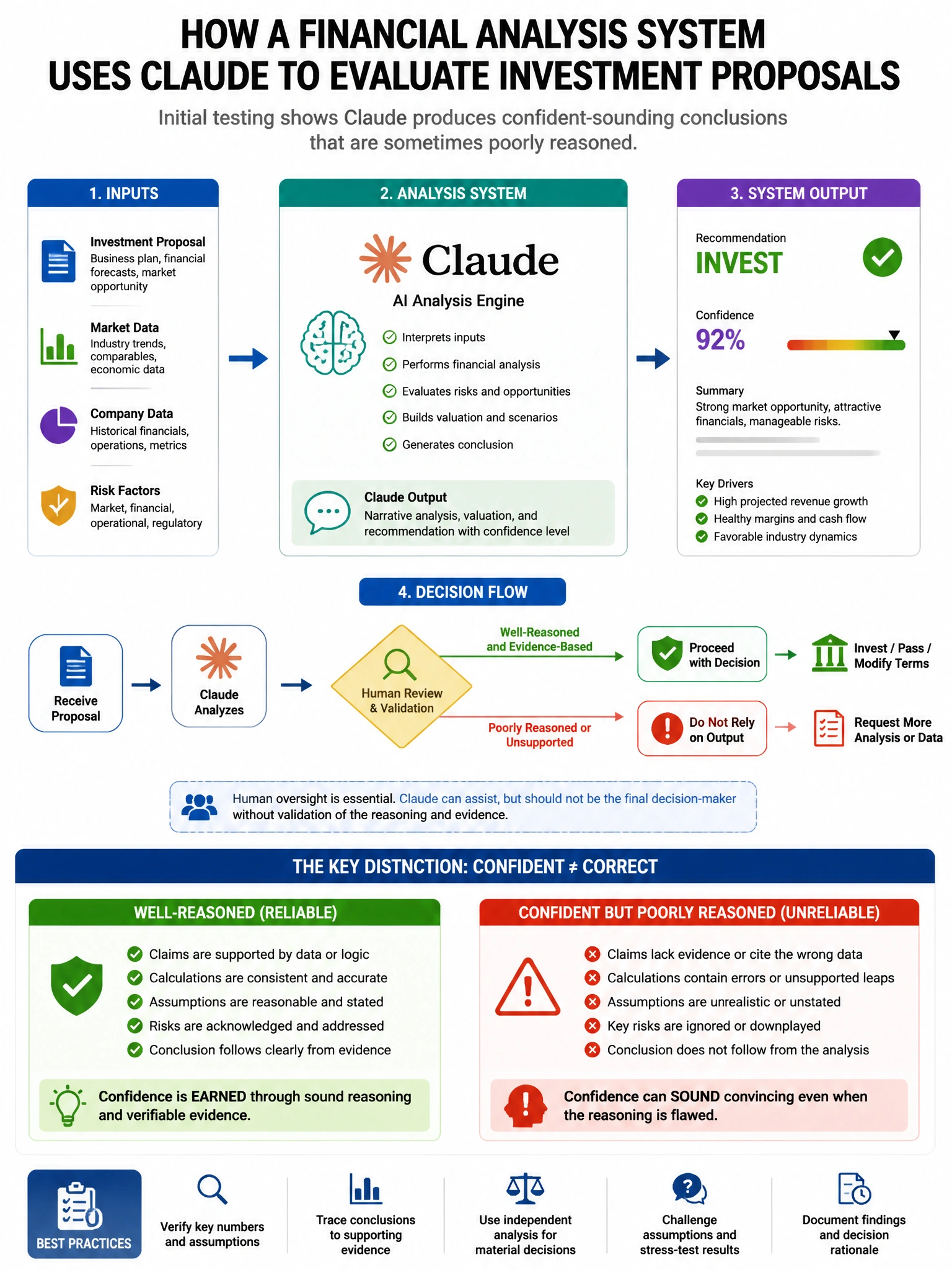
A financial analysis system uses Claude to evaluate investment proposals. Initial testing shows Claude produces confident-sounding conclusions that are sometimes poorly reasoned. An architect wants to improve reasoning quality without changing the model. Which prompting technique most reliably elicits higher-quality step-by-step reasoning?
Select an answer to reveal the explanation.
Short Explanation and Infographic
Here's the deal — a is correct because explicit structural decomposition is the most effective CoT elicitation technique — requiring Claude to enumerate factors, evaluate evidence, and consider counterarguments forces the model through a complete reasoning process before committing to a conclusion. This catches errors that surface during structured enumeration.
Full explanation below image
Full Explanation
A is correct because explicit structural decomposition is the most effective CoT elicitation technique — requiring Claude to enumerate factors, evaluate evidence, and consider counterarguments forces the model through a complete reasoning process before committing to a conclusion. This catches errors that surface during structured enumeration. B is wrong because 'think carefully' is too vague — it nudges the model toward slightly more deliberate generation but does not constrain the structure of reasoning or require evidence citation, leaving reasoning quality improvement to chance. C is wrong because higher temperature increases output variability and randomness, not reasoning depth — it makes the model more likely to explore unconventional ideas but also more likely to make unsupported leaps. D is wrong because few-shot examples showing correct answers without reasoning steps trains the model to pattern-match to conclusions, which is precisely the problem being observed — it does not improve the reasoning chain.