
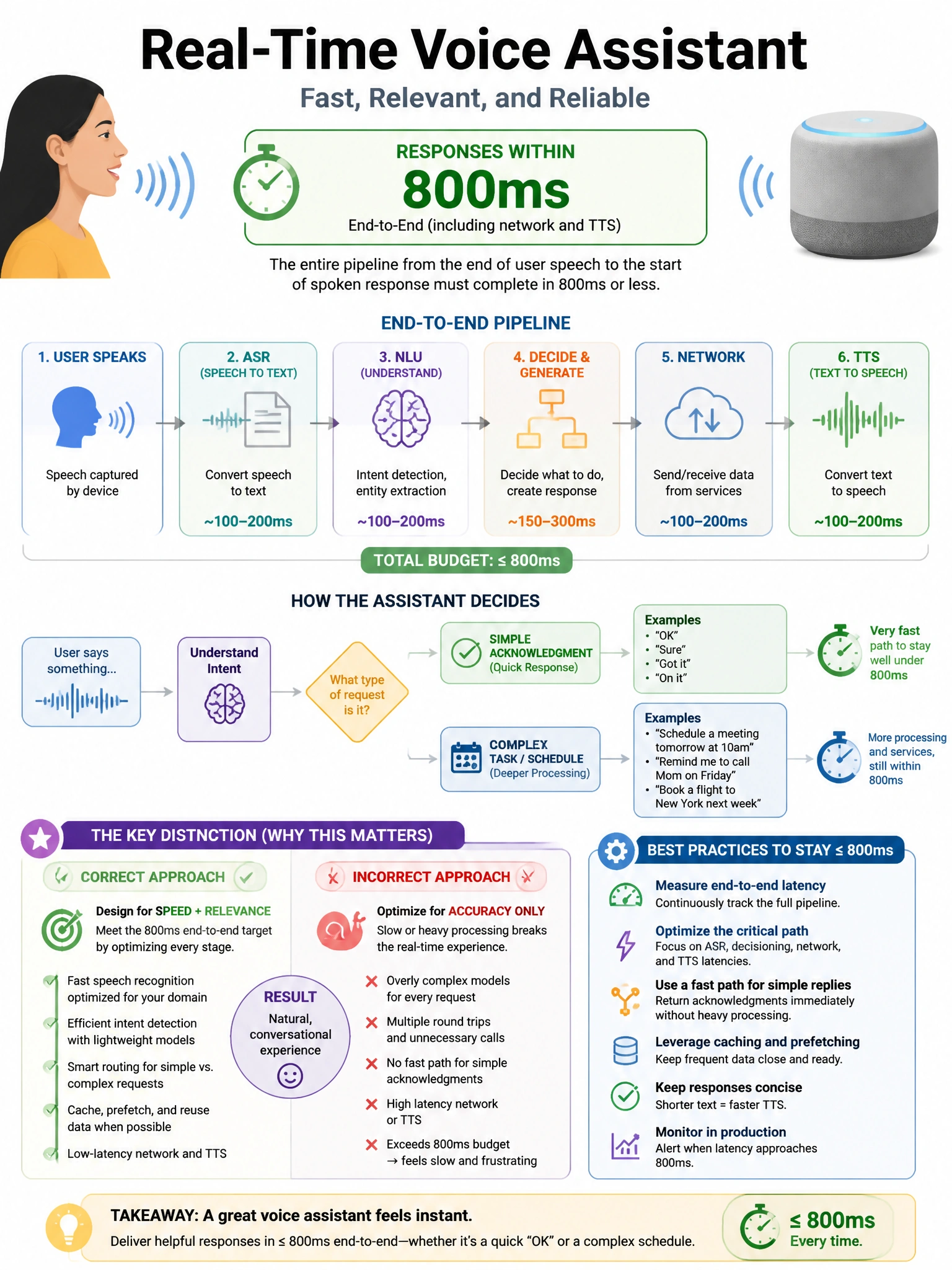
A real-time voice assistant application requires responses within 800ms end-to-end (including network and TTS). The assistant handles both simple acknowledgments and complex scheduling tasks. Streaming is enabled. An architect measures that claude-3-5-sonnet averages 1200ms time-to-first-token for complex queries. What is the best architectural strategy?
Select an answer to reveal the explanation.
Short Explanation and Infographic
Here's the deal — d is correct because for a real-time voice assistant with a hard 800ms SLA, Haiku's consistently low latency is the only model that meets the requirement reliably. Voice assistants are latency-critical, and users experience SLA misses as conversational failures — quality improvements from Sonnet are irrelevant if responses arrive too late.
Full explanation below image
Full Explanation
D is correct because for a real-time voice assistant with a hard 800ms SLA, Haiku's consistently low latency is the only model that meets the requirement reliably. Voice assistants are latency-critical, and users experience SLA misses as conversational failures — quality improvements from Sonnet are irrelevant if responses arrive too late. B is wrong because accepting SLA misses on scheduling queries creates an inconsistent user experience; voice assistants must be predictably responsive or the product fails. C is wrong because speculative response patterns create coherence problems — switching mid-stream between two model responses produces jarring audio artifacts in TTS and requires complex state management with no guarantee the switch happens at a natural boundary. A is wrong because SLA requirements are set by user experience needs, not model capabilities; the architect must design to the SLA, not negotiate it away.