
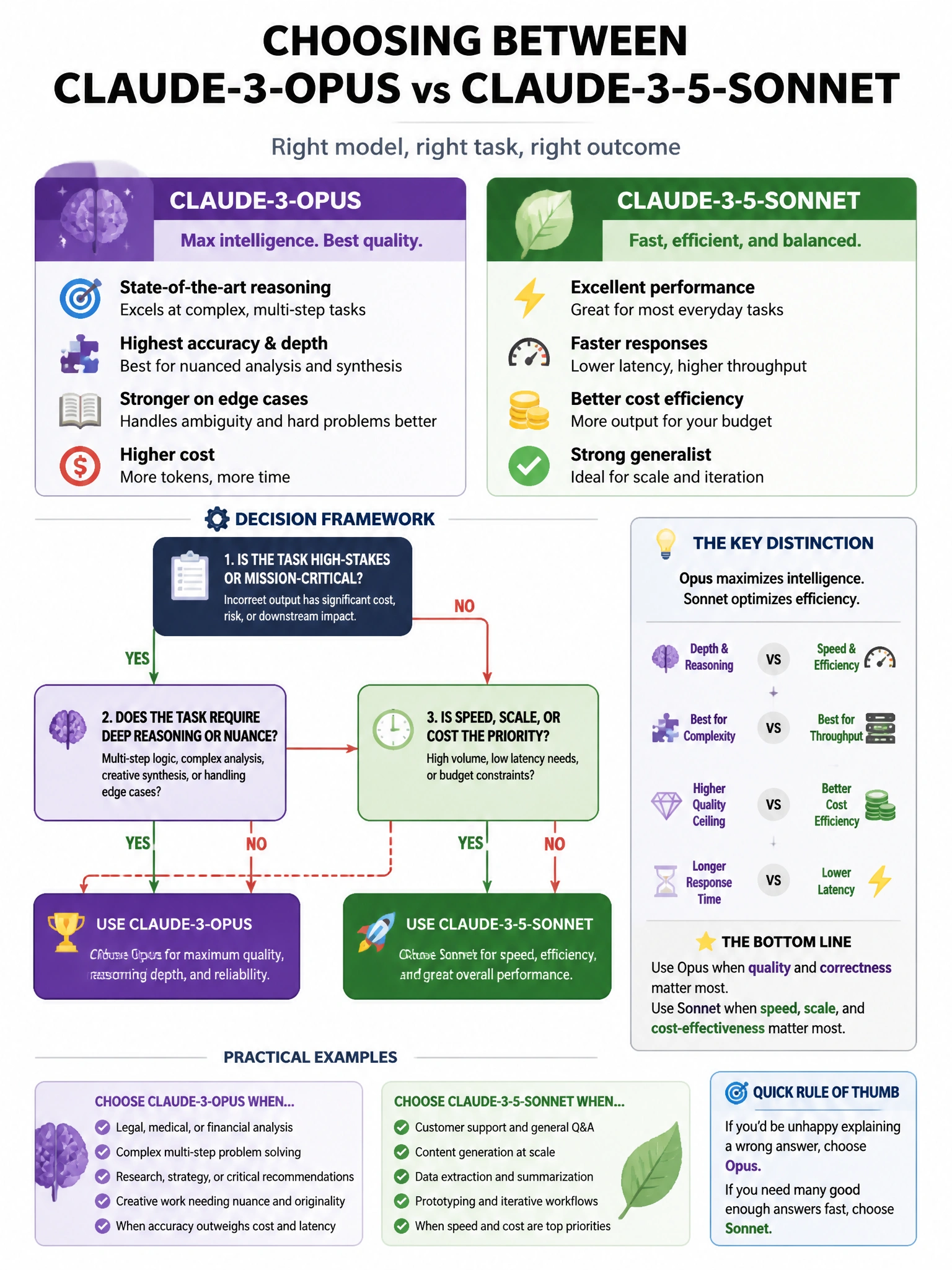
An AI product team is debating when to use claude-3-opus versus claude-3-5-sonnet. A senior architect is asked to define the decision criteria. Which set of criteria correctly identifies use cases that genuinely benefit from Opus over Sonnet?
Select an answer to reveal the explanation.
Short Explanation and Infographic
Here's the deal — c is correct because Opus's primary differentiation is on tasks requiring deep, multi-step reasoning over ambiguous or complex inputs — research synthesis, complex architectural decisions, and novel problem solving where reasoning chain quality cascades to final answer quality. B is wrong because Sonnet and Opus share similar context window sizes; context length alone is not the distinguishing factor.
Full explanation below image
Full Explanation
C is correct because Opus's primary differentiation is on tasks requiring deep, multi-step reasoning over ambiguous or complex inputs — research synthesis, complex architectural decisions, and novel problem solving where reasoning chain quality cascades to final answer quality. B is wrong because Sonnet and Opus share similar context window sizes; context length alone is not the distinguishing factor. A is wrong because Sonnet produces outputs that are indistinguishable from or superior to Opus on many common tasks — 'quality perception' is not a reliable criterion without task complexity analysis. D is wrong because classification tasks are typically well-suited to Haiku or Sonnet; they involve pattern matching over well-defined categories, not novel reasoning — using Opus wastes cost without quality gain.