
A benchmarking team is evaluating whether to migrate from claude-3-sonnet to claude-3-5-sonnet for a legal document analysis system. The system extracts clause types, identifies obligations, and flags potential risks. What evaluation methodology gives the most reliable signal for this migration decision?
Select an answer to reveal the explanation.
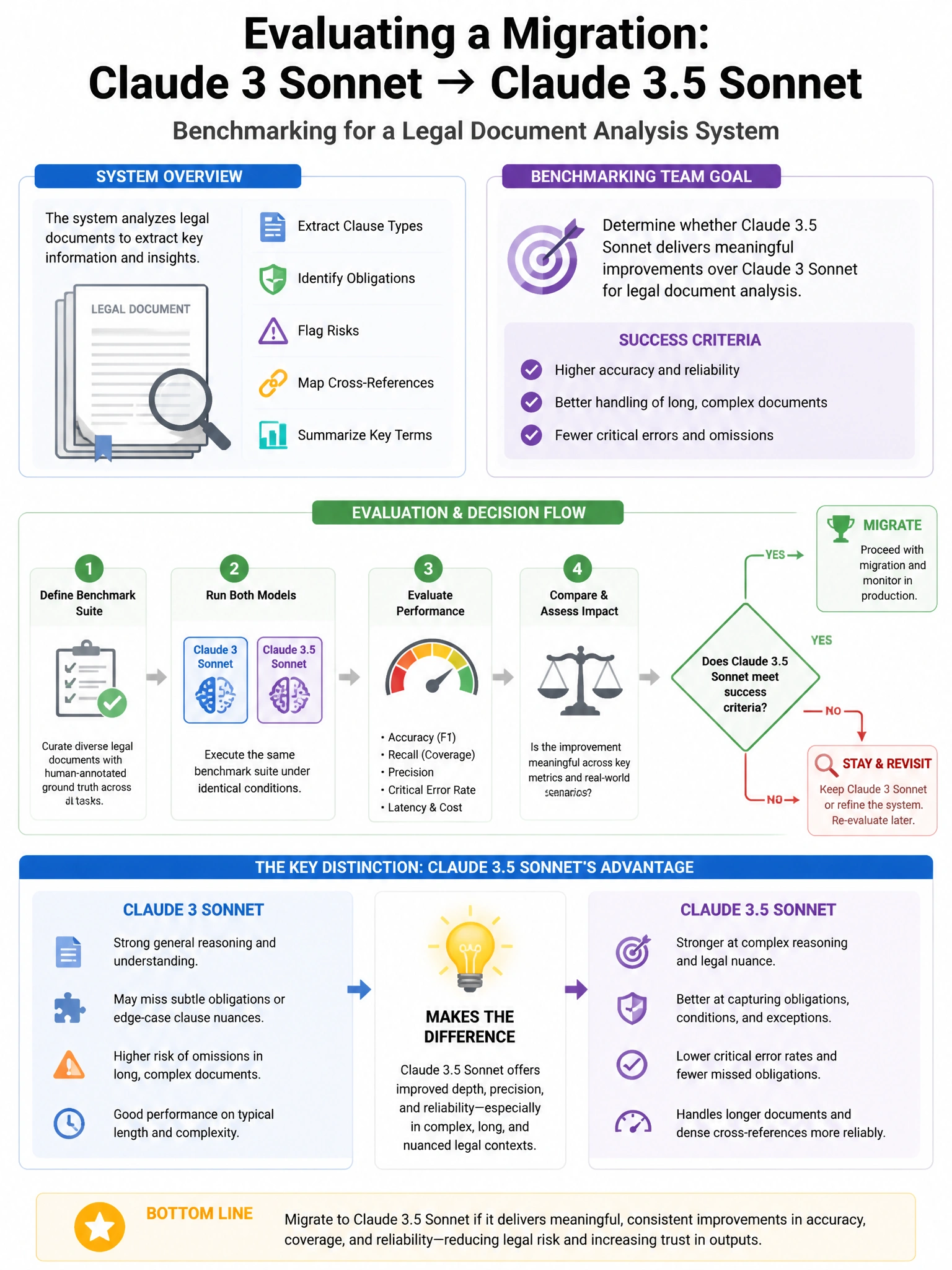
Short Explanation and Infographic
Here's the deal — c is correct because a golden test set with expert annotations provides objective, reproducible measurement against known correct answers — F1 scores across clause types give quantitative evidence of extraction quality, and 200+ documents provides statistical power to detect real differences. A is wrong because 10 documents is insufficient for statistical significance, and manual review introduces human variability; cherry-picked documents may not represent the real distribution.
Full explanation below image
Full Explanation
C is correct because a golden test set with expert annotations provides objective, reproducible measurement against known correct answers — F1 scores across clause types give quantitative evidence of extraction quality, and 200+ documents provides statistical power to detect real differences. A is wrong because 10 documents is insufficient for statistical significance, and manual review introduces human variability; cherry-picked documents may not represent the real distribution. B is wrong because published benchmarks use standardized tasks that may not reflect the specific clause types and obligation structures in this system's legal domain — benchmark performance rarely transfers directly to domain-specific tasks. D is wrong because running an A/B test in production with untested models risks deploying degraded quality to real users on legal documents where errors have consequences; evaluation should happen before production deployment.