
A data extraction pipeline uses Claude to convert unstructured survey responses into a structured JSON schema. The team adds chain-of-thought prompting to improve accuracy. They observe that adding 'Think step by step before responding' increases accuracy from 87% to 94% but also increases average response token length from 200 to 800 tokens, quadrupling output costs. What architectural pattern captures most of the accuracy gain while minimizing token cost?
Select an answer to reveal the explanation.
Short Explanation and Infographic
Here's the deal — instructing Claude to reason internally and output only the final structured answer is the most direct solution: the reasoning guidance improves extraction accuracy without generating verbose visible reasoning tokens in the output. This technique exploits Claude's ability to use reasoning implicitly while constraining output format.
Full explanation below image
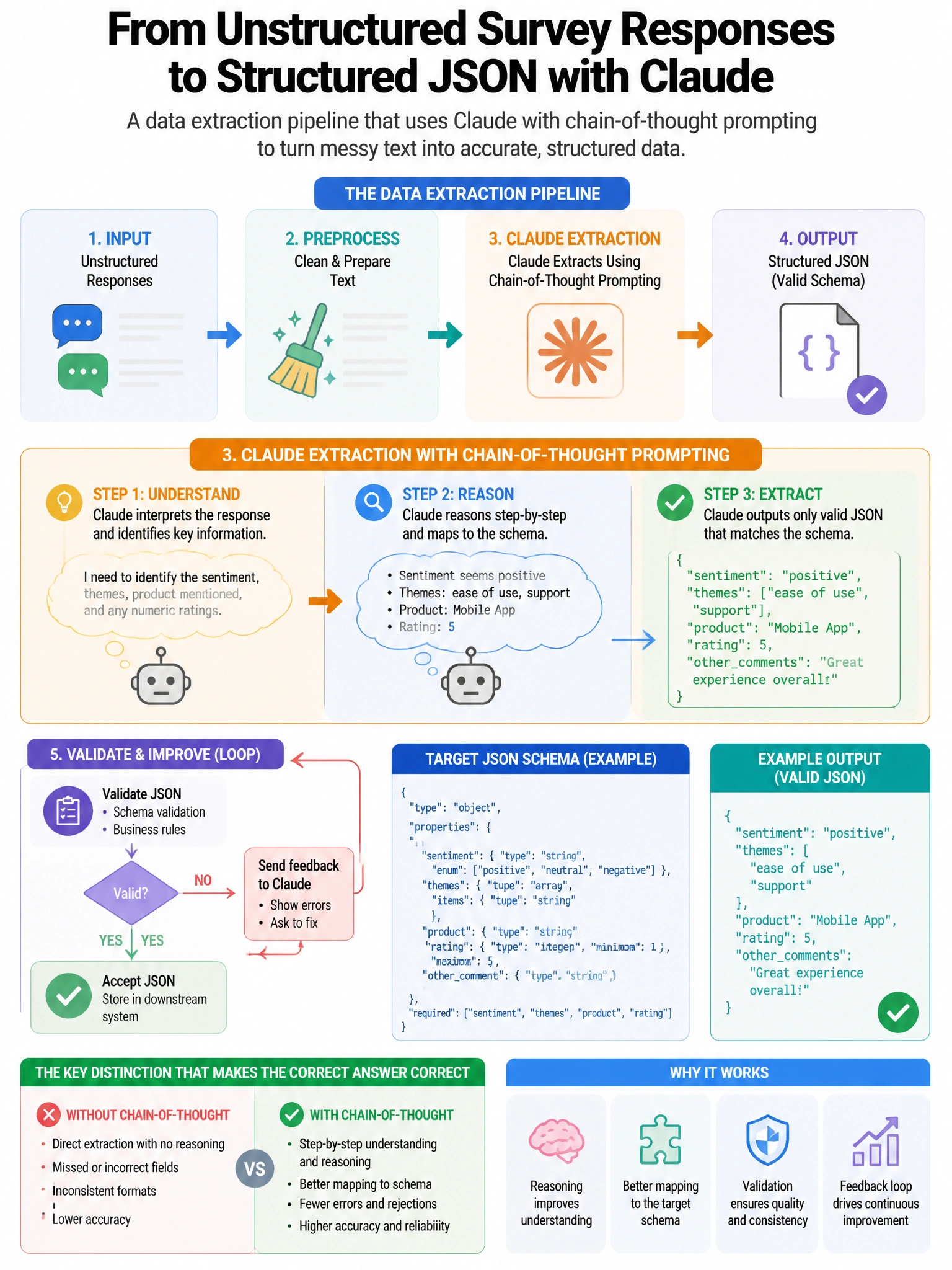
Full Explanation
Instructing Claude to reason internally and output only the final structured answer is the most direct solution: the reasoning guidance improves extraction accuracy without generating verbose visible reasoning tokens in the output. This technique exploits Claude's ability to use reasoning implicitly while constraining output format. The output remains compact JSON. Option A abandons a meaningful 7% accuracy gain for a cost optimization that Option C already solves. Option B (two-pass) has the opposite problem — it uses two API calls and actually increases cost and latency. Option D (extended thinking) is a valid alternative if available and correctly identifies that reasoning in a separate block can be managed differently, but Option C is simpler, more universally available, and sufficient for this structured extraction use case where reasoning complexity is moderate.