
A code review platform uses Claude to analyze pull requests. Their system prompt defines coding standards, style guides, and review criteria (8,000 tokens). They implement prompt caching and observe that cache hit rates are only 40% despite high traffic. Investigation reveals that a timestamp and request ID are being prepended to the system prompt for audit logging purposes. What is the root cause and fix?
Select an answer to reveal the explanation.
Short Explanation and Infographic
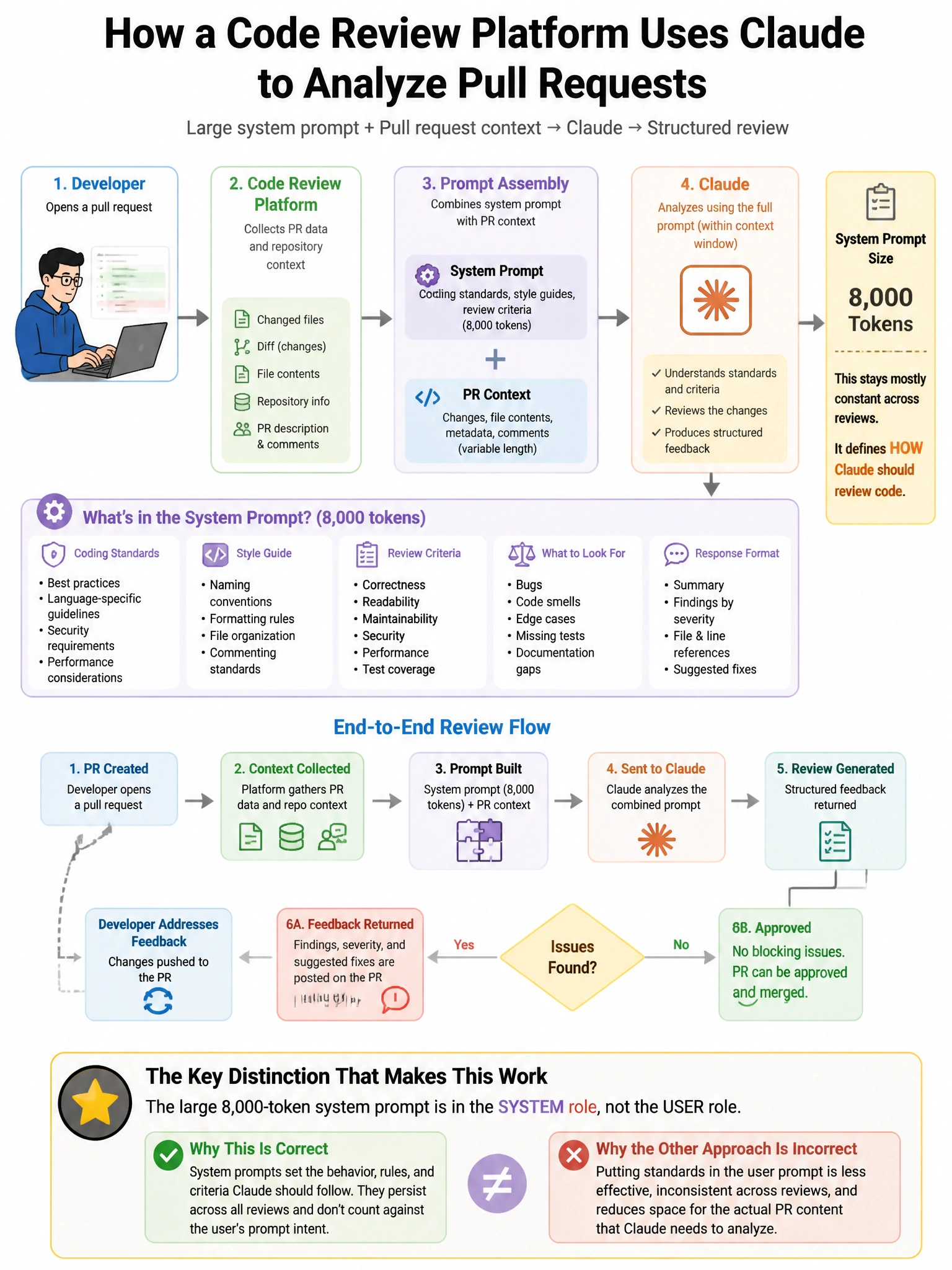
Here's the deal — prompt cache matching requires a byte-identical prefix up to the cache_control marker. A timestamp prepended to the system prompt makes every single request's prefix unique, invalidating caching entirely on those requests.
Full explanation below image
Full Explanation
Prompt cache matching requires a byte-identical prefix up to the cache_control marker. A timestamp prepended to the system prompt makes every single request's prefix unique, invalidating caching entirely on those requests. The 40% hit rate likely reflects only the fraction of requests that coincidentally share the same timestamp second (possible in high-throughput scenarios). The fix is straightforward: audit metadata belongs in application logs, not in the prompt. Moving the request ID and timestamp to an HTTP header, a database log entry, or a separate audit trail keeps the prompt stable and cacheable. Option A is incorrect — Anthropic's cache supports prompts well beyond 8,000 tokens. Option C is incorrect — prompt caching is per-organization, not per-API-key. Option D is incorrect — there is no theoretical 40% ceiling on prompt caching; properly implemented caching should approach near-100% hit rates for stable system prompts under sustained load.