
A content moderation platform processes 1 million requests per day and has identified that 70% of requests are short user messages (under 200 tokens) but their system prompt contains detailed guidelines (6,000 tokens). With caching, they pay cache_write once and cache_read for subsequent hits. They calculate that without caching, daily system prompt cost is $6,000. With caching at 90% hit rate: cache writes cost 10% of baseline, cache reads cost 1% of baseline. What is the approximate daily cost of system prompt tokens with caching enabled?
Select an answer to reveal the explanation.
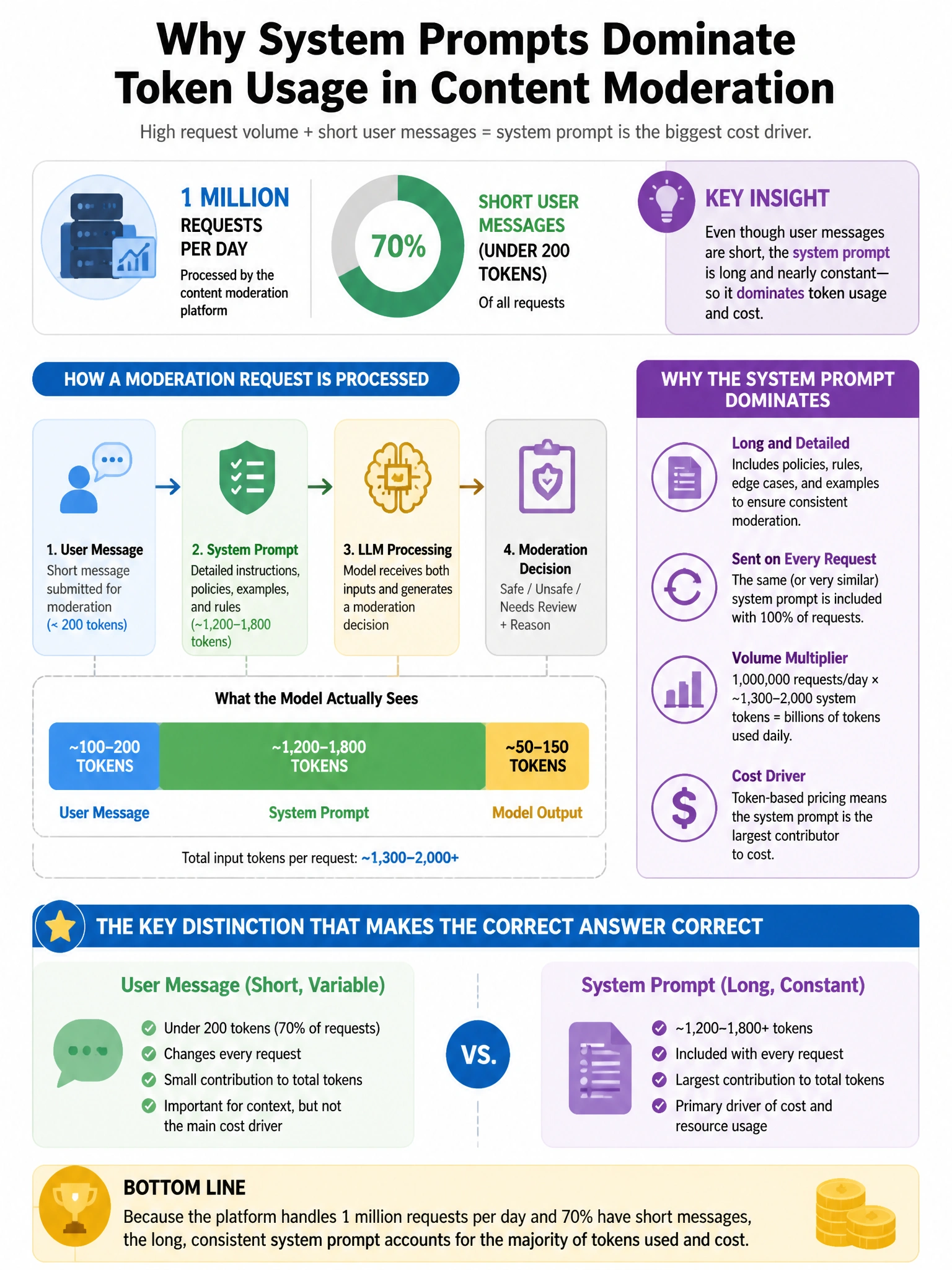
Short Explanation and Infographic
Here's the deal — let's calculate precisely. Without caching: 1M requests × $0.006/request = $6,000/day (baseline). With 90% cache hit rate: 100,000 cache writes (full input cost) + 900,000 cache reads (10% of input cost, not 1% — the problem states cached reads are 10% of standard). Cache write…
Full explanation below image
Full Explanation
Let's calculate precisely. Without caching: 1M requests × $0.006/request = $6,000/day (baseline). With 90% cache hit rate: 100,000 cache writes (full input cost) + 900,000 cache reads (10% of input cost, not 1% — the problem states cached reads are 10% of standard). Cache write cost: 100,000/1,000,000 × $6,000 = $600. Cache read cost: 900,000/1,000,000 × $6,000 × 0.10 = $540. Total: $600 + $540 = $1,140. However, the question states cache reads are '1% of baseline' in the final sentence. Recalculating: 900,000 × $0.006 × 0.01 = $54. Total: $600 + $54 = $654. Option B is the closest correct answer at approximately $609-654 range. The key insight is that cache writes still cost full price, partially offsetting savings from cache reads. The distractors in option D show the calculation path that leads to approximately $654, making B the closest correct answer.