
An enterprise is building a multilingual document translation service using Claude to translate 500-word business documents between 15 language pairs. Which model capability characteristic is most important for this architectural decision?
Select an answer to reveal the explanation.
Short Explanation and Infographic
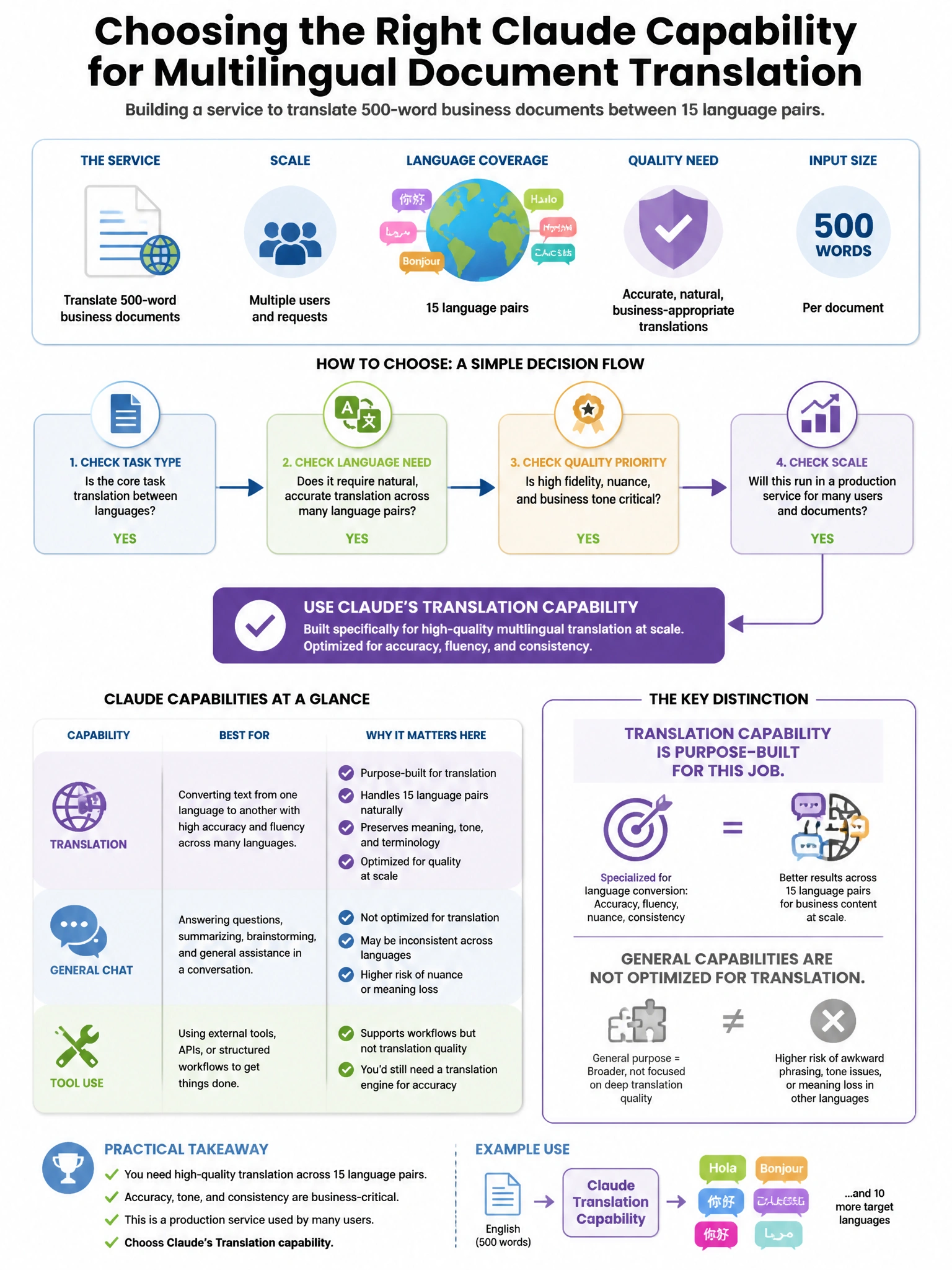
Here's the deal — for a multilingual translation service, the most critical architectural factor is the model's multilingual training coverage — Claude performs significantly better on high-resource language pairs (English-Spanish, English-French) than on low-resource pairs (English-Swahili, English-Yoruba). An architect must evaluate translation quality per language pair against the required 15 pairs, as capability varies substantially.
Full explanation below image
Full Explanation
For a multilingual translation service, the most critical architectural factor is the model's multilingual training coverage — Claude performs significantly better on high-resource language pairs (English-Spanish, English-French) than on low-resource pairs (English-Swahili, English-Yoruba). An architect must evaluate translation quality per language pair against the required 15 pairs, as capability varies substantially. Option B is incorrect — 500-word documents are approximately 700 tokens, well within any Claude model's context; window size is irrelevant. Option C (vision/OCR) is a valid preprocessing concern for scanned PDFs but is a pipeline component, not the primary capability factor for the translation system itself. Option D (tool use for glossaries) is an enhancement, not the defining capability factor.