
A team is comparing Claude 4 Opus with Claude 3.5 Sonnet for a task requiring identification of flawed logical steps in graduate-level mathematical proofs. Which architectural consideration should drive model selection?
Select an answer to reveal the explanation.
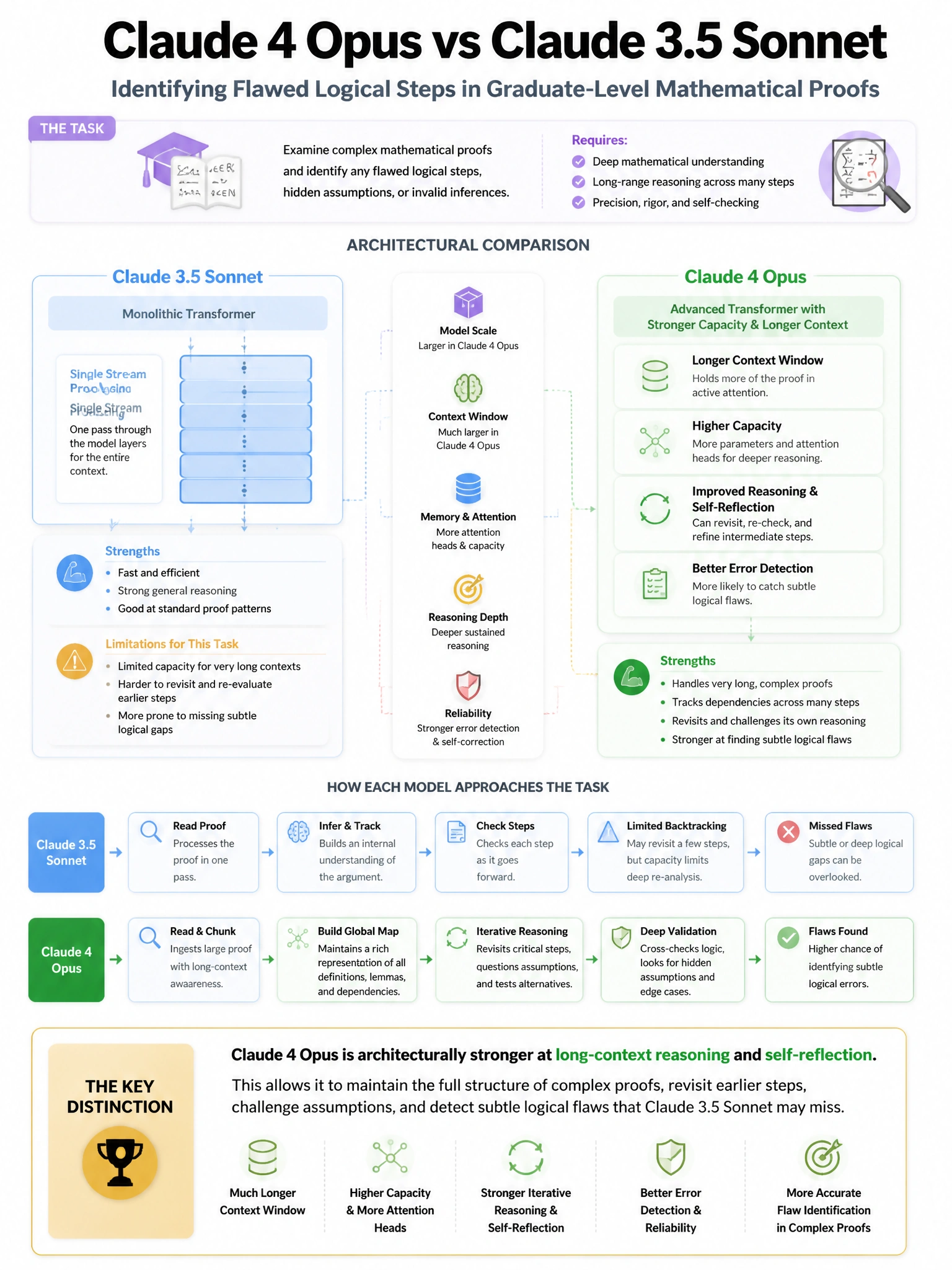
Short Explanation and Infographic
Here's the deal — for complex multi-step reasoning tasks like graduate-level mathematical proof verification, Claude 4 Opus represents the highest capability tier and is specifically designed for tasks where reasoning depth matters most. Identifying flawed logical steps in graduate proofs requires sustained logical coherence across many reasoning steps — precisely the scenario where the top-tier model's additional capability translates to measurable quality differences.
Full explanation below image
Full Explanation
For complex multi-step reasoning tasks like graduate-level mathematical proof verification, Claude 4 Opus represents the highest capability tier and is specifically designed for tasks where reasoning depth matters most. Identifying flawed logical steps in graduate proofs requires sustained logical coherence across many reasoning steps — precisely the scenario where the top-tier model's additional capability translates to measurable quality differences. Option B is flawed reasoning: more speed doesn't help if each reasoning pass is lower quality. Option C is incorrect — while prompt structure matters significantly, for truly complex reasoning tasks model capability creates a performance ceiling that prompting alone cannot overcome. Option D is incorrect — Claude 4 Opus represents a generational improvement in reasoning over Claude 3.5 Sonnet; they are not equivalent for hard reasoning tasks.