
A production system uses Claude 3 Opus for complex reasoning tasks. The team wants to reduce costs by 60% without degrading output quality on their specific use case — generating structured JSON reports from unstructured sales data. Which approach should an architect recommend first?
Select an answer to reveal the explanation.
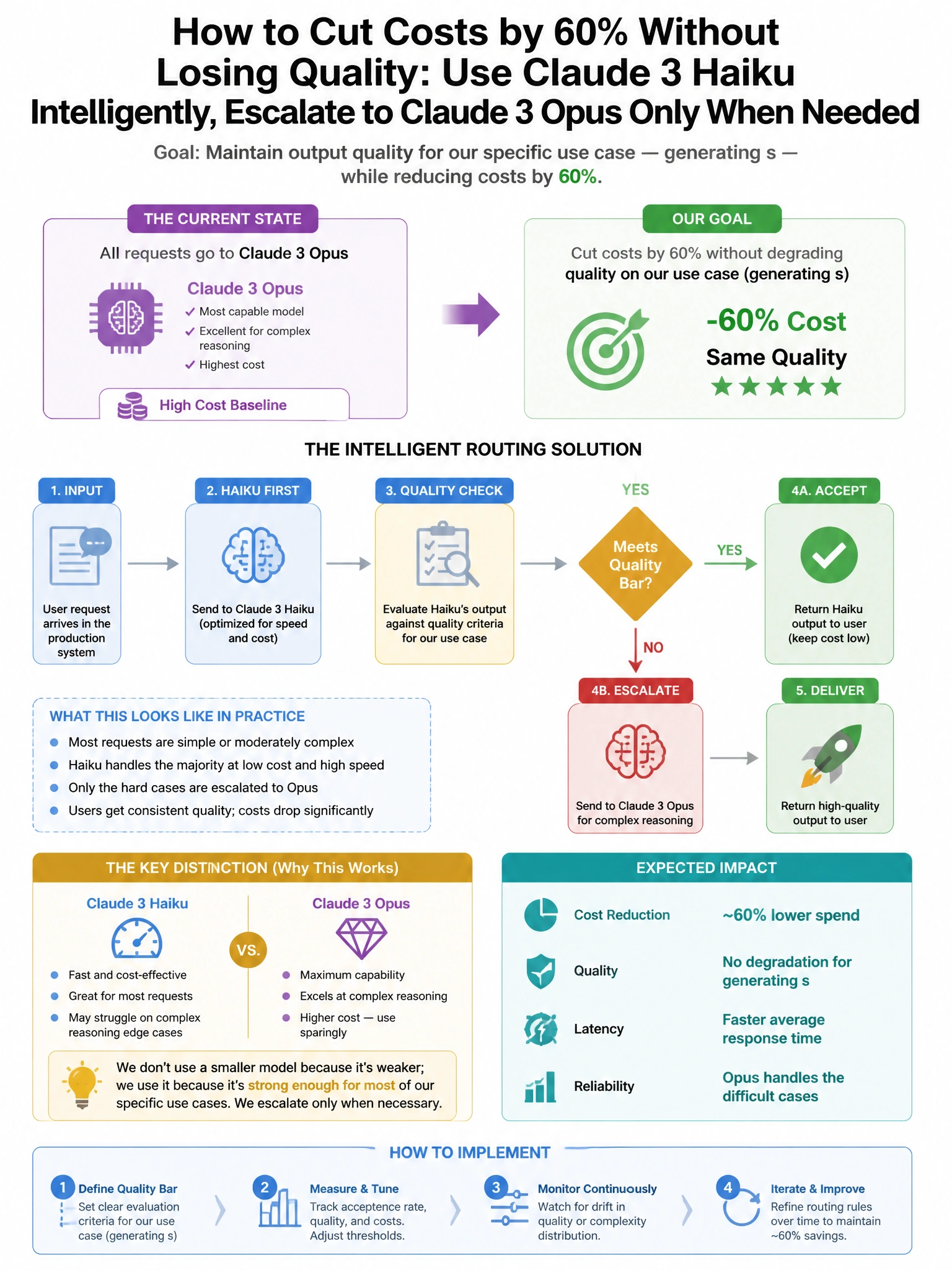
Short Explanation and Infographic
Here's the deal — before making a model downgrade decision, an architect must establish ground truth on quality equivalence for the specific task. Claude 3.5 Sonnet often matches or exceeds Opus on structured extraction tasks due to its improved training, and costs significantly less — but this must be validated on the actual dataset, not assumed.
Full explanation below image
Full Explanation
Before making a model downgrade decision, an architect must establish ground truth on quality equivalence for the specific task. Claude 3.5 Sonnet often matches or exceeds Opus on structured extraction tasks due to its improved training, and costs significantly less — but this must be validated on the actual dataset, not assumed. A/B benchmarking on representative samples quantifies the real quality delta and makes the business case defensible. Option A (immediate Sonnet switch) skips validation and risks quality regression on a production system. Option B (prompt caching) reduces costs but typically not by 60% if Opus remains the model; caching primarily helps with repeated system prompts. Option D (output caching) helps only for identical inputs, providing no savings on novel sales data which is the primary use case.