
An architect is designing a research assistant that must synthesize information from 50 academic papers simultaneously, each averaging 8,000 tokens. The system must identify contradictions across papers and generate a unified literature review. What is the primary architectural consideration?
Select an answer to reveal the explanation.
Short Explanation and Infographic
Here's the deal — 50 papers x 8,000 tokens = 400,000 tokens, which exceeds Claude's 200K context window. However, the right architectural response is not naive two-batch processing but selective retrieval: use embeddings to identify the most relevant papers for a given research question, retrieve the top 20-25 that fit the context window, and use that curated set.
Full explanation below image
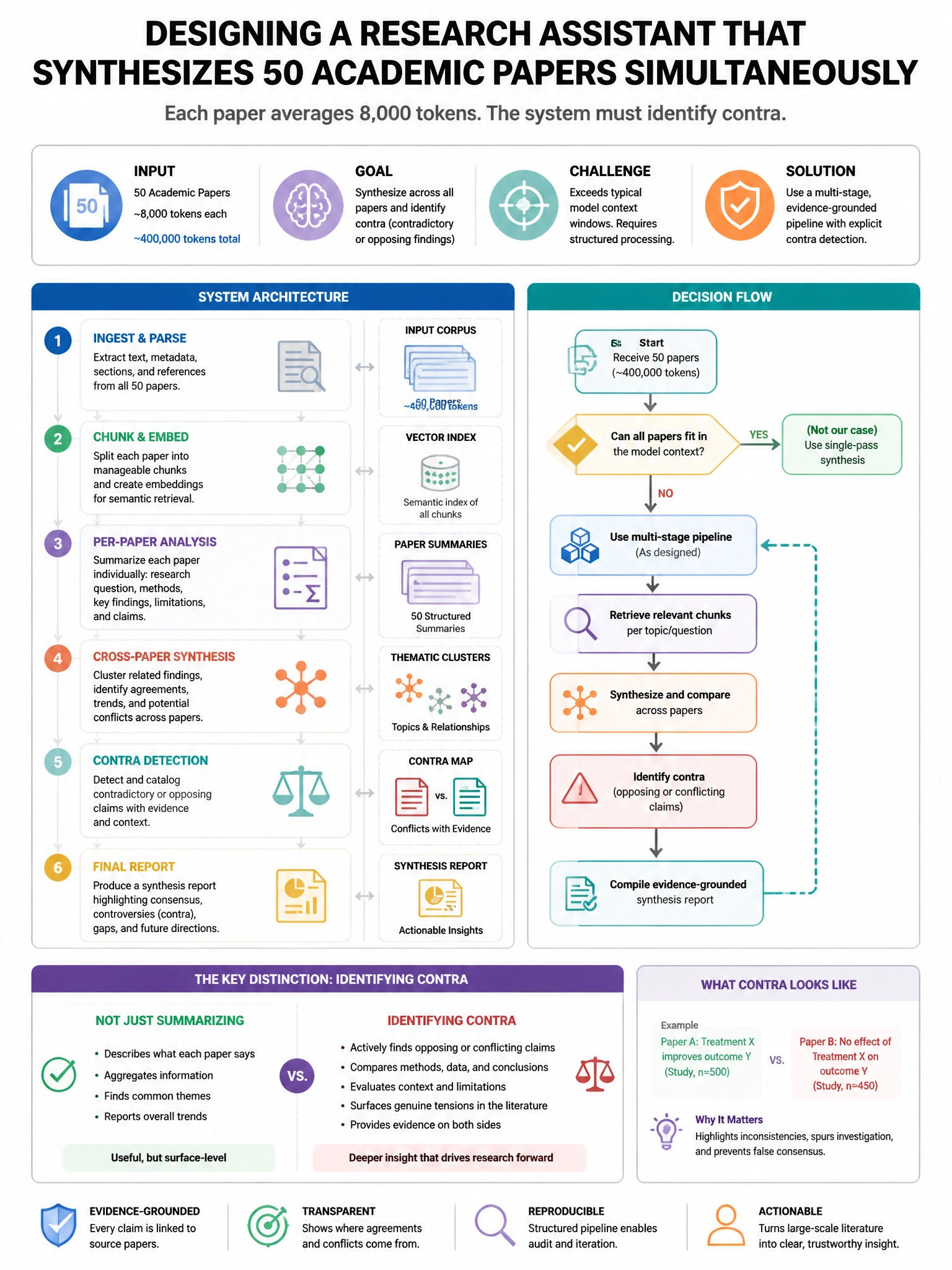
Full Explanation
50 papers x 8,000 tokens = 400,000 tokens, which exceeds Claude's 200K context window. However, the right architectural response is not naive two-batch processing but selective retrieval: use embeddings to identify the most relevant papers for a given research question, retrieve the top 20-25 that fit the context window, and use that curated set. This produces higher-quality synthesis than arbitrary batching because relevance filtering reduces noise. Option A is correct that the task exceeds the window but wrong that map-reduce is mandatory — selective retrieval is architecturally superior for synthesis tasks. Option B is factually incorrect — 400K tokens exceeds the 200K limit. Option C (two equal batches) loses cross-batch contradiction detection, which is the core requirement.