
A software team is choosing between Claude 3 Haiku, Claude 3.5 Haiku, and Claude 3.5 Sonnet for a real-time code autocomplete service embedded in an IDE. The primary requirements are sub-200ms p95 latency, code correctness, and cost efficiency at high volume. Which model is the most defensible choice?
Select an answer to reveal the explanation.
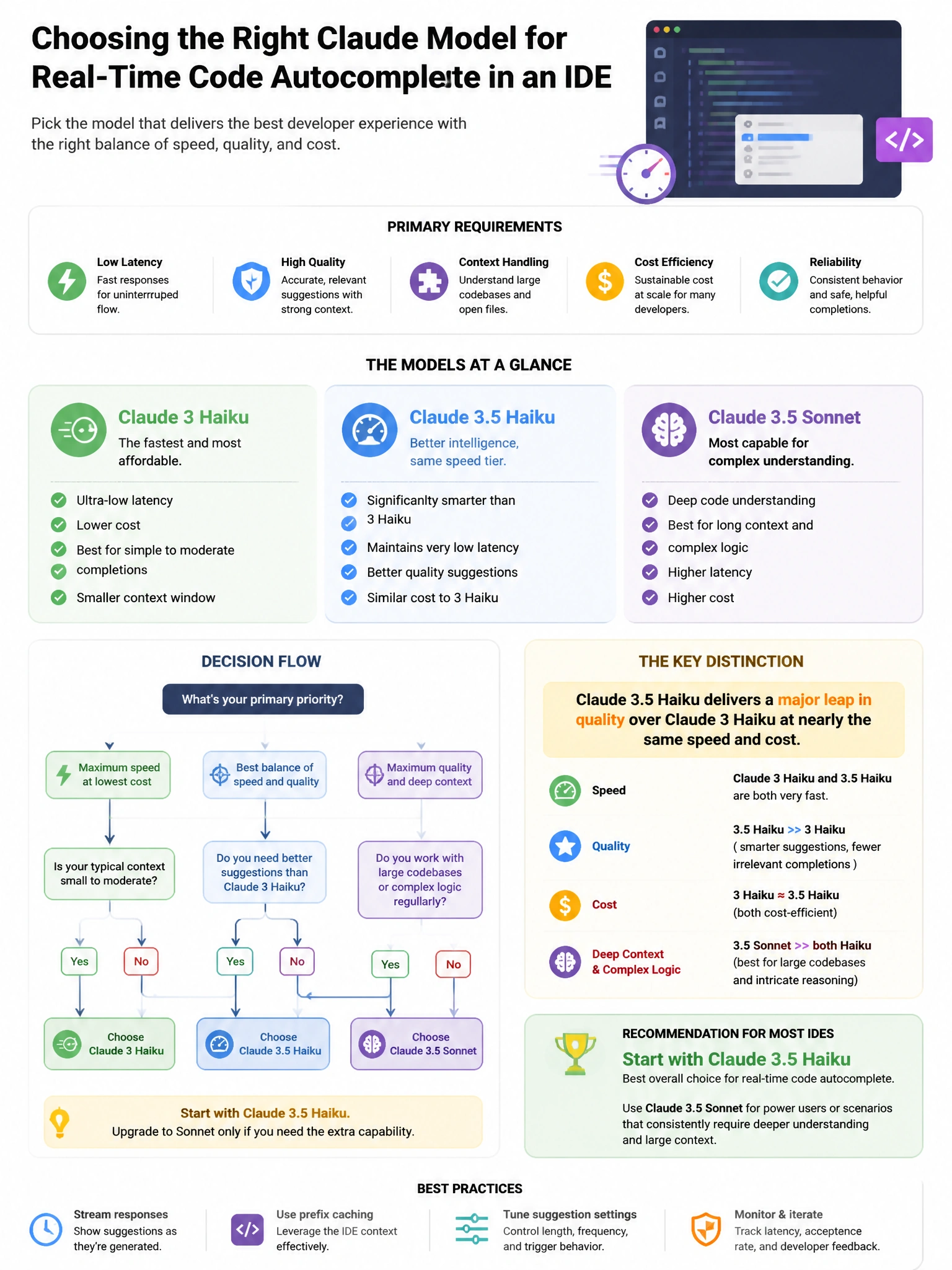
Short Explanation and Infographic
Here's the deal — claude 3.5 Haiku represents the optimal tradeoff: it substantially outperforms Claude 3 Haiku on coding tasks (reflecting the generational improvement of the 3.5 model family) while maintaining the low latency and cost characteristics of the Haiku tier. For a high-volume IDE autocomplete service where every millisecond matters, the 3.5 Haiku's improved intelligence-per-token-cost ratio makes it the best fit.
Full explanation below image
Full Explanation
Claude 3.5 Haiku represents the optimal tradeoff: it substantially outperforms Claude 3 Haiku on coding tasks (reflecting the generational improvement of the 3.5 model family) while maintaining the low latency and cost characteristics of the Haiku tier. For a high-volume IDE autocomplete service where every millisecond matters, the 3.5 Haiku's improved intelligence-per-token-cost ratio makes it the best fit. Option B (Claude 3 Haiku) is cheaper but sacrifices meaningful coding quality in the generational gap. Option C (Claude 3.5 Sonnet) likely exceeds latency requirements at scale and costs more per request. Option D adds architectural complexity (RAG) to paper over a model capability gap when a better model exists at comparable cost.