
A historic lime-works classifier needs a durable record of training-data origin, intended use, and known failure cases for the next auditor. Which governance artifact should they file?
Select an answer to reveal the explanation.
Short Explanation
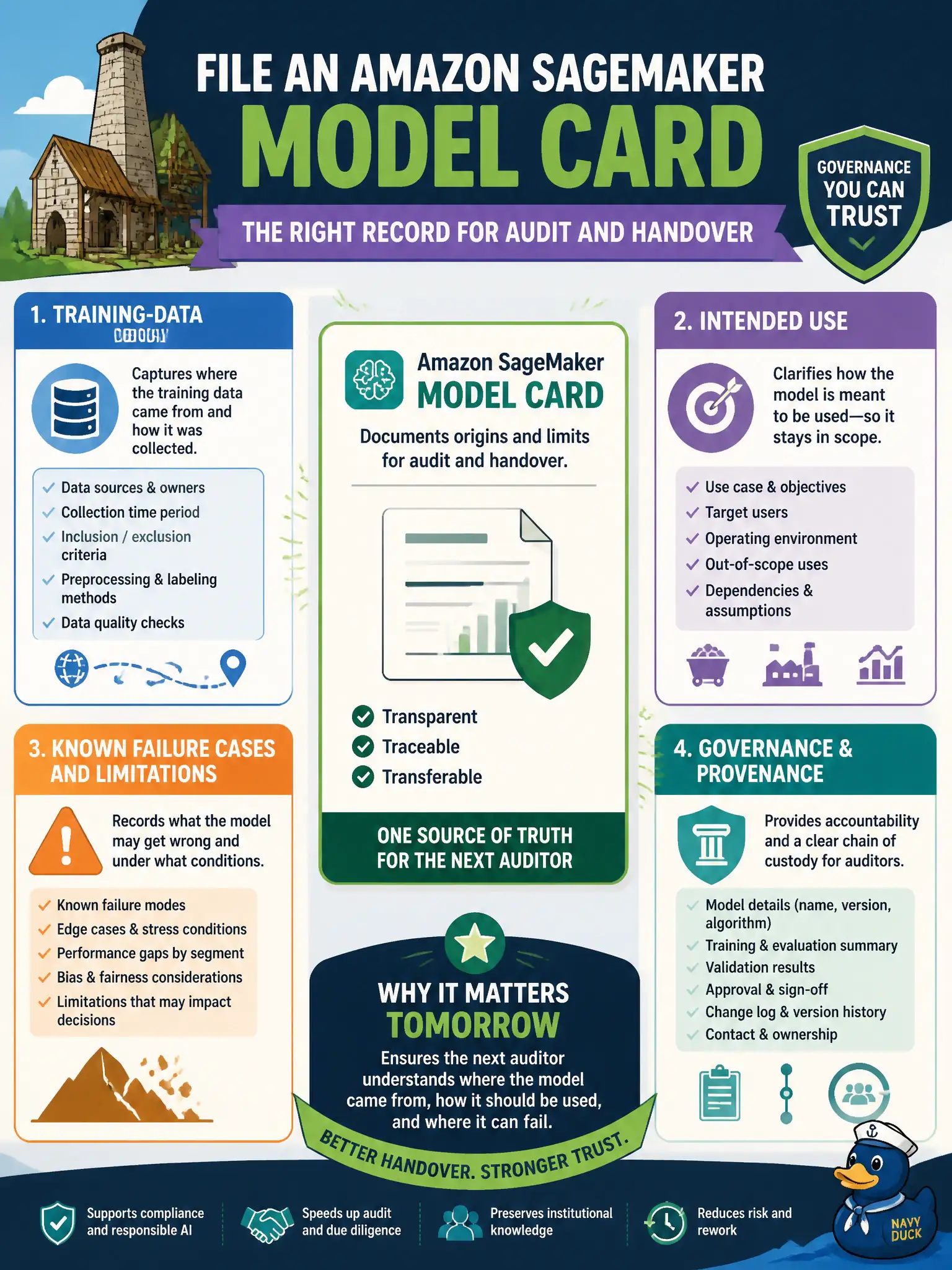
Think of a durable record of training-data origin, intended use, and known failures for the next auditor. File an Amazon SageMaker Model Card. A file named final_v7 is not that record.
Full Explanation
The historic lime-works classifier needs a durable record of training-data origin, intended use, and known failure cases for the next auditor. An Amazon SageMaker Model Card is the governance artifact designed for that handover: it documents origins, intended uses, and limitations so audit and operational ownership survive staff turnover at the works.
A Domain 4 explain-this-prediction essay with no origin record fails because local interpretability of one score does not preserve training provenance or intended-use boundaries for auditors. A laptop file named final_v7 with no intended-use line fails because informal filenames are not durable, discoverable governance records that an auditor can trust. Amazon Polly fails because speech synthesis is not a model card or provenance registry.
Exam caveat: a model card that is never updated after retraining becomes misleading—treat the card as a living release artifact versioned with the model binary and evaluation report. Operational check: file a SageMaker Model Card (or equivalent) that lists data origin, intended use, and known failures; link it from the lime-works runbook; and require card updates in the same change ticket as model promotion before the next auditor review.