
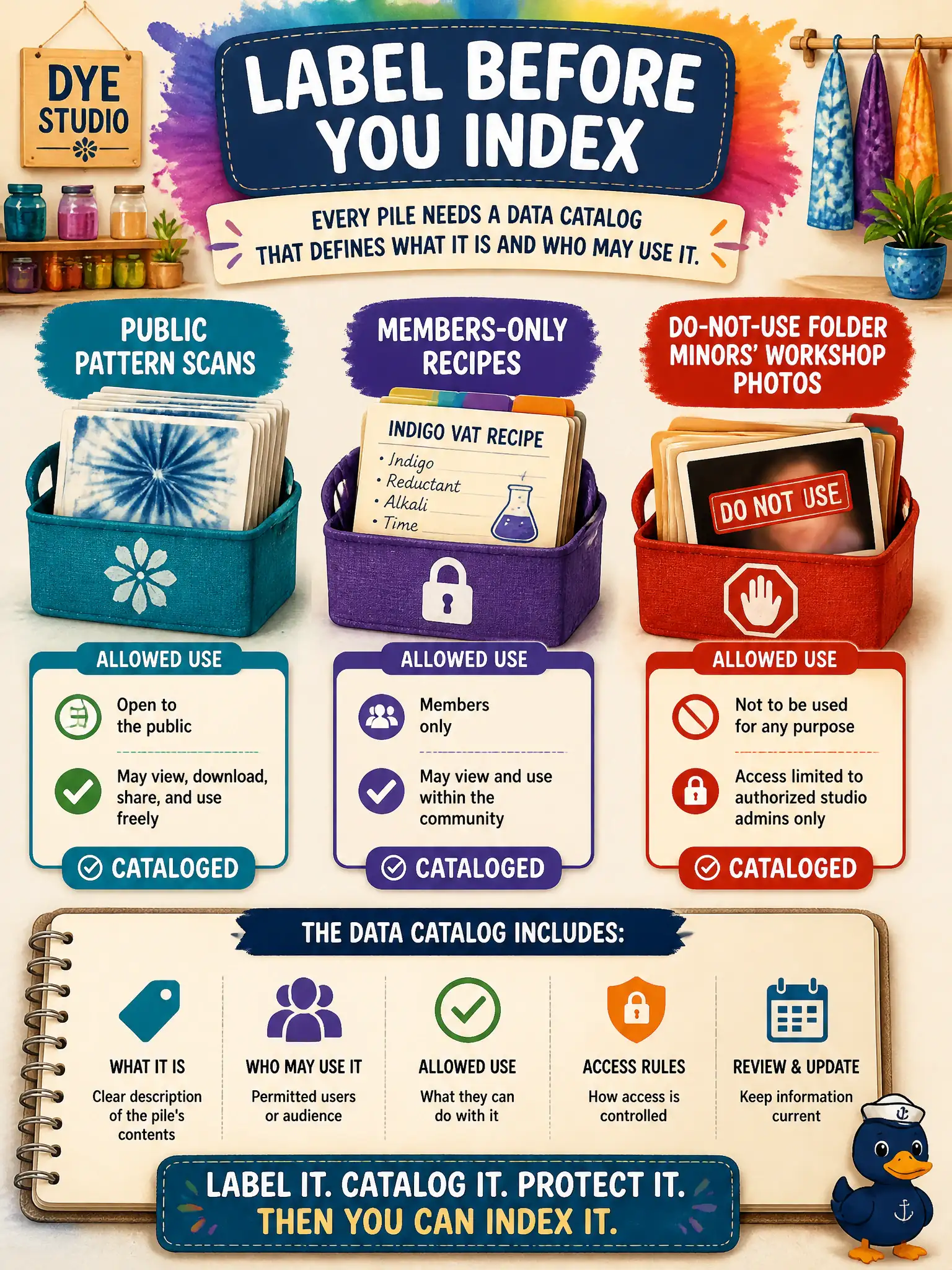
A community dye-studio has three piles: public pattern scans, members-only recipes, and a do-not-use folder of minors’ workshop photos. What must mark each pile’s allowed use before anything is indexed or fitted?
Select an answer to reveal the explanation.
Short Explanation
Think of public scans, members-only recipes, and a do-not-use folder of kids’ photos. Catalog each pile’s allowed use before anything is indexed. Catalog later is too late.
Full Explanation
The community dye-studio has three piles—public pattern scans, members-only recipes, and a do-not-use folder of minors' workshop photos. Before anything is indexed or fitted, a data catalog must mark what each pile is and who may use it. Cataloguing use rights and sensitivity up front prevents the do-not-use photos from entering embeddings and keeps members-only recipes out of public retrieval paths.
Indexing all three piles first and cataloguing later fails because once vectors and caches exist, removal is slower, incomplete, and already a privacy incident for minors' photos. A dashboard title fails because charts are not use-rights labels on corpora. Raising temperature so the do-not-use folder labels itself fails because sampling parameters do not classify or restrict datasets.
Exam caveat: catalog entries must be enforced by access controls and ingest filters—labels without technical gates will be ignored under deadline pressure. Operational check: register each pile in the catalog with allowed purposes and principals, block the do-not-use folder from the AI ingest role, dual-control any change that expands members-only recipes to public indexes, and audit the indexer allow-list before every corpus refresh.