
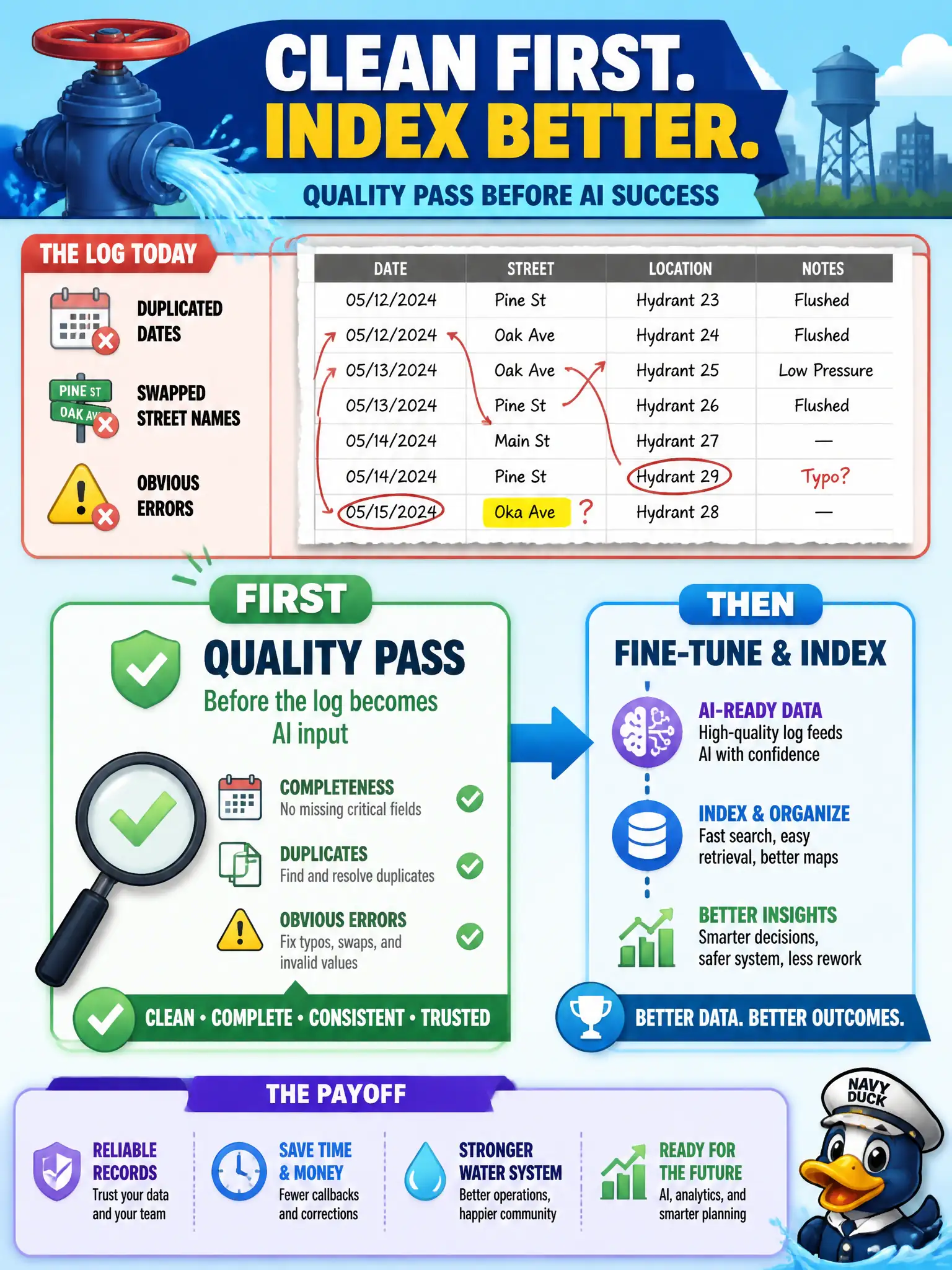
A municipal valve-flush log is full of duplicated dates and swapped street names. Staff want to fine-tune or index it anyway. What should happen first?
Select an answer to reveal the explanation.
Short Explanation
Think of a valve-flush log full of duplicated dates and swapped street names. Run a quality pass before it becomes an AI input. Do not throw the dirty log at the model first.
Full Explanation
The municipal valve-flush log is full of duplicated dates and swapped street names, yet staff want to fine-tune or index it anyway. What should happen first is a quality pass for completeness, duplicates, and obvious errors before the log becomes an AI input. Garbage in becomes confident garbage out: duplicated flushes distort frequencies, and swapped streets can misdirect field crews relying on the helper.
Throwing the dirty log at the model now and skipping the quality pass fails because training or indexing will encode the errors at scale across future answers. Raising temperature so swapped street names correct themselves fails because decoding temperature does not repair source data or municipal street registries. A dashboard title fails because charts do not assess completeness or deduplicate flush events in the source extract.
Exam caveat: automated cleaning can delete legitimate rare events—pair rules with spot checks by someone who knows the valve network before discarding outliers. Operational check: run duplicate detection on dates and assets, flag street-name mismatches against the official street list, quarantine suspect rows, and only then permit fine-tune or knowledge-base ingest from the cleaned valve-flush extract.