
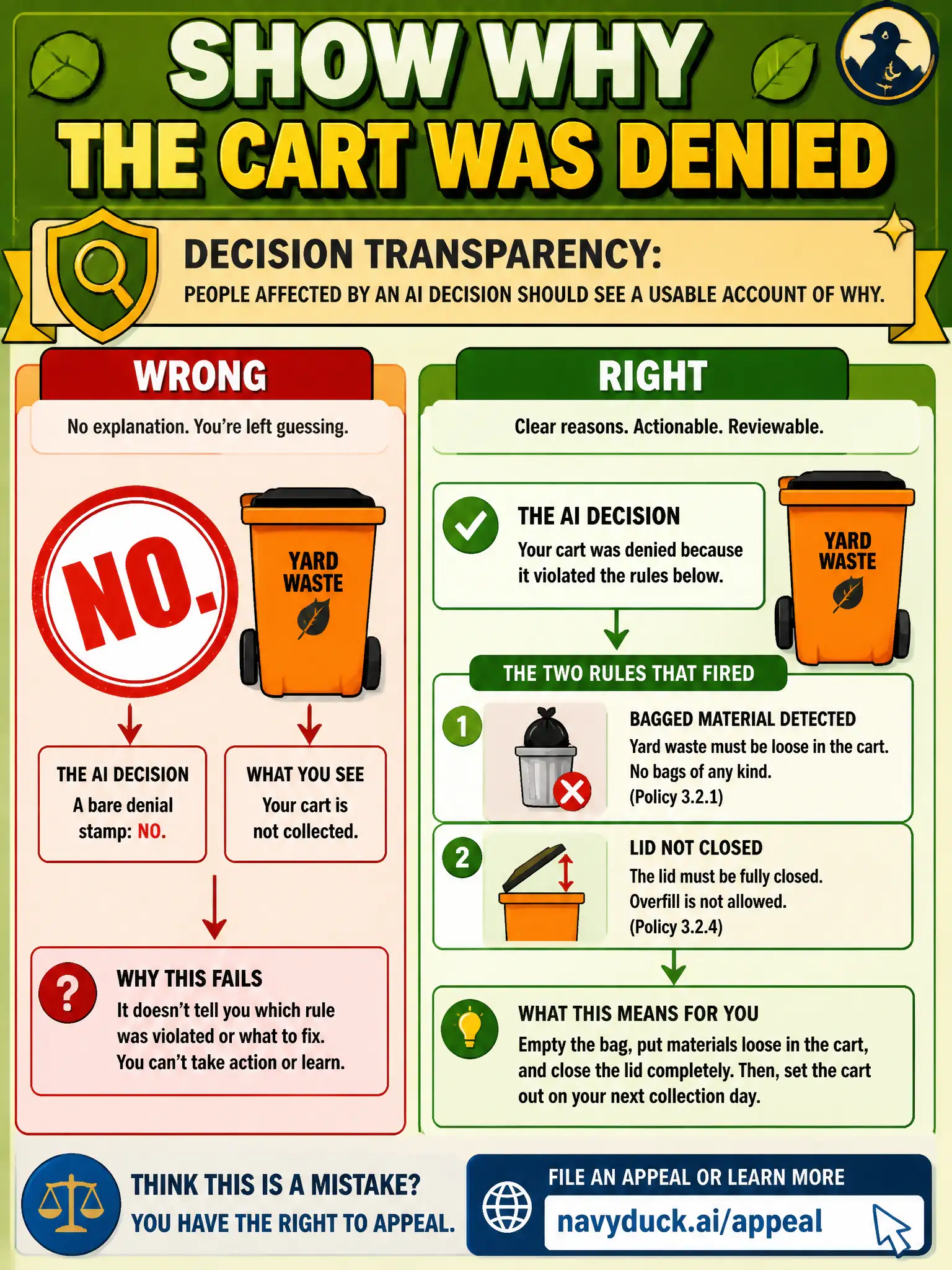
A municipal yard-waste household that was denied a larger cart sees only No. A redesign shows the two posted rules that fired and a link to appeal. Which human-centered requirement is that?
Select an answer to reveal the explanation.
Short Explanation
Think of a denied larger cart that used to say only No. Now the household sees the two posted rules that fired and a link to appeal. That is decision transparency. Affected people need a usable why.
Full Explanation
When a municipal yard-waste household is denied a larger cart, a one-word "No" leaves people without a usable account of why. Redesigning the experience to show the two posted rules that fired and a link to appeal is decision transparency. Human-centered AI requires that people affected by automated decisions can understand the grounds well enough to contest or correct them—not merely receive an opaque outcome.
Insisting a one-word No is enough fails because affected residents cannot check whether the right rule applied or whether household facts were misread. Treating the appeal link as a new foundation model fails because transparency and recourse are product and policy features, not training runs. Treating posted rules as prompt caching fails because static prefix reuse is an inference optimization, not an explanation or appeal path for a denied cart.
Exam caveat: usable reasons must be faithful to the actual decision logic; a polished narrative that does not match the rules that fired is worse than a terse but accurate citation. Operational check: for every denial, persist the rule identifiers shown to the household, verify they match the engine's fired rules in logs, and test that the appeal link reaches a human queue that can overturn bad applications of those rules.