
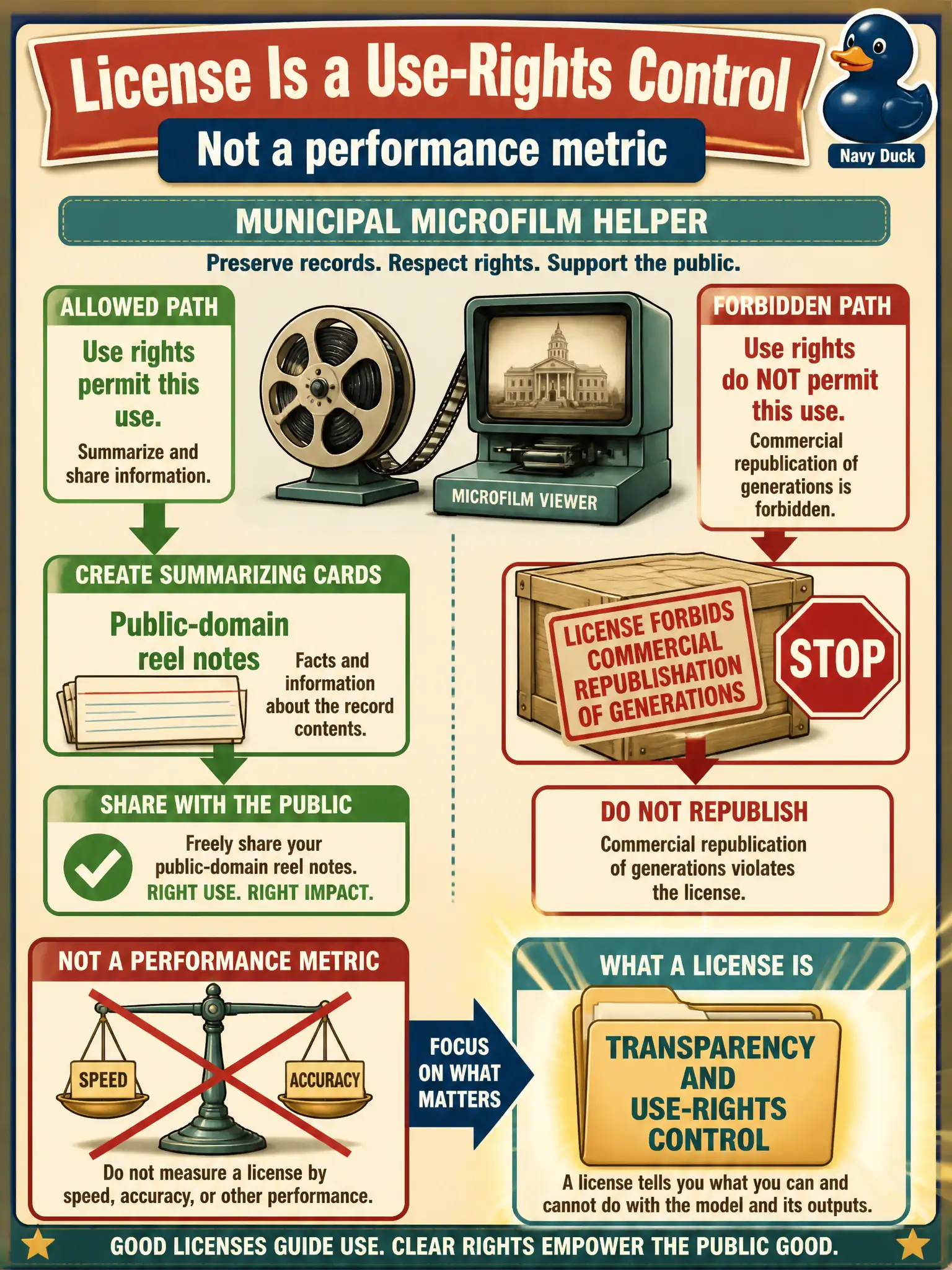
A municipal microfilm helper may summarize public-domain reel notes but must not ship a model whose license forbids commercial republication of generations. What should the team treat the license as?
Select an answer to reveal the explanation.
Short Explanation
Think of a helper that must not ship a model whose license forbids commercial republication. Treat the license as a use-rights control. It is not a ROUGE score or a leaderboard.
Full Explanation
A municipal microfilm helper that may summarize public-domain reel notes still has a hard constraint: it must not ship a model whose license forbids commercial republication of generations. The license is a transparency and use-rights control. It tells the team what they may redistribute, whether commercial use is allowed, and what attribution or share-alike duties apply. That is a governance gate on the product, not a quality score on the summaries.
Treating the license as a ROUGE score fails because ROUGE measures n-gram overlap between generated text and references; it says nothing about legal permission to republish. Treating it as an accuracy benchmark or public leaderboard fails because leaderboards rank task performance, not the right to commercially redistribute model outputs. Treating it as a latency budget fails because milliseconds of response time do not encode forbidden republication clauses.
Exam caveat: a strong benchmark result can coexist with a license that blocks the municipality's intended deployment path—performance never overrides rights. Operational check: before promotion, log the exact license identifier, paste the commercial-use and republication clauses into the change ticket, and block release if those clauses conflict with how the microfilm helper will publish generations to the public.