
A historic farrier education desk must show the board how two Bedrock models behave on the same safety and faithfulness checks, with a paper trail. Which AWS feature supplies that evidence?
Select an answer to reveal the explanation.
Short Explanation
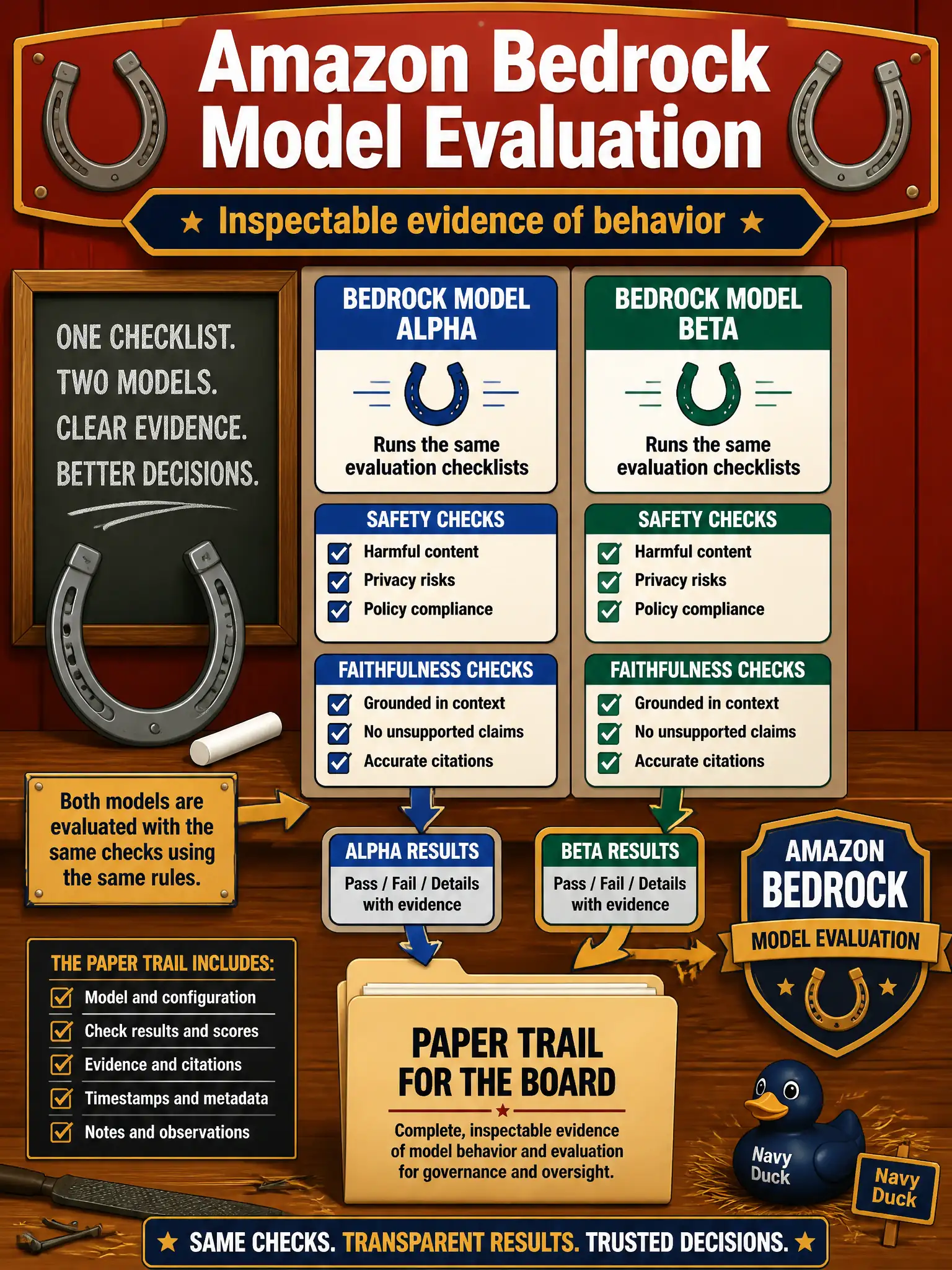
Think of showing the board how two Bedrock models behave on the same safety and faithfulness checks. Amazon Bedrock Model Evaluation is that paper trail. A lone ROUGE number is not.
Full Explanation
A historic farrier education desk that must show the board how two Bedrock models behave on the same safety and faithfulness checks, with a paper trail, should use Amazon Bedrock Model Evaluation as inspectable evidence of behavior. Model evaluation jobs compare candidates on defined metrics and prompts and retain results you can present—exactly the governance artifact a board needs—rather than anecdotes. Responsible selection between foundation models is evidence-driven when safety and faithfulness matter for education content.
A single ROUGE number with no paper trail and no safety check fails because lexical overlap alone does not measure safety or faithfulness and lacks an auditable comparison design. Relying on charts alone (without a named model-evaluation comparison) fails if there is no underlying evaluation job producing comparable safety and faithfulness results; a dashboard without that methodology is not the evidence. A laptop chat log with no named comparison fails because informal chats are not a controlled, repeatable evaluation of two models on the same checks.
Exam caveat: evaluation quality depends on the prompt set and rubrics—if safety cases are missing from the eval, the paper trail will not show the risks the board cares about. Operational check: define a shared prompt suite covering safety refusals and faithfulness to farrier curriculum sources, run Bedrock Model Evaluation on both models, archive the report with dates and versions, and present side-by-side results before the board selects a default model.