
A community maple-coop wants a single place that records a SageMaker-hosted classifier’s purpose, data snapshot, metrics, and known limits before the spring season. Which tool fits?
Select an answer to reveal the explanation.
Short Explanation
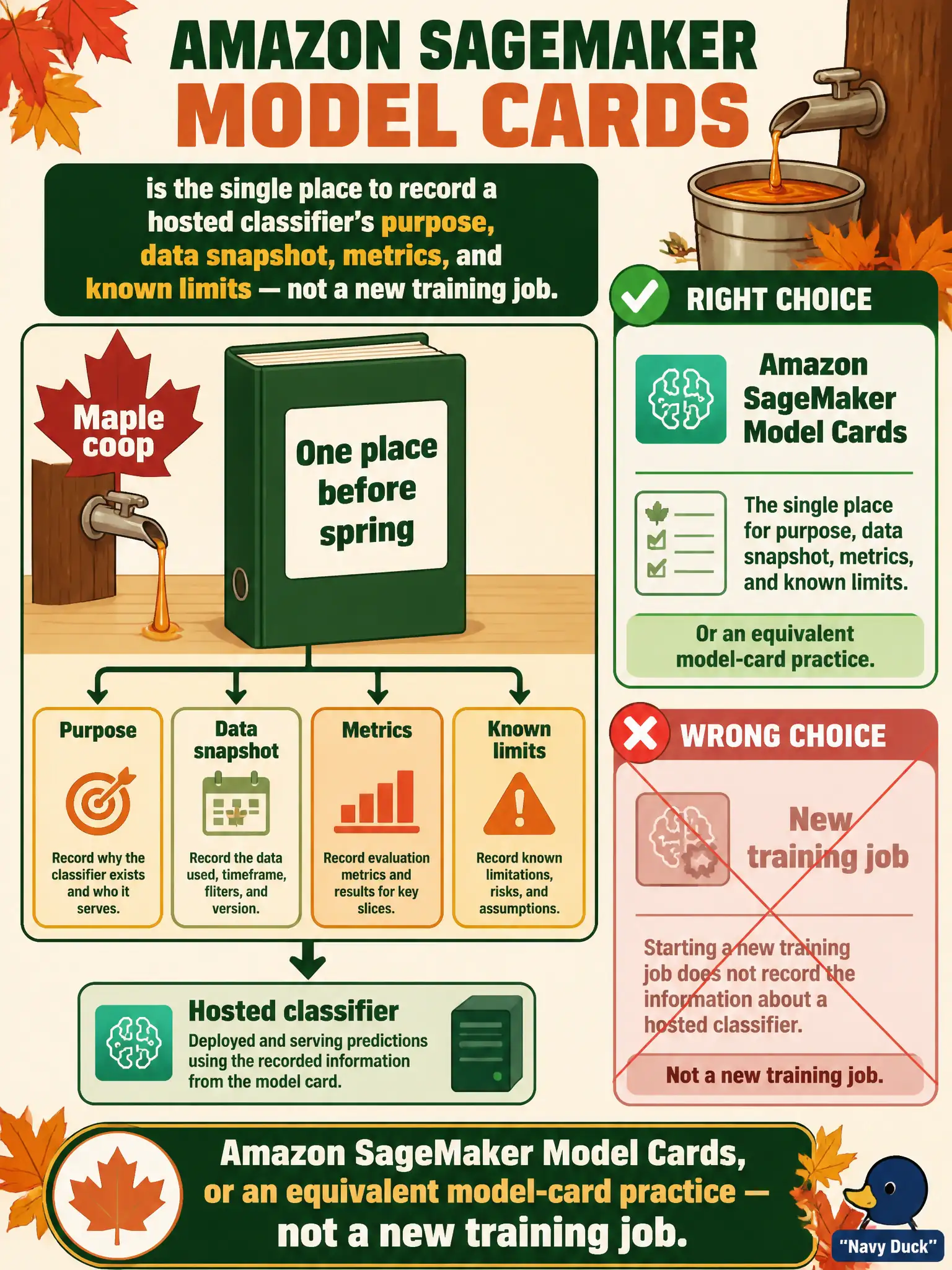
Think of one place for purpose, data snapshot, metrics, and known limits before maple season. Amazon SageMaker Model Cards, or the same practice. A new training job and a filename are not that card.
Full Explanation
A community maple-coop that needs one place recording a SageMaker-hosted classifier’s purpose, data snapshot, metrics, and known limits before spring should use Amazon SageMaker Model Cards or an equivalent model-card practice. Model cards centralize intended use, evaluation results, and limitations so seasonal operators can govern the classifier without hunting tribal knowledge. That is documentation and transparency tooling—not a substitute training job.
Starting a new training job fails because updating weights does not produce the governed narrative of purpose, data, metrics, and limits; documentation is not a weight update. Amazon Polly fails because text-to-speech synthesizes audio; it does not store model purpose and limitation cards for a classifier. A laptop filename such as final_v7 fails because a local name is not a published model card with the required fields.
Exam caveat: creating an empty card template is insufficient—fields must be filled with the actual data snapshot, metrics, and limits for the spring deployment version. Operational check: complete a SageMaker Model Card (or equivalent) for the hosted classifier, peer-review the limits section with coop operators, attach evaluation metrics from the latest test set, and require the card to be approved before enabling spring-season inference.