
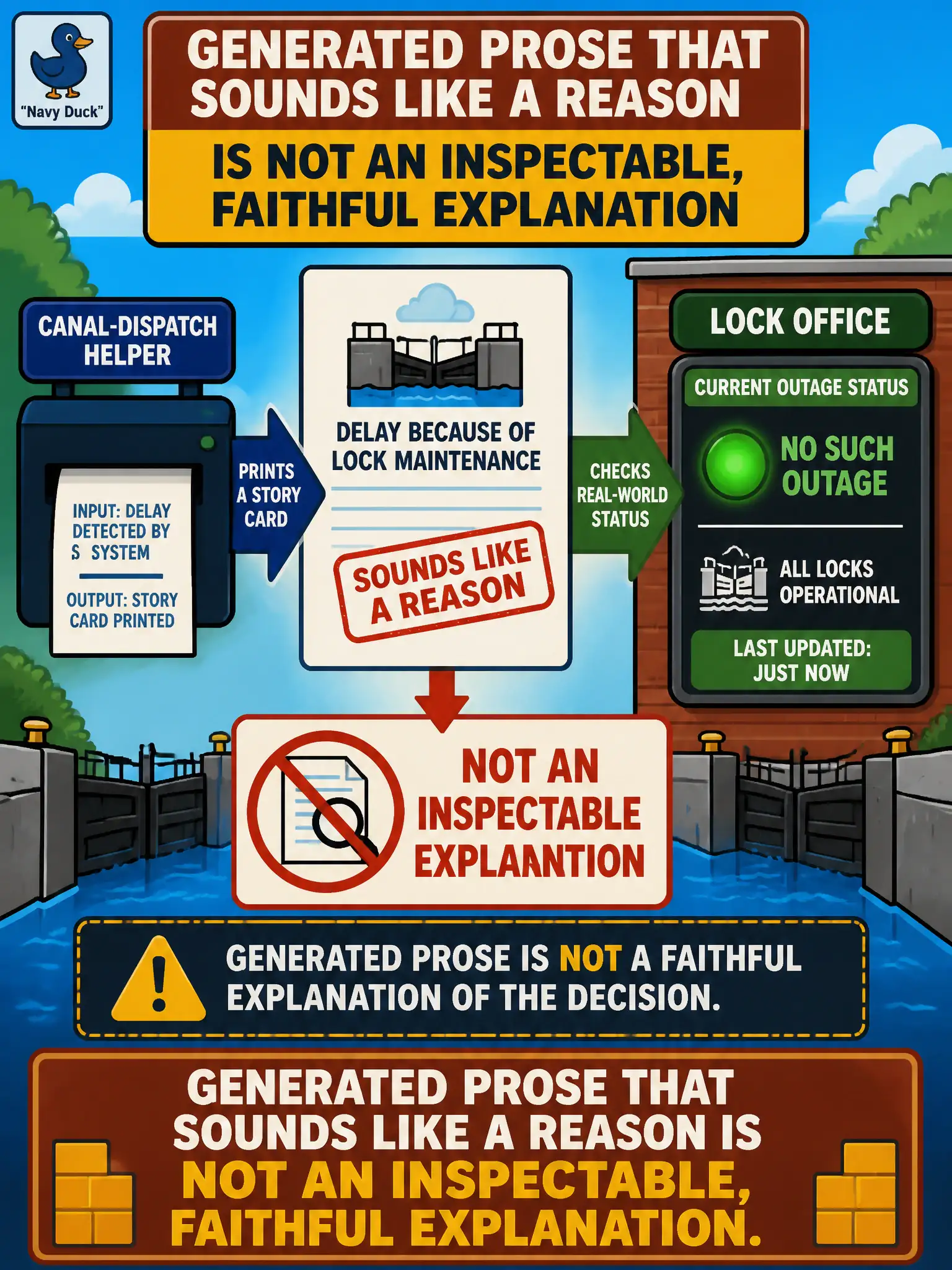
A municipal canal-dispatch helper prints a confident delay because of lock maintenance story. The lock office has no such outage. Why is that story not an explanation of the model’s decision?
Select an answer to reveal the explanation.
Short Explanation
Think of a confident lock-maintenance delay when the lock office has no outage. A story that sounds like a reason is not an inspectable explanation. Fluency and confidence are not a reason trail.
Full Explanation
A municipal canal-dispatch helper that prints a confident “delay because of lock maintenance” story when the lock office has no such outage shows why generated prose is not an inspectable, faithful explanation of the model’s decision. Sounding like a reason is not the same as exposing the features, retrievals, or rules that produced the output; fluency and confidence can accompany fabricated causes. True explainability requires faithful, verifiable rationale tied to system state—not a plausible narrative.
Assuming a fluent paragraph is always a faithful explanation if it names a lock fails because naming an entity does not prove causal grounding in live lock status. Equating confidence with an inspectable reason trail fails because confidence scores do not show which evidence was used or whether it was true. Calling a missing outage a font problem fails because typography is unrelated to explainability or factual grounding failures.
Exam caveat: asking the model to “explain itself” in natural language often yields another hallucination layer; prefer structured attributions, retrieved status records, or inherently interpretable policies for dispatch decisions. Operational check: require delay causes to resolve against lock-office status feeds before publication, compare generated causes to those feeds on a daily audit, and suppress free-text causal stories that cannot cite a current outage record.