
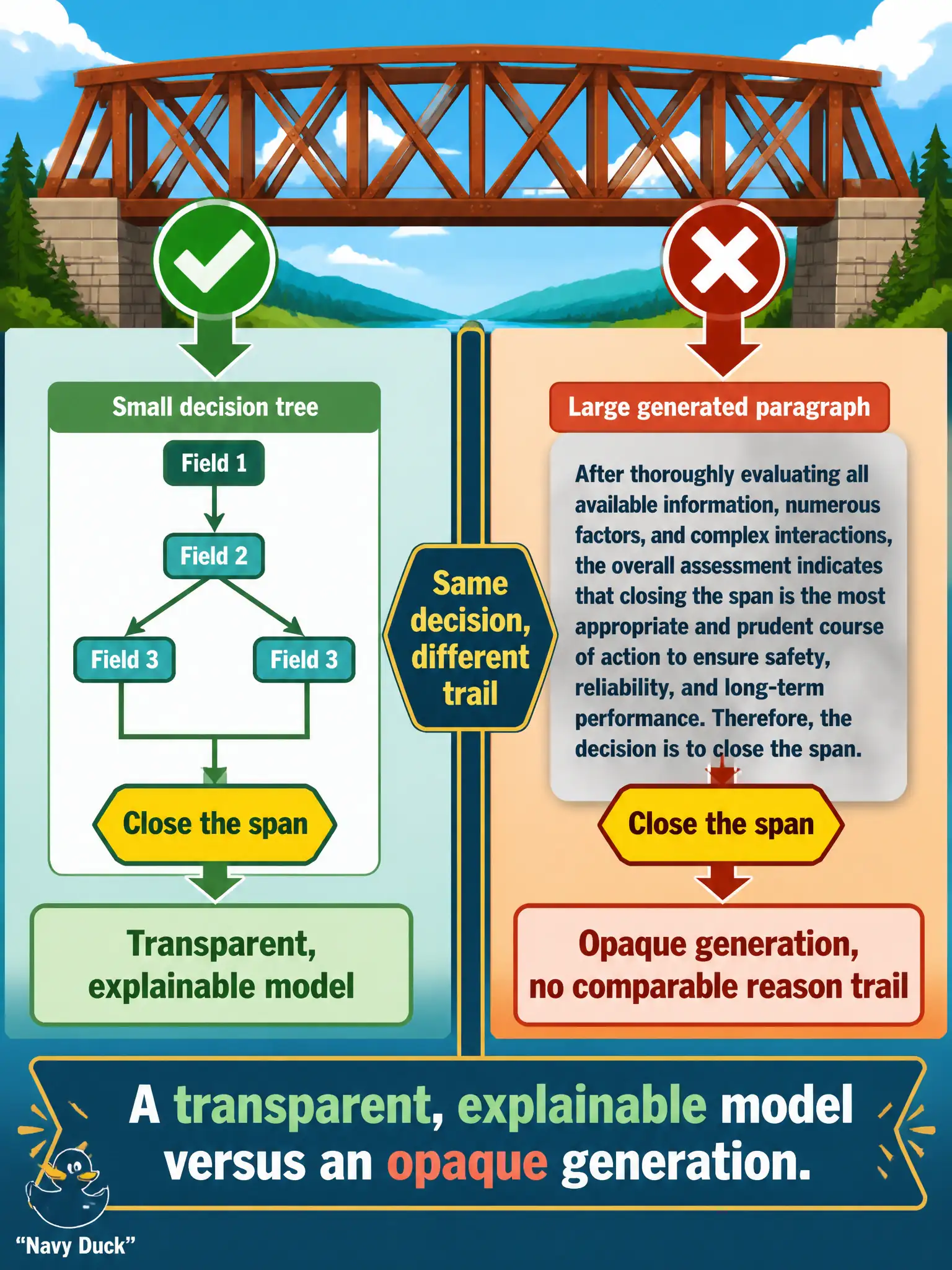
A historic trestle committee can list the three inspection fields that pushed a small decision-tree toward close the span, but cannot list any comparable reason trail for a large generated paragraph that says the same thing. What contrast is that?
Select an answer to reveal the explanation.
Short Explanation
Think of a small tree that can name the three inspection fields, versus a large paragraph that cannot. That is a transparent, explainable model versus an opaque generation. Fluency is not a reason trail.
Full Explanation
A historic trestle committee that can list the three inspection fields driving a small decision tree to close the span—but cannot extract a comparable reason trail from a large generated paragraph saying the same thing—illustrates transparent, explainable modeling versus opaque generation. Classical trees expose feature contributions; unconstrained generative text may be fluent without faithful, inspectable linkage to the inspection fields. When committees must justify safety closures, explainability is a functional requirement, not a nice-to-have.
Claiming both systems are equally explainable fails because a paragraph that merely asserts closure does not list the three governing fields unless the system is designed to emit faithful attributions. Reducing the contrast to cost-per-token fails because opacity is about inspectability of reasons, not unit price. Calling it only a latency contrast fails because a reason trail is about accountability, not milliseconds.
Exam caveat: post-hoc text that “explains” a black box can itself be unfaithful—prefer models that are interpretable by design when documentation of why is mandatory for safety decisions. Operational check: for each close-the-span recommendation, require export of the triggering inspection fields and thresholds from the tree (or an equivalent structured rationale), reject free-form generations that cannot cite those fields, and archive the reason trail with the committee minutes.