
A community kayak-livery waiver helper posts a high overall correct-waiver rate, but errors cluster on renters whose names use diacritics and on same-day walk-ups. What should the team ask for?
Select an answer to reveal the explanation.
Short Explanation
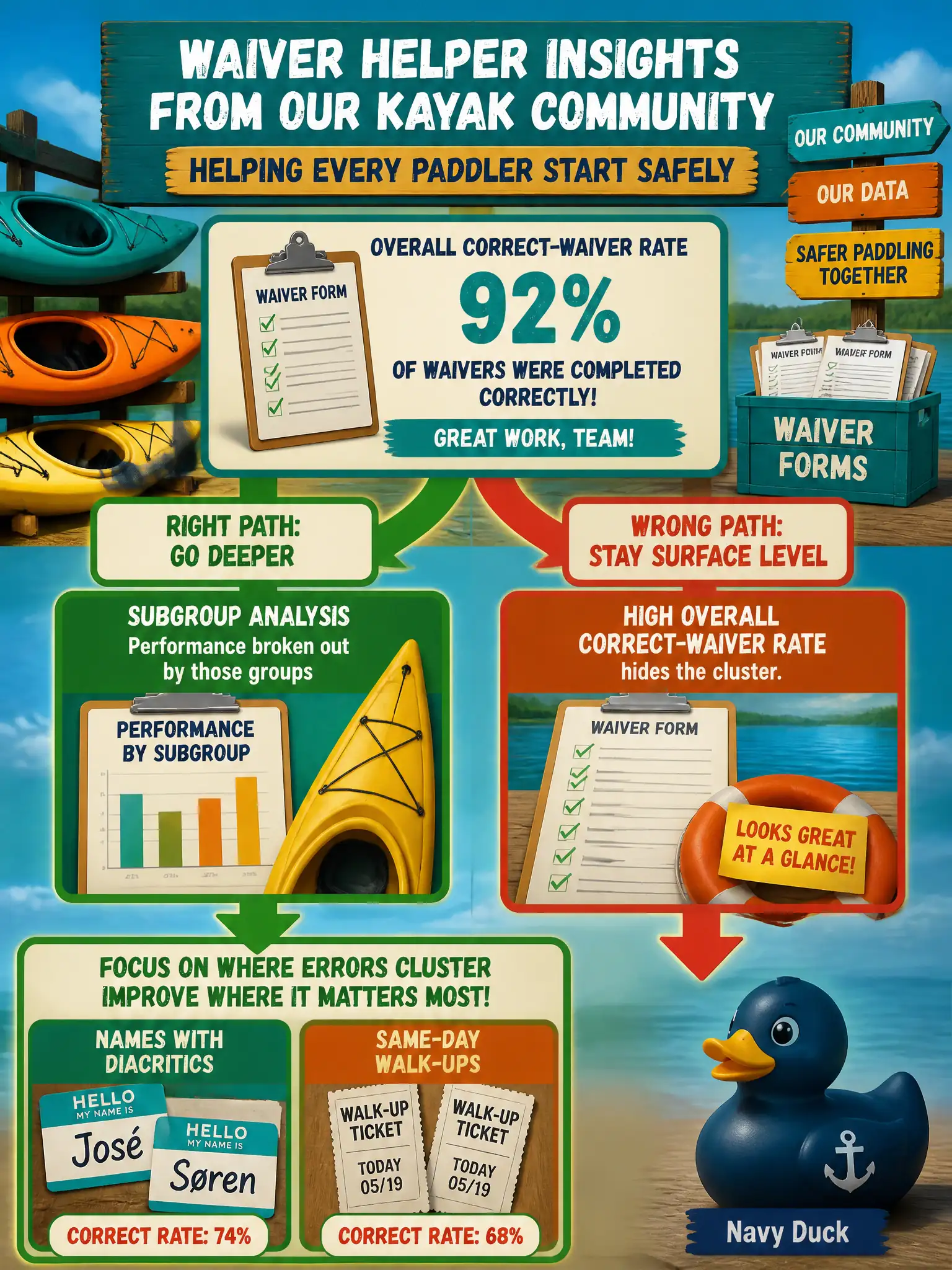
Think of a high overall waiver rate with errors piled on diacritic names and same-day walk-ups. Ask for subgroup analysis. The headline number conceals that cluster.
Full Explanation
A kayak-livery waiver helper with a high overall correct-waiver rate but errors clustered on diacritic names and same-day walk-ups needs subgroup analysis: break performance out by those groups rather than trusting the headline. Concentrated failures on name orthography and walk-up timing are classic hidden disparities; responsible teams report and act on group-level error rates. Overall success can coexist with unacceptable harm to identifiable renter segments.
Relying only on the headline rate fails because aggregate accuracy conceals the cluster on diacritic and walk-up cohorts. Treating diacritics as merely a font change fails: encoding and model handling of names are data/model issues, and errors there are real incorrect waivers, not typeface cosmetics. Prompt caching fails because walk-up timing problems are not solved by reusing a static prefix; caching does not fix subgroup error patterns.
Exam caveat: subgroups must be chosen carefully—privacy and sample size matter—but ignoring obvious operational cohorts (name scripts, walk-ups) is not acceptable monitoring. Operational check: compute waiver error rates for diacritic versus ASCII names and for advance bookings versus same-day walk-ups, inspect failure transcripts, improve normalization and training coverage, and block rollout until subgroup rates meet the same bar as the overall rate.