
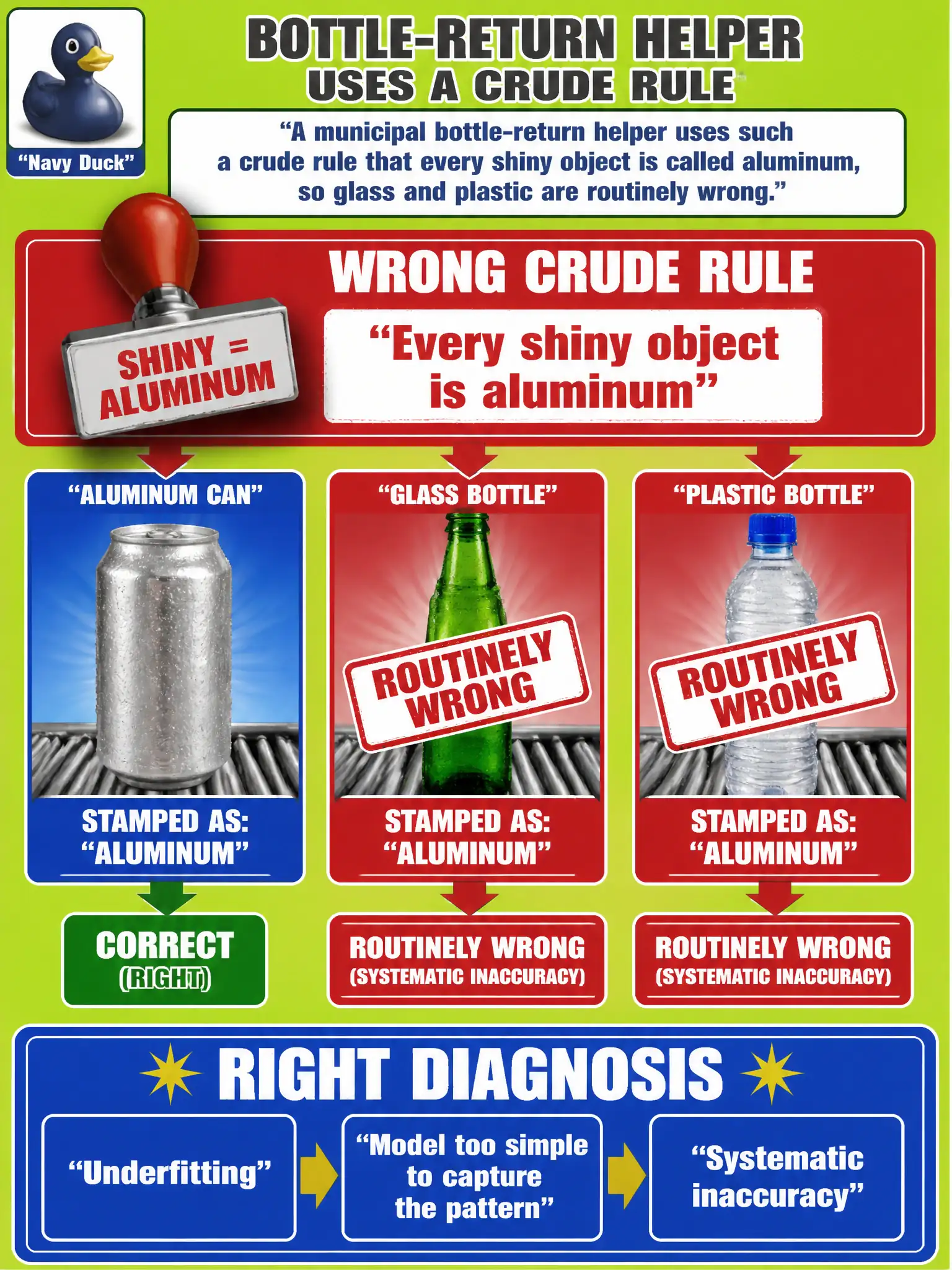
A municipal bottle-return helper uses such a crude rule that every shiny object is called aluminum, so glass and plastic are routinely wrong. Which effect is that?
Select an answer to reveal the explanation.
Short Explanation
Think of a bottle-return helper that calls every shiny object aluminum. That is underfitting, a model too simple to see the pattern. It is not last January’s memorized IDs.
Full Explanation
A municipal bottle-return helper that uses such a crude rule that every shiny object is called aluminum shows underfitting: the model is too simple to capture the pattern, so glass and plastic are systematically wrong. Underfit systems miss relevant features (material cues beyond shininess) and produce consistent errors across many inputs. The remedy is richer features or a more expressive model and better labeled examples—not celebrating a one-rule heuristic.
Calling it overfitting fails because overfitting memorizes fine detail (for example, last January’s IDs); a crude one-rule shiny→aluminum map is the opposite—insufficient complexity. Blaming a GPU shortage fails because hardware count does not define whether the decision rule is expressive enough for materials. Prompt Management fails because versioning stored prompts does not turn an under-expressive classifier into one that separates glass, plastic, and aluminum.
Exam caveat: adding capacity alone can swing past the sweet spot into overfitting if labels are noisy—pair model richness with clean material labels and validation. Operational check: build a confusion matrix across aluminum, glass, and plastic on a labeled bin sample, confirm high systematic shiny-object errors, then retrain with additional features or examples and require per-material precision/recall thresholds before redeploying on the return line.