
A municipal breakwater-station log summarizer recites last January’s incident IDs almost verbatim and fails on this week’s new icing pattern. Which bias-and-variance effect is that?
Select an answer to reveal the explanation.
Short Explanation
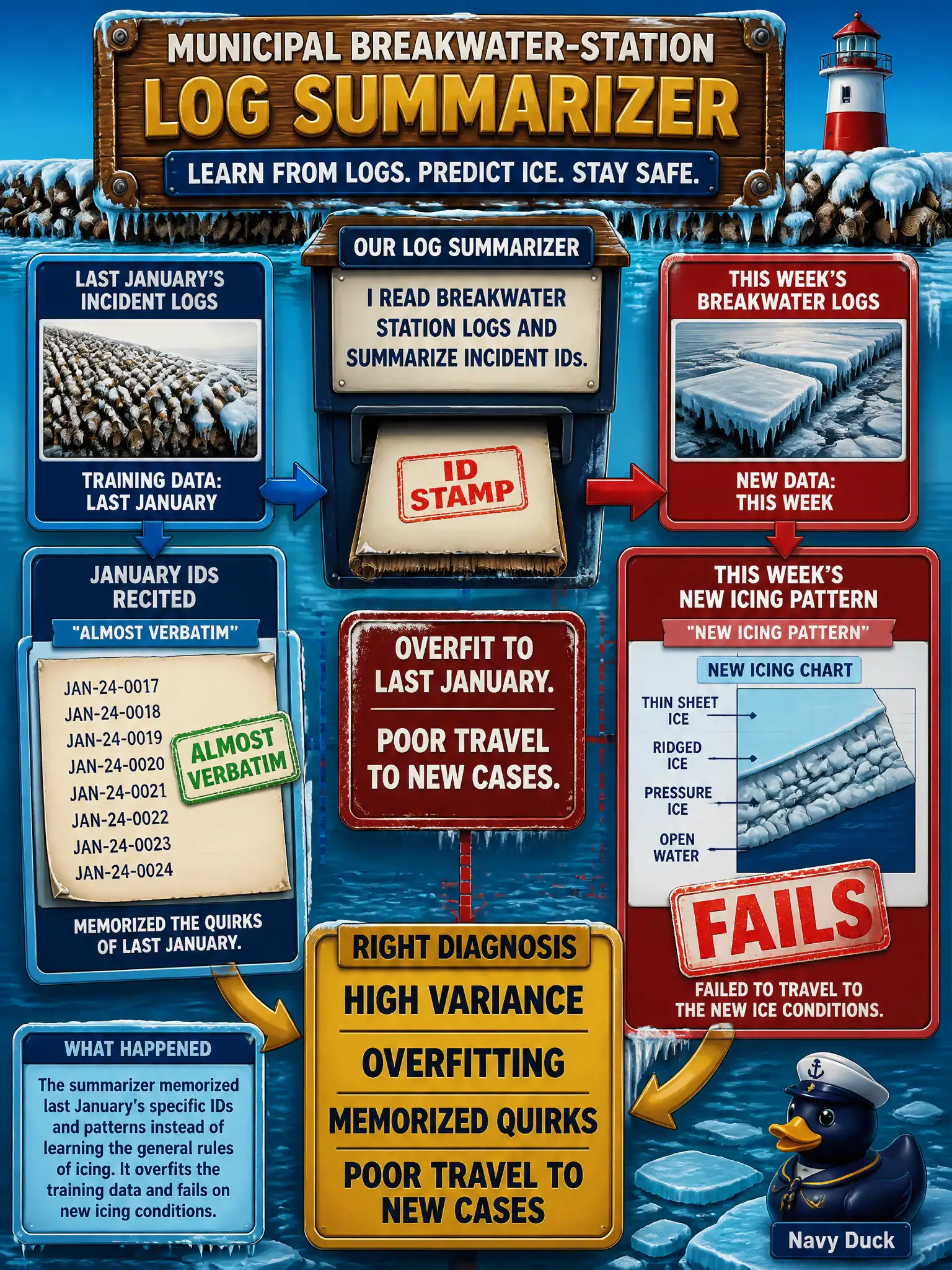
Think of a summarizer reciting last January’s incident IDs and missing this week’s icing. That is high variance, or overfitting. Memorized quirks do not travel.
Full Explanation
A municipal breakwater-station log summarizer that recites last January’s incident IDs nearly verbatim yet fails on this week’s new icing pattern shows high variance, or overfitting: the model memorized training quirks instead of learning transferable structure. Overfit systems look strong on familiar IDs and collapse on new seasonal patterns, which is exactly poor generalization. Bias-variance diagnosis points to reducing memorization—more varied icing examples, regularization, simpler capacity, or earlier stopping—rather than celebrating verbatim recall.
Buying more storage fails because memorized IDs are a generalization failure, not a disk-capacity problem. Calling the behavior underfitting fails conceptually: underfitting is too-simple systematic error, whereas verbatim ID recital plus failure on new icing is classic over-complexity/memorization. Treating verbatim IDs as a public benchmark win fails because memorization is the opposite of proven generalization.
Exam caveat: retrieval of true prior incident IDs can be desirable in a RAG design—but generative memorization without retrieval provenance is still overfitting when it crowds out new-pattern understanding. Operational check: evaluate on a holdout of recent icing weeks excluded from training, penalize exact regurgitation of stale incident IDs without retrieval citations, and only promote models that summarize novel icing events without inventing or recycling old identifiers.