
A county-extension hay-lab helper keeps recommending the wrong protein tag. A reviewer samples the labeled fit rows and finds many bales tagged with the neighbor field’s crop. Where should the team start?
Select an answer to reveal the explanation.
Short Explanation
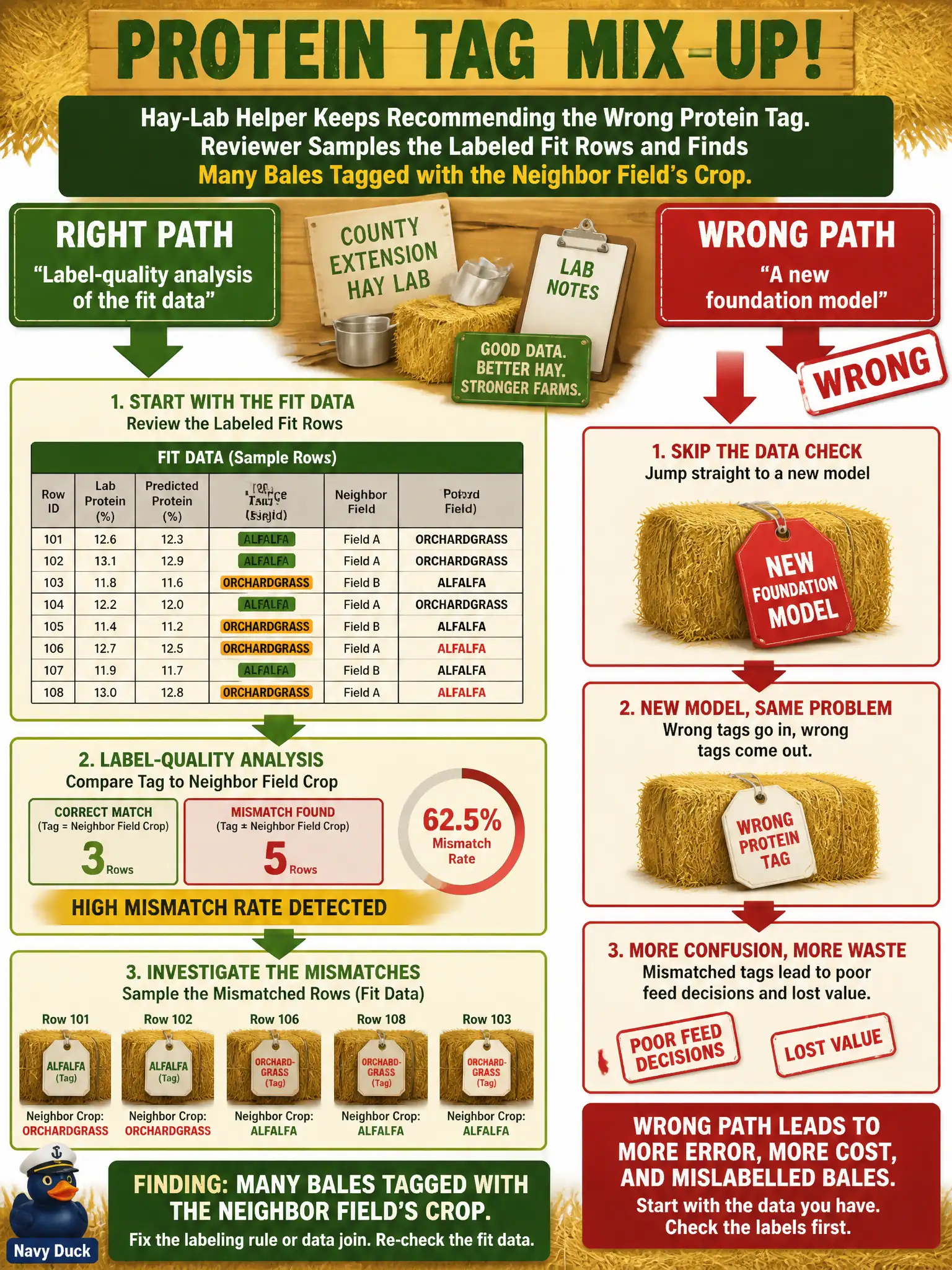
Think of hay-lab rows tagged with the neighbor field’s crop. Start with label-quality analysis of the fit data. A new foundation model and a temperature knob do not inspect those tags.
Full Explanation
When a county-extension hay-lab helper keeps recommending the wrong protein tag and sampled fit rows show bales tagged with the neighbor field’s crop, start with label-quality analysis of the fit data. Wrong supervision teaches the wrong mapping; no amount of model shopping fixes systematically mislabeled protein tags until labels are audited and corrected. Responsible ML debugging checks data integrity before escalating to new foundation models or decoding knobs.
Jumping to a new foundation model first fails because model family changes do not inspect or repair neighbor-field tag errors in the training rows. Raising temperature fails because sampling randomness does not correct bad labels; it can make recommendations less stable without fixing the supervision. A dashboard title fails because a chart label is not a label-quality audit of hay-lab rows.
Exam caveat: after cleaning labels, you still retrain or fine-tune and re-evaluate—analysis alone does not update the deployed helper. Operational check: double-key a random sample of fit rows against field records, measure label error rate by field and crop, quarantine corrupted shards, correct tags, and only then retrain and compare protein-tag accuracy on a clean holdout.