
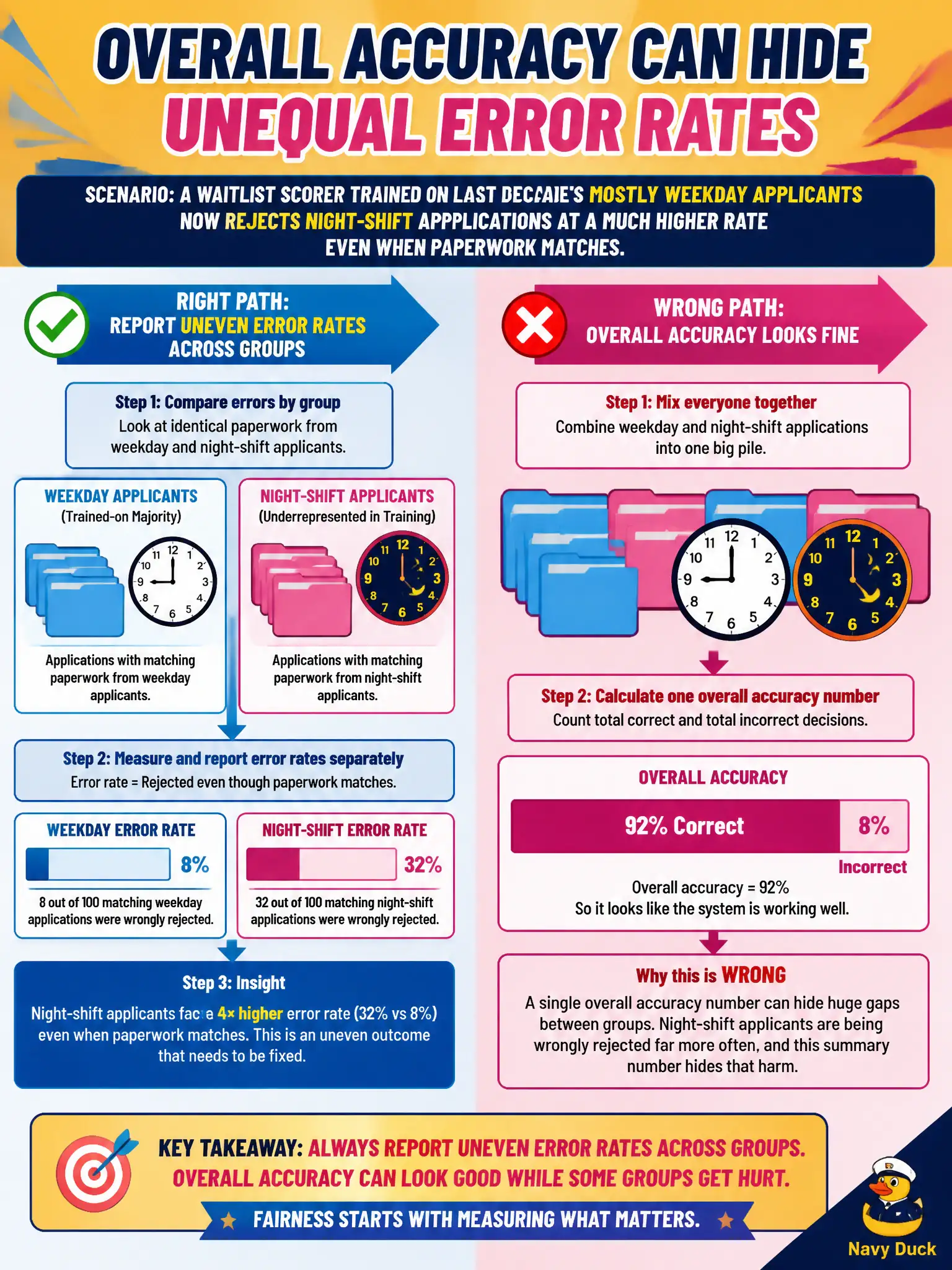
A community crew-club waitlist scorer trained on last decade’s mostly weekday applicants now rejects night-shift parents at a much higher rate even when their paperwork matches. What should the team report?
Select an answer to reveal the explanation.
Short Explanation
Think of night-shift parents getting denied at a much higher rate while weekday applicants sail through. Report the uneven outcomes. A shiny overall accuracy number can hide that.
Full Explanation
A crew-club waitlist scorer that rejects night-shift parents at a much higher rate despite matching paperwork exhibits uneven outcomes across groups—an fairness and monitoring finding that a single overall accuracy number can hide. Responsible reporting breaks performance out by relevant groups (shift pattern, caregiver status) and surfaces disparate error or rejection rates for remediation. Headline accuracy is necessary but not sufficient when subgroups systematically lose.
Reporting only overall accuracy fails because aggregate metrics average away concentrated harm to night-shift applicants. Calling night-shift denials a font problem fails because typography does not drive selection disparities. Framing the issue as latency fails because rejection-rate gaps are fairness outcomes, not milliseconds.
Exam caveat: equalized overall accuracy after threshold tweaks can still leave disparity on false negatives—inspect rejection and approval rates per group, not only a global score. Operational check: publish a subgroup report for weekday versus night-shift applicants on a recent cohort, compare false-reject rates at the same decision threshold, and pause automated waitlist actions until the disparity is investigated and mitigated with data or policy changes.