
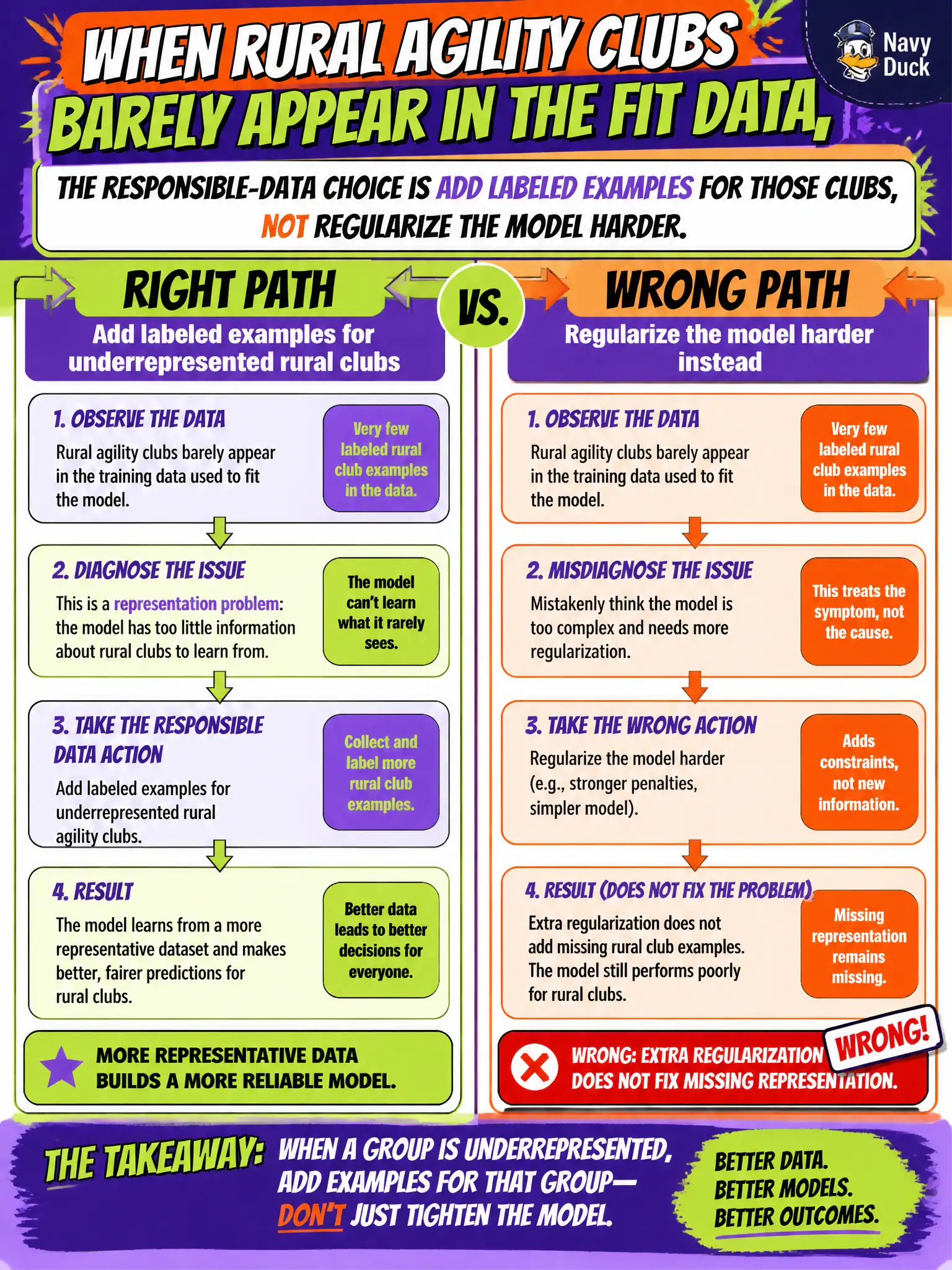
A community agility-trial clerk notices rural clubs barely appear in the fit data. A reviewer proposes adding labeled examples for those clubs rather than regularizing the model harder. Which move is the responsible-data choice?
Select an answer to reveal the explanation.
Short Explanation
Think of rural clubs that barely appear in the fit data. Add labeled examples for those clubs. A regularization slogan, dropping the clubs, or buying storage is not the fairness fix.
Full Explanation
When rural clubs barely appear in a community agility-trial clerk’s fit data, the responsible-data move is to add representative labeled examples for those clubs so the model learns their patterns. Underrepresentation is a data coverage problem; collecting balanced, correctly labeled trials from rural clubs directly addresses the gap without pretending a training hyperparameter slogan fixes missing people. Inclusive performance requires seeing the clubs the live system will score.
Treating a regularization slogan as the fairness fix fails because regularization constrains model complexity; it does not insert absent rural-club examples or correct sampling gaps. Dropping rural clubs from the live system fails ethically and operationally: erasing the gap by excluding people is not fairness, and the clerk still needs to serve those clubs. Buying more storage fails because disk capacity does not create labeled rural-club trials; storage without collection leaves the distribution unchanged.
Exam caveat: added examples must be correctly labeled and drawn from real rural-club conditions—synthetic filler or mislabeled urban trials can worsen disparity. Operational check: measure enrollment and error rates by club geography before and after the data refresh, require a minimum count of verified rural-club labels, and re-run acceptance tests on rural holdouts before redeploying the clerk helper.