
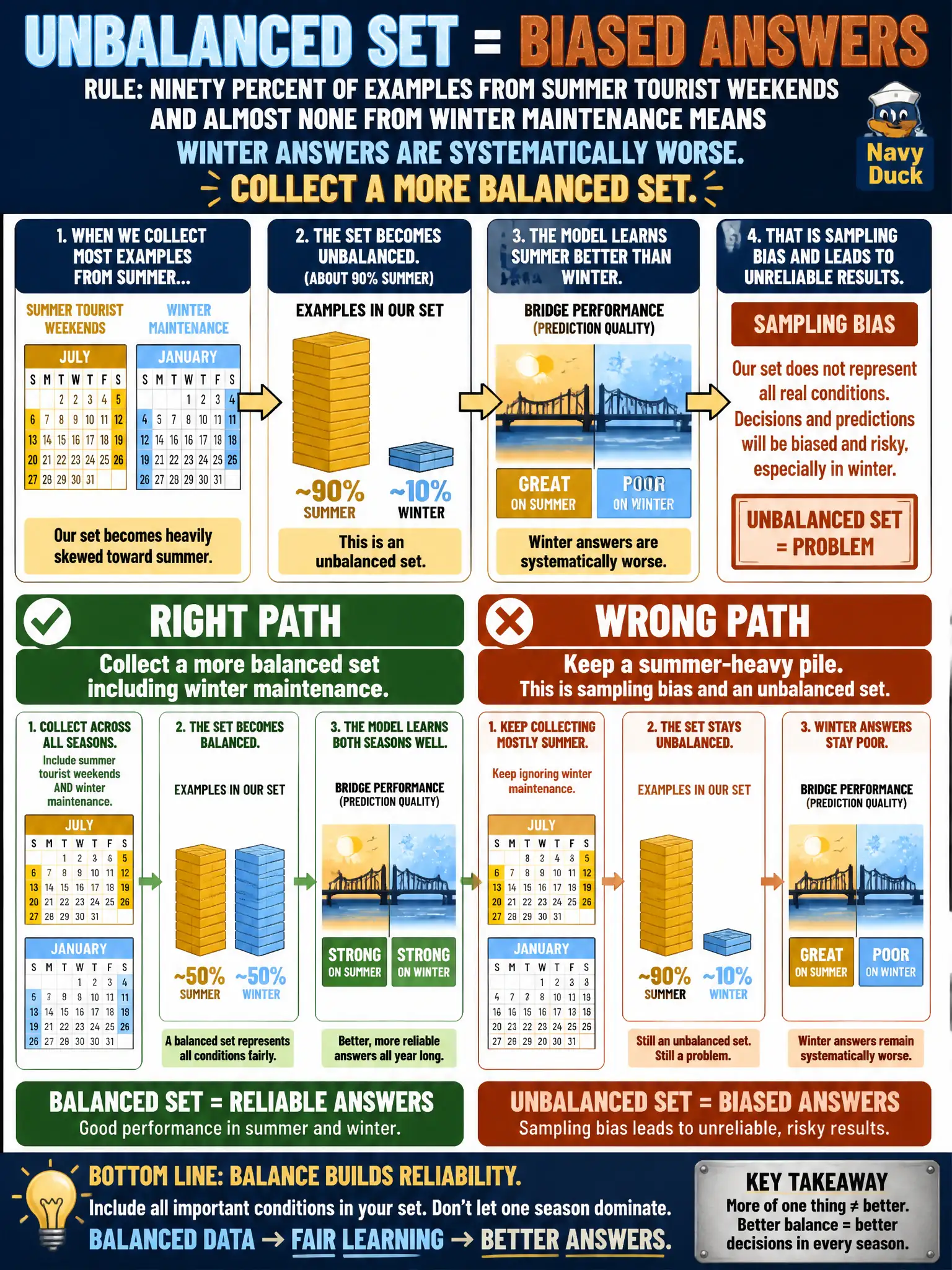
A historic lift-bridge education model saw ninety percent of its examples from summer tourist weekends and almost none from winter maintenance crews. Winter answers are systematically worse. What dataset problem is that, and what should the team ask for?
Select an answer to reveal the explanation.
Short Explanation
Think of a lift-bridge model that saw summer tourist weekends and almost no winter crews. Winter answers go sideways. That is an unbalanced set and sampling bias. Collect a more balanced pile, not more GPUs.
Full Explanation
A historic lift-bridge education model trained mostly on summer tourist weekends and almost never on winter maintenance crews exhibits an unbalanced set and sampling bias: winter contexts are underrepresented, so winter answers degrade systematically. The responsible fix is to collect a more balanced set—intentionally sample winter crews, night shifts, and off-season maintenance—then retrain or evaluate with seasonal strata. Hardware and caching do not repair a missing slice of the operating distribution.
Calling it a GPU shortage fails because accelerators do not create winter examples; without those labels, extra compute still fits the summer-heavy distribution. Treating tourist-weekend success as a public benchmark win fails because in-distribution summer scores do not prove winter quality under sampling bias. Prompt caching fails because a reused prefix cannot supply missing winter maintenance knowledge or balance the dataset.
Exam caveat: simply duplicating the few winter rows can overfit those sparse examples—seek new, varied winter crew records and keep a seasonal holdout for honest measurement. Operational check: report accuracy and failure modes by season and crew type, set collection targets until winter share meets a defined minimum, and block promotion of a new model version until winter holdout metrics clear the same bar as summer.