
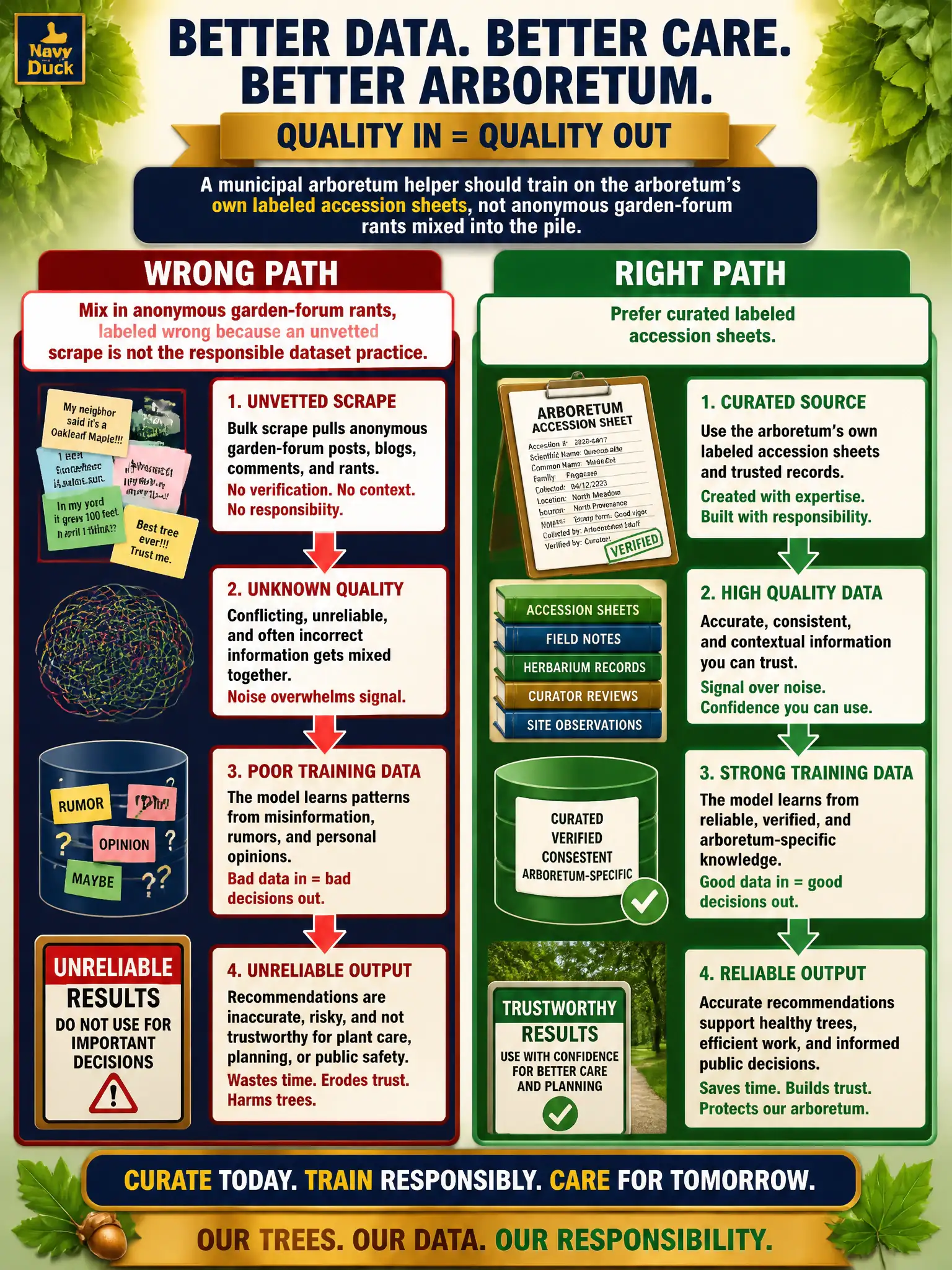
A municipal arboretum helper’s training pile includes anonymous garden-forum rants next to the arboretum’s own labeled accession sheets. Which dataset practice is the responsible one?
Select an answer to reveal the explanation.
Short Explanation
Think of anonymous garden-forum rants sitting next to labeled accession sheets. Prefer the curated, known sources. A bigger unvetted scrape is not the responsible pile.
Full Explanation
For a municipal arboretum helper, responsible dataset practice prefers curated, known sources—the arboretum’s labeled accession sheets—over mixing in anonymous garden-forum rants. Source quality and provenance drive label reliability, toxicity, and rights risk; anonymous rants inject unverifiable claims, hostile language, and unclear licensing next to authoritative botanical records. Curating known sources is how teams keep training piles aligned with institutional truth and policy.
Scraping everything because “more pages are always better” fails: volume without provenance amplifies noise and harmful content rather than improving accession accuracy. Keeping anonymous rants while dropping labeled accession sheets inverts priority—discarding the high-trust signal and retaining the low-trust scrap. Treating source quality as irrelevant once the pile is large fails responsible-data principles: scale does not cancel the need for documented, appropriate sources.
Exam caveat: curated does not mean tiny—you can still grow the set, but growth should come from vetted partners, staff labels, and licensed corpora, not unfiltered web rants. Operational check: tag every training shard with source type and rights status, exclude anonymous forum text from the fit set used for accession guidance, spot-check labels against living collections, and record who approved each shard before the next training cycle.