
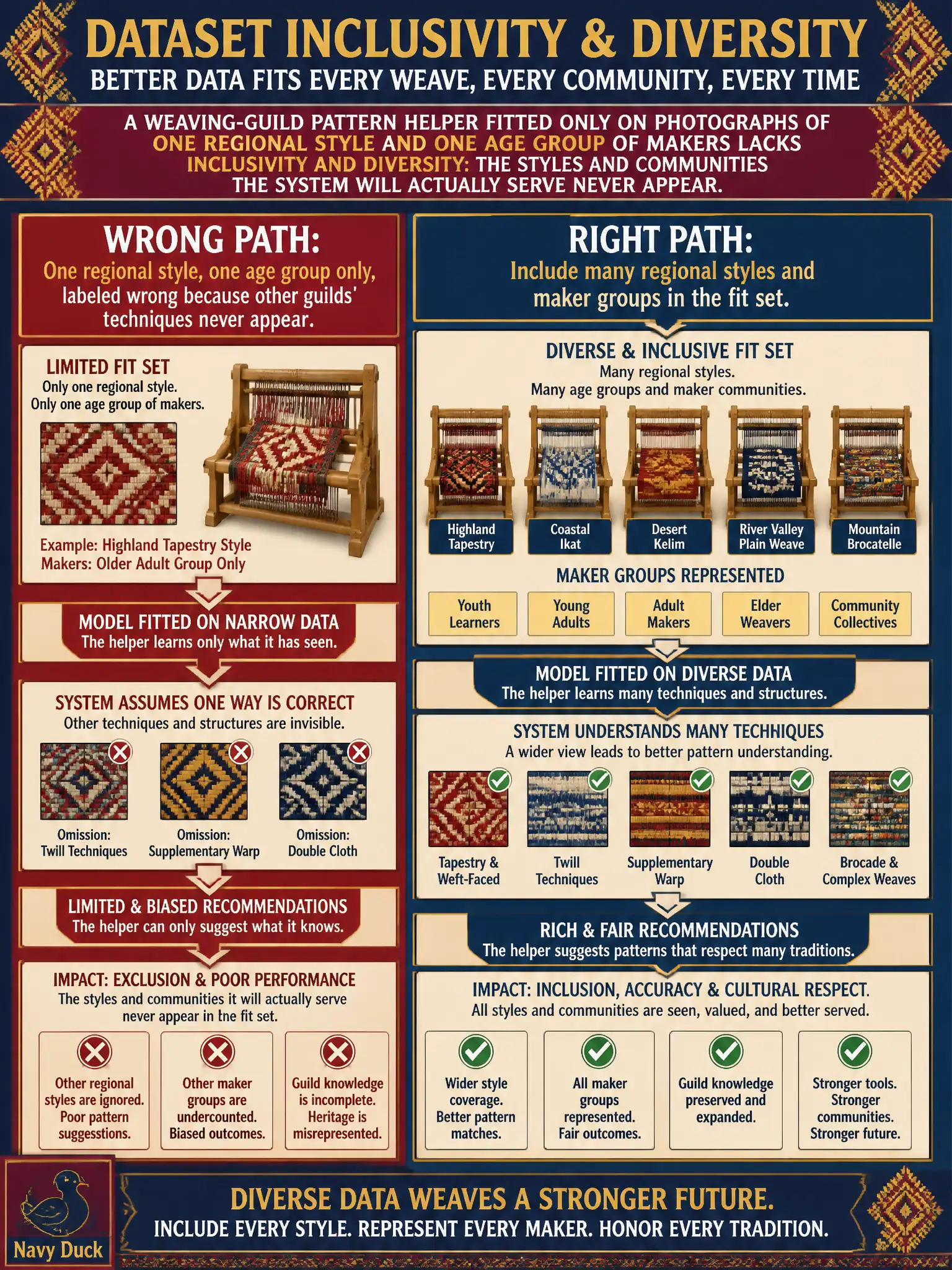
A community weaving-guild pattern helper was fitted only on photographs of one regional style and one age group of makers. Other guilds’ techniques never appear. What does the dataset lack?
Select an answer to reveal the explanation.
Short Explanation
Think of a pattern helper fitted only on one regional style and one age group. Other guilds never appear. The dataset lacks inclusivity and diversity, and more GPUs will not add those makers.
Full Explanation
A weaving-guild pattern helper fitted only on one regional style and one age group lacks inclusivity and diversity in its data: other guilds’ people and techniques never appear, so the system cannot fairly or usefully serve the broader maker community. Responsible dataset practice asks whose work is represented and who will be affected—coverage of styles, ages, and guilds is a data-quality and fairness property, not a hardware dial. Without representative examples, outputs will systematically ignore or mischaracterize underrepresented techniques.
Adding more GPUs fails because compute scales training speed, not demographic or stylistic coverage; missing makers are not created by extra accelerators. Pointing at a public writing benchmark fails because ROUGE-style scores on one style do not prove inclusive coverage across guilds. Prompt Management versions fail because stored prompt variants do not insert absent photographic or pattern examples into the fit set; they rearrange instructions, not representation.
Exam caveat: token diversity in prompts is not a substitute for diverse training or fine-tuning data—if the weights never saw other guilds, clever prompting cannot reliably invent authentic technique coverage. Operational check: inventory the fit set by region, age group, and guild; set minimum example counts for each served community; collect labeled patterns from underrepresented guilds; and re-evaluate generation quality per guild before expanding the helper’s audience.