
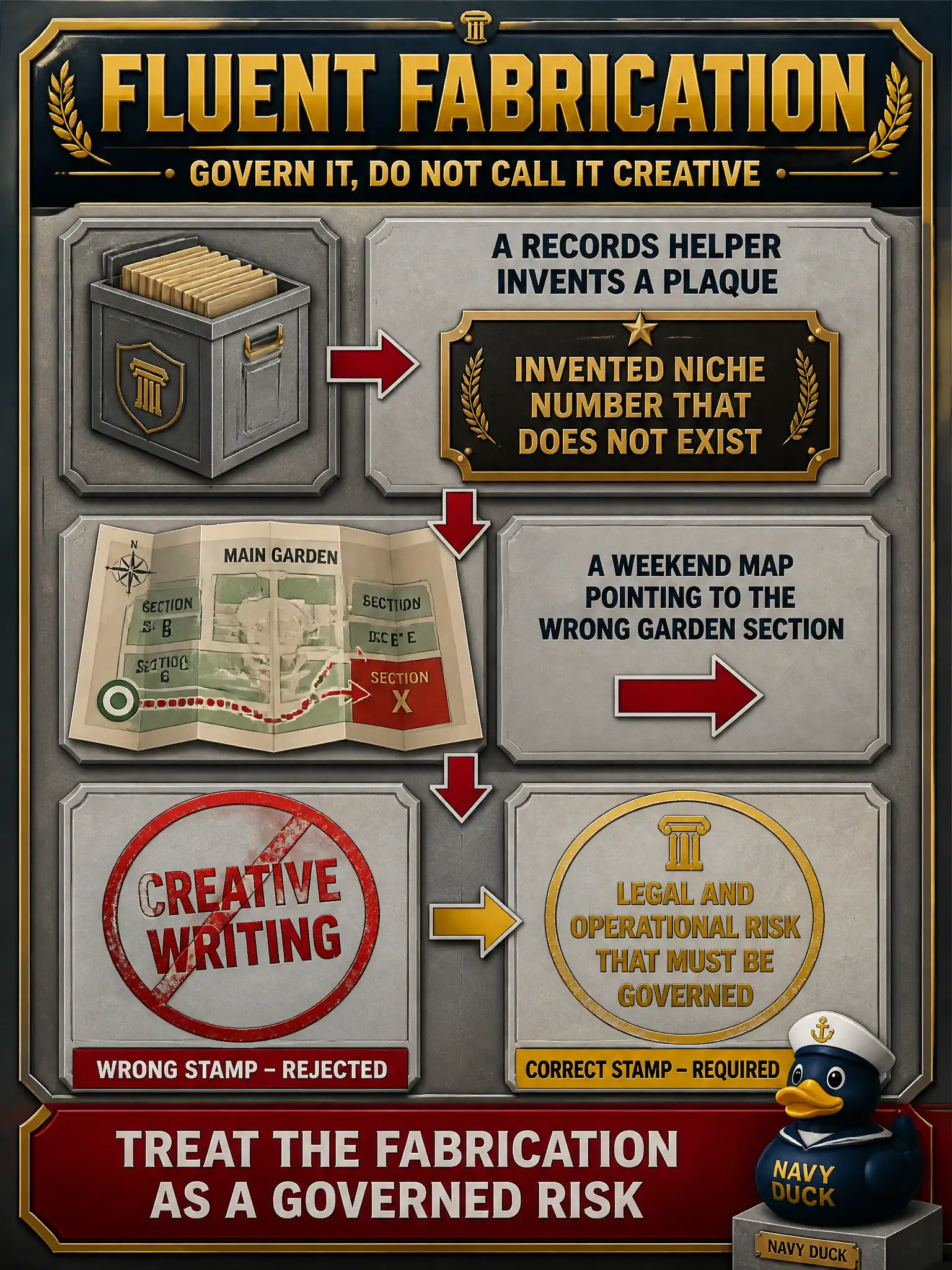
A municipal columbarium-records helper invents a niche number that does not exist. A family spends a weekend at the wrong section. How should that fluent fabrication be treated?
Select an answer to reveal the explanation.
Short Explanation
Think of an invented niche number that sends a family to the wrong section all weekend. Treat that fluent fabrication as a legal and operational risk. It is not creative writing.
Full Explanation
An invented niche number from a municipal columbarium-records helper is fluent fabrication with real legal and operational consequences: a family spends a weekend at the wrong section, records may be mistrusted, and staff must remediate. Treat that hallucination as a governed risk—grounding to the records system, verification before release, and escalation when confidence or retrieval fails—not as creative writing. Responsible operations assume patrons will act on printed identifiers, so unverifiable niche IDs must never ship as fact.
Calling invented niche numbers a style choice or creative writing fails because cemeteries and columbaria operate on precise locations; fluency does not make a fake ID acceptable. Stopping at a Domain 2 definition recap with no operational follow-up fails because naming “hallucination” without controls leaves families exposed. Blaming a font problem fails because typography does not create nonexistent niche numbers; the failure is ungrounded generation.
Exam caveat: low temperature and “be accurate” prompting reduce but do not eliminate ID invention—authoritative lookup or constrained decoding against the records database is required for identifier fields. Operational check: disallow free-form niche IDs in user-facing output unless they resolve in the official records API, show source row IDs to staff, and audit a sample of weekend visitor tickets against system truth after any helper-assisted lookup.