
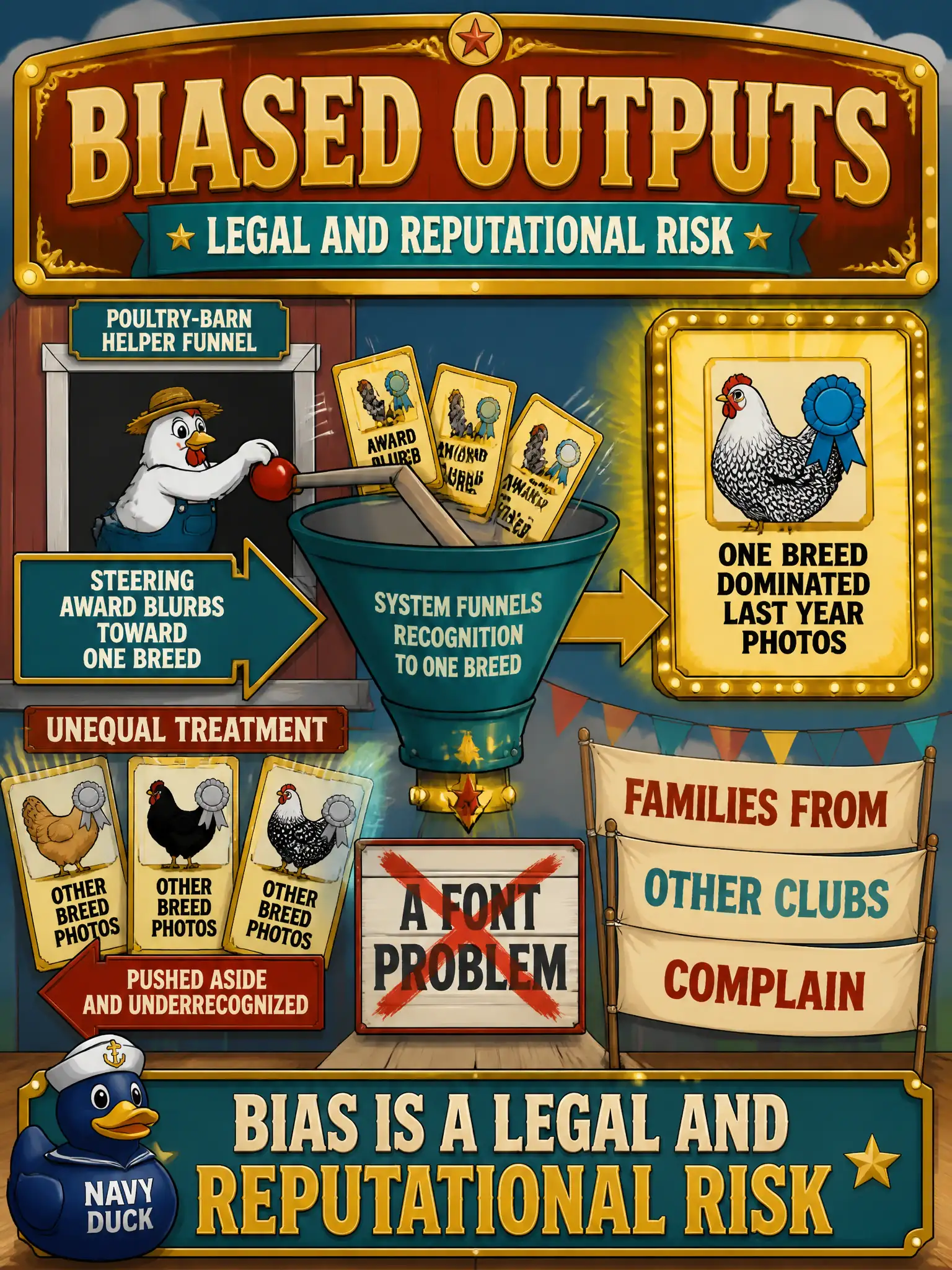
A county-fair poultry-barn helper consistently steers 4-H award blurbs toward one breed that dominated last year’s photos. Families from other clubs complain of unequal treatment. Which kind of risk is that?
Select an answer to reveal the explanation.
Short Explanation
Think of award blurbs that always steer toward last year’s dominant breed. That is biased output as a legal and reputational risk, not a font choice. Families from other clubs are getting unequal treatment.
Full Explanation
A county-fair poultry-barn helper that steers 4-H award blurbs toward last year’s dominant breed produces biased outputs: other clubs receive unequal narrative treatment even when their birds merit comparable recognition. That is a legal and reputational risk—perceived favoritism, fairness complaints, and possible policy or civil-rights scrutiny—not a cosmetic presentation issue. Responsible AI treats systematic steer toward one group as a bias harm requiring dataset balance, evaluation by breed/club, and output review before ribbons language goes public.
Treating unequal blurbs as a font choice fails because typeface does not create breed favoritism; the skew is in content selection and generation, not typography. Calling it a latency score fails because timing metrics do not measure unequal treatment across clubs. Reducing it to a Domain 1 vocabulary label with no trust or legal consequence fails because bias vocabulary exists precisely to flag real-world harm; ignoring downstream trust and fairness impact is incomplete responsible practice.
Exam caveat: correcting copy after publication does not erase reputational damage—families already saw skewed blurbs—so prevention and pre-release audits matter more than post-hoc apologies. Operational check: break blurb outcomes and sentiment by breed and club on a held-out week of awards, compare mention rates to actual placing distributions, and require human sign-off when the helper over-indexes on any single breed before posting to the fair’s channels.