
A community costume-atelier window helper produces hat-copy that closely tracks a living designer’s copyrighted lookbook text. Counsel asks what legal exposure that creates. Which risk is that?
Select an answer to reveal the explanation.
Short Explanation
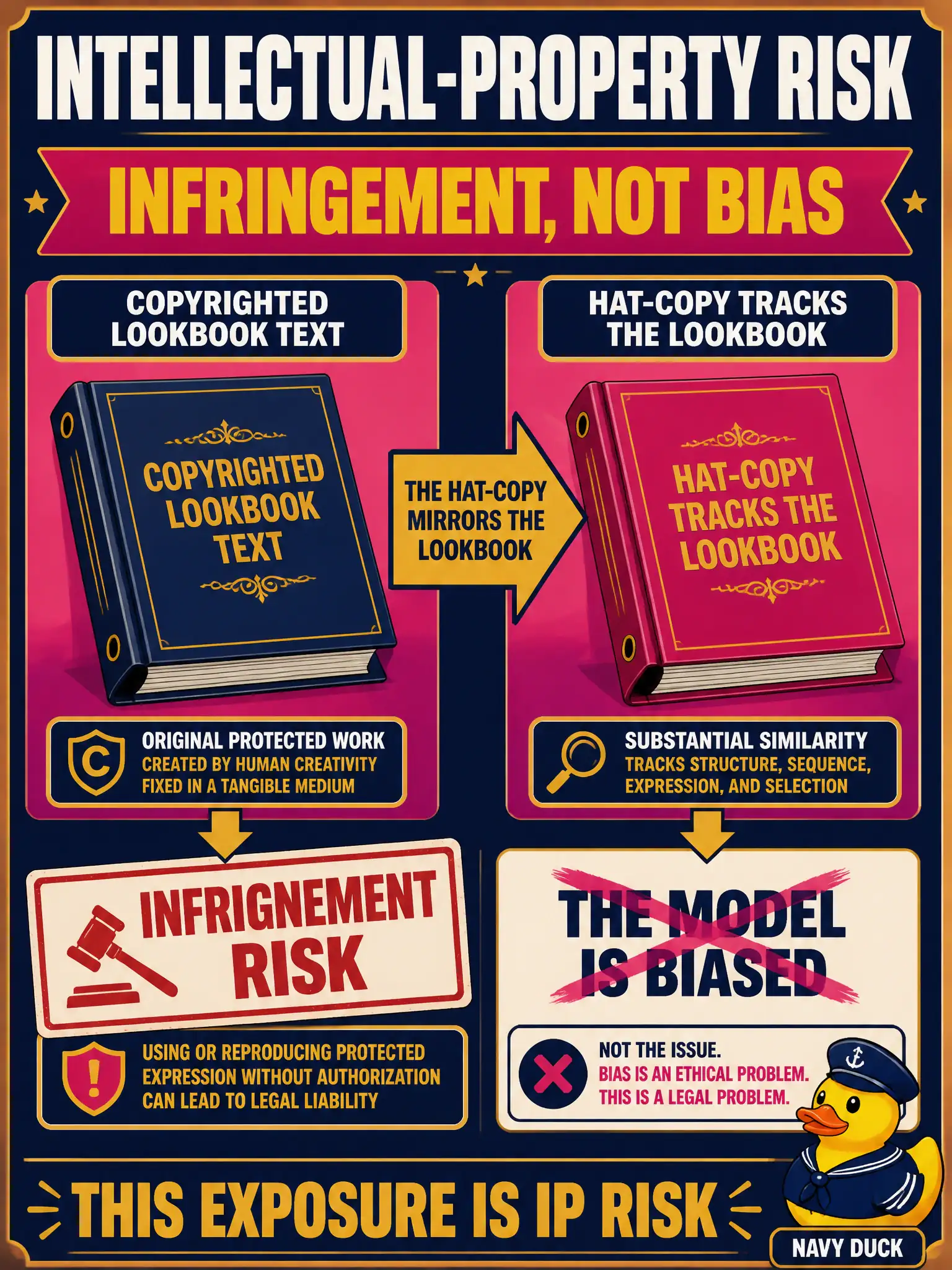
Think of hat-copy that tracks a living designer’s copyrighted lookbook. That is intellectual-property risk, not a bias vocabulary item. Copying is not hallucination and not a milliseconds problem.
Full Explanation
Hat-copy that closely tracks a living designer’s copyrighted lookbook is intellectual-property or infringement risk: the helper may reproduce protected expression, exposing the community atelier to legal claims. Responsible practice treats unauthorized close paraphrase or reproduction of copyrighted source text as a rights issue requiring rights clearance, stricter grounding on licensed materials, or blocking lookalike generations—not as a fairness vocabulary synonym. Counsel’s question is about legal exposure from copying, which is distinct from demographic bias, hallucination definitions, or performance timing.
Calling it “bias only” fails because fairness/bias concerns unequal treatment across groups; copied lookbook prose is an IP problem even if every demographic is treated equally. Labeling it hallucination under a Domain 2 definition fails because hallucination is fluent invention without grounding; here the text is too faithful to a protected source, which is the opposite failure mode. Framing it as latency fails because copyright exposure is not a milliseconds or throughput issue; speeding up generation does not clear rights.
Exam caveat: transformative fair-use arguments are fact-specific and jurisdiction-dependent—do not assume a community helper is safe because outputs are “inspired by” a lookbook; close tracking is exactly what triggers review. Operational check: sample window outputs against known lookbook passages with similarity review, quarantine high-overlap drafts, restrict training and retrieval to licensed or original atelier text, and keep a rights log before any public display of generated hat-copy.