
A tool-library kiosk cannot miss the 9 a.m. Saturday rush. A hobbyist newsletter writer can wait if a reply is slow. Which pairing of capacity styles fits?
Select an answer to reveal the explanation.
Short Explanation
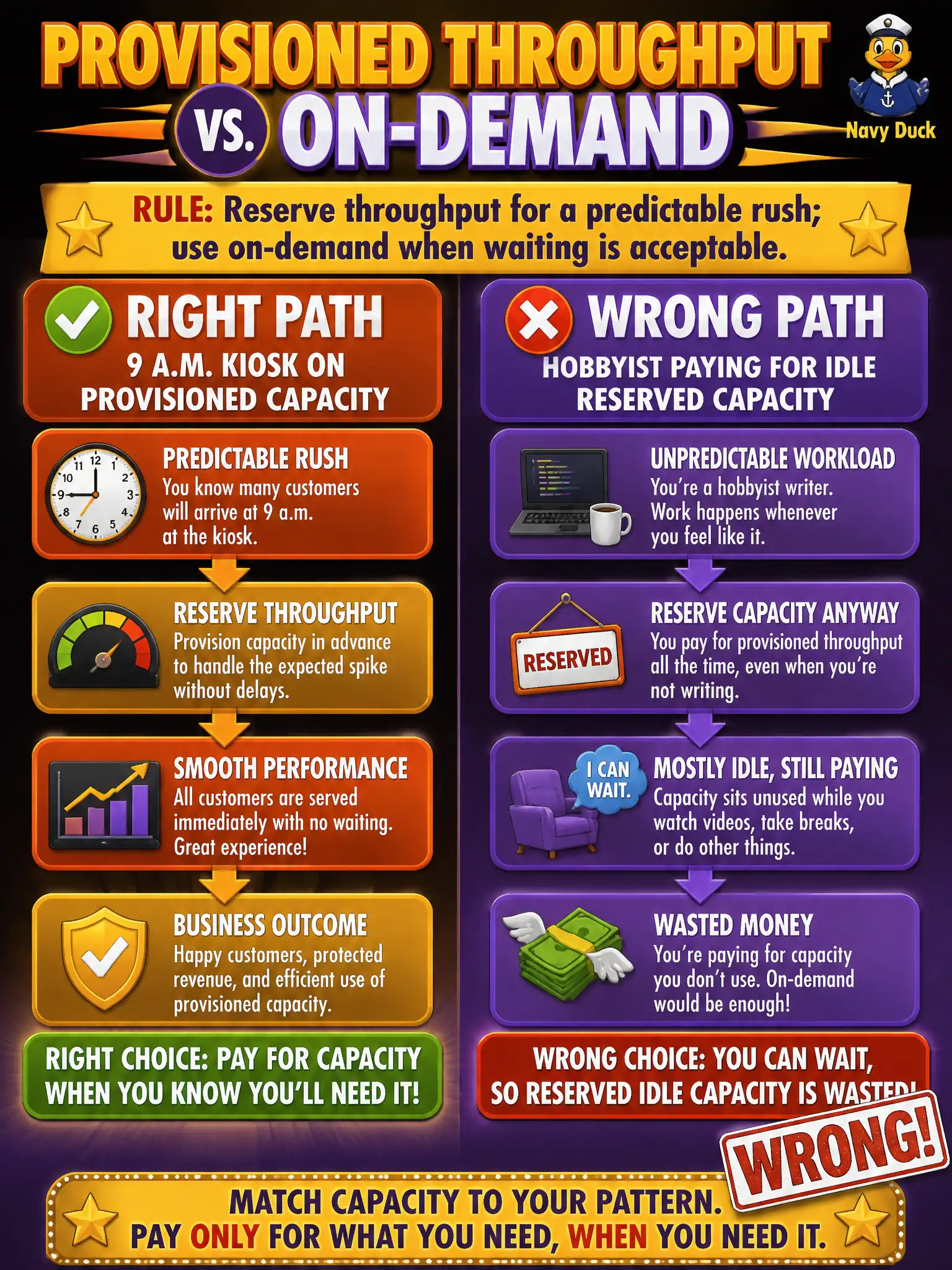
Think of reserving a Saturday-morning lane for the kiosk, and letting the hobbyist newsletter wait in the drop-in line. Provisioned throughput for the rush, on-demand tokens for the writer who can wait.
Full Explanation
Provisioned throughput for the tool-library kiosk rush and on-demand tokens for the hobbyist who can wait pairs capacity style to latency sensitivity. Predictable Saturday 9 a.m. volume that cannot miss a slot justifies reserved capacity; a newsletter writer who tolerates delay fits usage-based on-demand calls. Matching those two styles is the exam’s practical cost-and-capacity lesson.
On-demand only for the kiosk because the Saturday rush can always wait contradicts the kiosk constraint—the rush cannot wait for capacity. Provisioned throughput for the hobbyist because idle reserved capacity is cheapest when unused misunderstands reserved capacity: you pay for what you reserve whether the hobbyist is idle or not. Claiming neither style exists and every GenAI call needs a dedicated GPU server ignores managed on-demand and provisioned options.
Exam caveat: provisioned capacity still needs right-sizing—over-reserving for a one-hour rush can waste budget if the rest of the week is empty. Operational check: chart Saturday arrival patterns, reserve enough for the kiosk service objective, leave the hobbyist on on-demand, and revisit reservations after two rush weekends of latency and utilization metrics.