
A bakery wants a private recipe-card voice and is told that fine-tuning a custom model costs more up front than prompting a stock foundation model. Which statement is accurate?
Select an answer to reveal the explanation.
Short Explanation
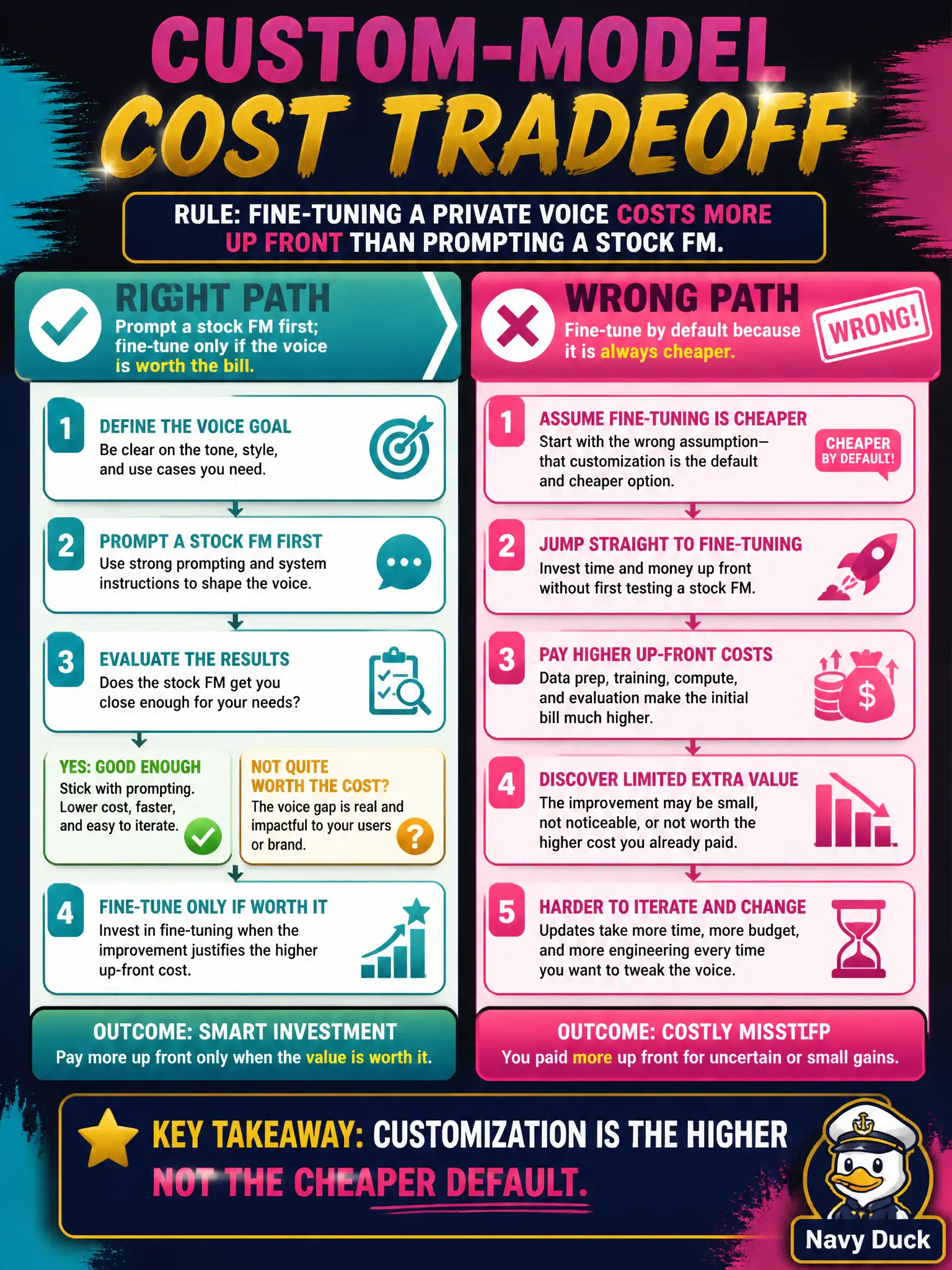
Think of paying extra up front for a private recipe-card voice versus prompting the stock model. Custom is a cost tradeoff, not the cheaper default, and not a closet of idle GPUs.
Full Explanation
A custom model is a cost tradeoff: higher up-front spend for a narrower private recipe-card voice versus prompting a stock foundation model. Fine-tuning or otherwise customizing can buy house style and domain fit for the bakery, but that spend is an investment decision, not free and not automatically cheaper than prompting. The accurate statement is tradeoff language, not “always cheaper.”
Fine-tuning is not always cheaper than a single prompt and should not be the default; many needs are met by prompting a stock FM with far less up-front cost. Saying custom models have no cost difference from prompting a stock FM erases training, hosting, and iteration costs. Claiming the only way to get a recipe card is to buy year-round idle GPUs invents a hardware mandate; managed prompting or managed training paths can produce cards without a closet of idle GPUs.
Exam caveat: even a well-tuned private voice can still hallucinate ingredients or allergens—style fit does not replace recipe validation. Operational check: compare prompt-only quality on a gold set of cards against a fine-tune pilot’s up-front cost and ops burden, require human kitchen review before any custom voice ships to customers, and revisit whether house style alone justifies the custom path.