
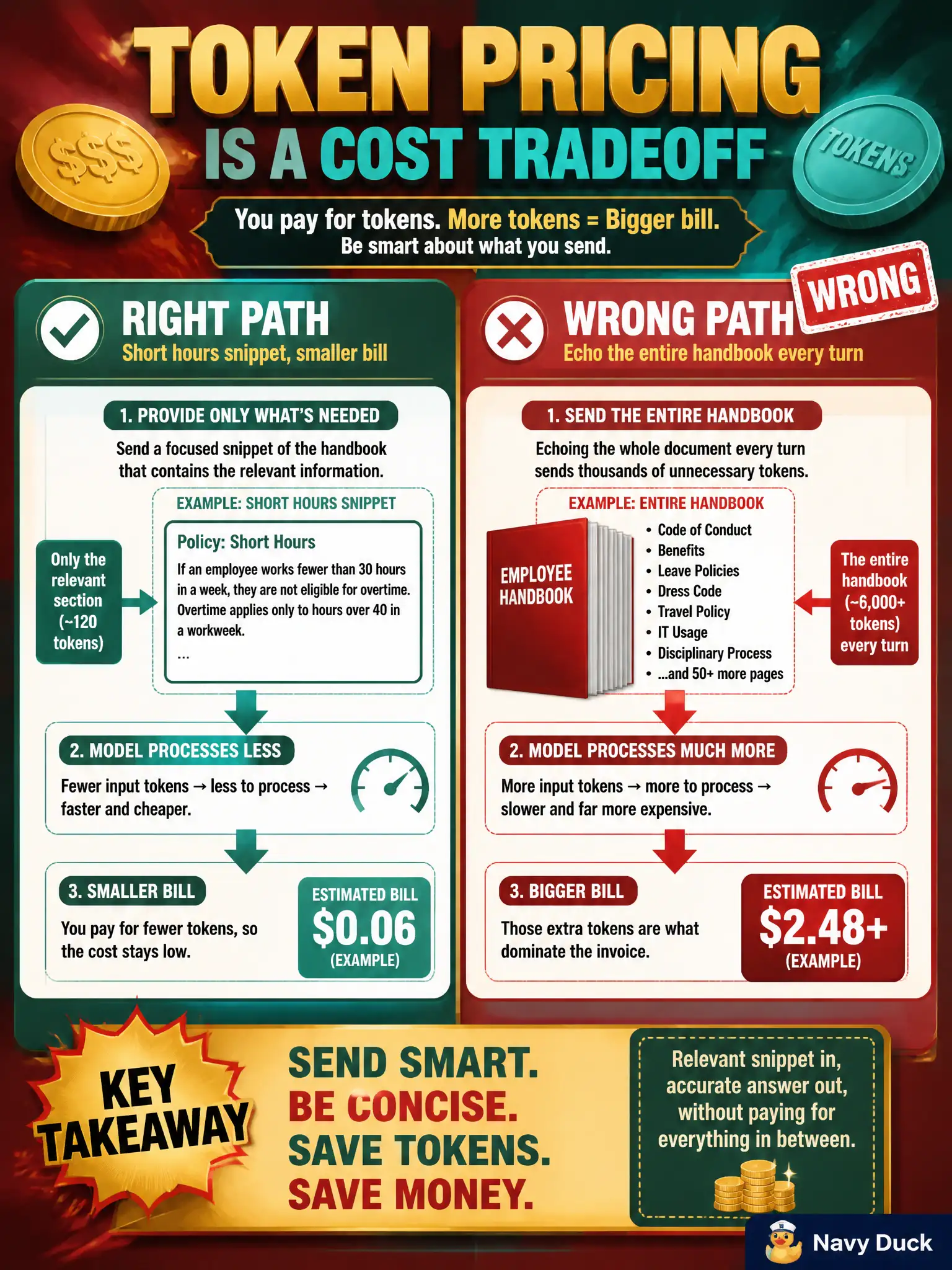
A swim-club helper echoes entire handbooks back to the model on every hours question. The bill jumps even though the answers stay simple. Which cost tradeoff is this?
Select an answer to reveal the explanation.
Short Explanation
Think of stuffing the whole handbook into every what-time-do-lanes-open turn. Token pricing makes that the whole bill. More tokens are not cheaper, and this is not a GPU-temperature fee.
Full Explanation
Token pricing means repeating large context on every turn dominates the bill: when a swim-club helper echoes entire handbooks into each hours question, input tokens accumulate even if answers stay short. Cost follows tokens read and written, so context design is a first-class cost control for GenAI on AWS, not an afterthought once the answer looks fine.
Billing per building so handbook size cannot change the invoice invents a facility fee model that does not describe foundation-model token pricing. Claiming more tokens always lower the bill reverses the pricing logic; more tokens raise cost. Calling token price a GPU-temperature fee confuses usage text metering with hardware telemetry that is not how the invoice is calculated.
Exam caveat: aggressive truncation can drop needed policy clauses—optimize retrieval or summarization of handbook sections rather than blindly deleting safety text. Operational check: measure tokens per turn with and without full-handbook injection, retrieve only relevant sections for hours questions, set a max context budget, and alert when average tokens per session exceed a club-defined threshold.
Teach the club’s operators a simple rule: if the question is only lane hours, retrieve the hours section—do not resend the full handbook. That habit is the operational expression of token-aware design and usually cuts the bill without changing the answer quality members see.