
Those ice-rink agents now need a secure, scalable place to run, keep session memory, and call tools without the pair babysitting servers. They are not asking for a ticket dashboard. Which offering matches this job?
Select an answer to reveal the explanation.
Short Explanation
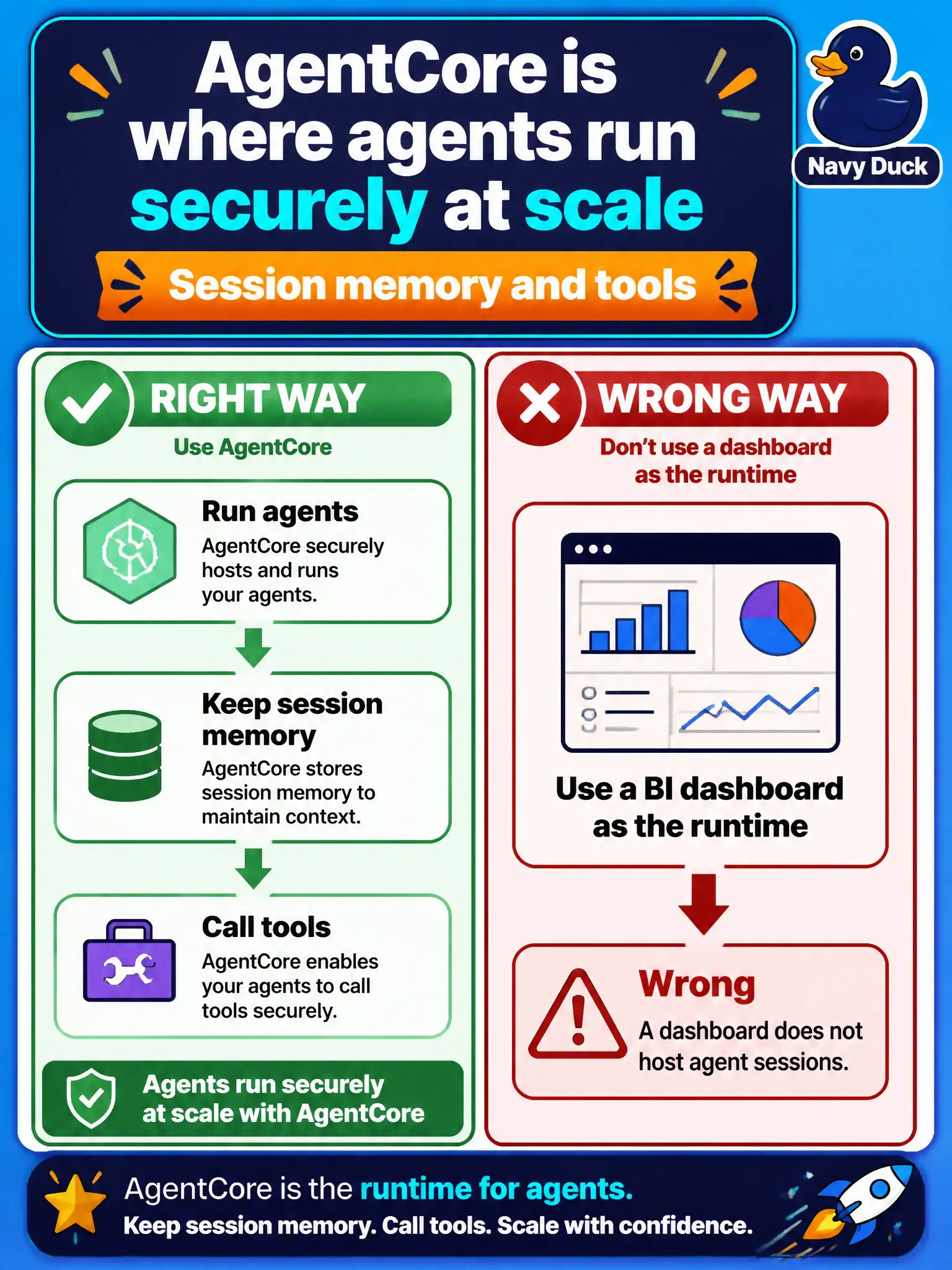
Think of a secure stage where those ice-rink agents can run, remember the session, and call tools without a closet full of servers. That is Bedrock AgentCore. An IDE, a dashboard, and Transcribe are not that stage.
Full Explanation
Amazon Bedrock AgentCore is the managed, secure, scalable place to run agents, keep session memory, and call tools without the ice-rink pair babysitting servers. After agents are designed, this is the operate-and-host step—not a ticket dashboard request. The exam expects you to separate the runtime that serves production agents from analytics or IDE tools.
Amazon Quick visualizes business data; a dashboard is not a secure agent runtime with session memory and tool calling. Kiro is a developer IDE for building software; production visitors should not call agents through an IDE. Amazon Transcribe turns speech into text; session memory for agents is not a speech-to-text feature and does not provide the secure run place described.
Exam caveat: managed agent runtimes still require you to define which tools agents may call and what data they may see—scalability does not equal unconstrained tool access. Operational check: enable session memory only for needed context, restrict tool IAM to rink-appropriate actions, load-test concurrent scenarios, and confirm operators have logs and alarms without owning raw servers.
Once AgentCore (or the managed agent runtime in general) is chosen, treat session memory as sensitive state: it may hold patron or incident context and must follow the same retention and access rules as other rink systems. Runtime convenience is not a reason to keep forever-logs of every tool call without policy.